For a Dolby Atmos home theater, I’d start with the Onkyo TX-NR7100 as the strongest fit for a system that may grow, thanks to its 9.2-channel design. The Denon AVR-X1800H is a more approachable all-rounder, while the Yamaha RX-A2A suits buyers who want a 7.2-channel receiver from Yamaha’s AVENTAGE line. The main choice is how many speakers you plan to run: 5.2-channel models limit expansion, while 7.2- and 9.2-channel options offer more layout flexibility. HDMI features, streaming, and setup needs also separate these receivers. Read on for the full comparison and a pick for different room plans.

Get the latest gadgets delivered free with Prime
- Fast, free delivery on millions of items
- Prime Video, Amazon Music and more included
- Member-only deals all year
Complete the kit



Key Takeaways
- The Onkyo TX-NR7100 leads for expansion: Its 9.2-channel format gives buyers more room to build an Atmos setup than the 7.2-channel models in this roundup.
- Most picks are 7.2-channel receivers: Denon, Yamaha, Pioneer, Sony, and Onkyo options in this group suit buyers whose planned system fits that channel count.
- Two Yamaha RX300A listings describe the same receiver family: One includes an HDMI cable bundle, so the receiver’s capabilities matter more than the bundle when comparing fit.
- Some listed choices are complete systems: The Yamaha YHT-4970U includes speakers, while most entries are receiver-only; buyers should check what their room still needs.
- Not every listing fits an Atmos expansion plan equally well: The 5.2-channel Denon AVR-S570BT and Yamaha RX300A offer fewer channels than 7.2- or 9.2-channel choices.
| Denon AVR-S570BT 5.2-Channel AV Receiver with 8K HDMI |  | Best for a Simple 5.1 Atmos-Ready System | Channels: 5.2 | Power output: 70 W x 5 | HDMI inputs: 4, with 8K support | VIEW ON AMAZON | See Our Full Breakdown |
| Denon AVR-X1800H 7.2 Channel AV Receiver (80W x 7) with WiFi and Bluetooth |  | Best Overall for a Starter Atmos Setup | Channels: 7.2 | Power output: 80 W x 7 | HDMI inputs / outputs: 6 / 2 | VIEW ON AMAZON | See Our Full Breakdown |
| Yamaha RX-A2A AVENTAGE 7.2-Channel AV Receiver | 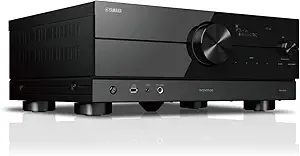 | Best for Yamaha Streaming and Room Tuning | Channels: 7.2 | Audio formats: Dolby Atmos, DTS:X | HDMI configuration: 7 inputs / 1 output | VIEW ON AMAZON | See Our Full Breakdown |
| Onkyo TX-NR6100 7.2-Channel THX-Certified Network AV Receiver |  | Best for THX-Certified 5.2.2 Playback | Channels: 7.2 | Playback configuration: 5.2.2 | Amplifier power: 210 W per channel, as specified | VIEW ON AMAZON | See Our Full Breakdown |
| Denon AVR-S770H 7.2-Channel 8K UHD Home Theater Receiver (75W x 7) |  | Best for HEOS Multi-Room Atmos | Channels: 7.2 | Power output: 75 W x 7 | HDMI inputs / outputs: 3 / 2 | VIEW ON AMAZON | See Our Full Breakdown |
| Yamaha RX300A 5.2-Channel Home Theater AV Receiver with Dolby Atmos, 4K120/8K HDMI and Bluetooth Multipoint (Black) |  | Best for Compact Atmos Setups | Channels: 5.2 | Power output: 70W | Audio formats: Dolby Atmos, DTS Virtual:X | VIEW ON AMAZON | See Our Full Breakdown |
| Denon AVR-X1700H 7.2-Channel AV Receiver, 80W per Channel, Built-in HEOS |  | Best for Streaming and Expandable Surround | Channels: 7.2 | Power output: 80W per channel | Audio formats: Dolby Atmos, DTS:X, DTS Virtual:X | VIEW ON AMAZON | See Our Full Breakdown |
| Sony STR-DH790 7.2-Channel Surround Sound Home Theater AV Receiver |  | Best Low-Profile Atmos Pick | Channels: 7.2 | Audio formats: Dolby Atmos, DTS:X | Video support: 4K HDR passthrough | VIEW ON AMAZON | See Our Full Breakdown |
| Onkyo TX-NR7100 9.2-Channel THX Certified AV Receiver |  | Best for Advanced 5.1.4 Atmos Systems | Channels: 9.2 | Certification: THX Certified | Room correction: Dirac Live built in | VIEW ON AMAZON | See Our Full Breakdown |
| Yamaha RX300A 5.2-Channel 8K AV Receiver Bundle with AudioQuest Sky 3 m HDMI Cable |  | Best Bundle for a Simple Atmos Upgrade | Channels: 5.2 | Video support: 8K/60, 4K/120 | Audio formats: Dolby Atmos, DTS:X virtualization | VIEW ON AMAZON | See Our Full Breakdown |
| Denon AVR-S970H 7.2-Channel 8K UHD AV Receiver with Wi-Fi and Bluetooth |  | Best Overall for a Connected Atmos Setup | Channels: 7.2 | Power output: 90W x 7 | Supported speaker configurations: 7.2 or 5.2.2 | VIEW ON AMAZON | See Our Full Breakdown |
| Pioneer VSX-935 7.2-Channel Network AV Receiver with Dolby Atmos |  | Best for Virtual Height Effects | Channels: 7.2 | Height effect: Dolby Atmos Height Virtualization | Output power: 80 watts | VIEW ON AMAZON | See Our Full Breakdown |
| Yamaha YHT-4970U 5.1-Channel Home Theater System with Dolby Atmos and 4K/120, 8K/60 Support |  | Best Starter System Bundle | Receiver: Yamaha RX300A AV receiver | Channel configuration: 5.1 | Included speakers: Two front, one center, and two surround speakers | VIEW ON AMAZON | See Our Full Breakdown |
| Yamaha RX500A 7.2-Channel Home Theater AV Receiver with Dolby Atmos, 4K120/8K HDMI, Wi-Fi and Streaming (Black) |  | Best for Built-In Streaming | Channels: 7.2 | Power output: 70W | Supported speaker layout: Up to 5.2.2 | VIEW ON AMAZON | See Our Full Breakdown |
| Onkyo TX-NR5100 7.2-Channel 8K Smart AV Receiver, Black |  | Best for Gaming and eARC | Channels: 7.2 | HDMI version: HDMI 2.1 | Video support: 8K; 4K/120Hz HDR pass-through | VIEW ON AMAZON | See Our Full Breakdown |
| av receivers for dolby atmos home theater | Channels | Audio formats | Video support |
|---|---|---|---|
| Denon AVR-S570BT 5.2-Channel A | 5.2 | DTS-HD Master Audio, Dolby TrueHD | — |
| Denon AVR-X1800H 7.2 Channel A | 7.2 | Dolby Atmos, DTS:X, DTS Virtual:X | — |
| Yamaha RX-A2A AVENTAGE 7.2-Cha | 7.2 | Dolby Atmos, DTS:X | 8K60B, 4K120AB, 4K60, Dolby Vision, HDR10+, HLG |
| Onkyo TX-NR6100 7.2-Channel TH | 7.2 | Dolby Atmos, DTS:X | 8K |
| Denon AVR-S770H 7.2-Channel 8K | 7.2 | Dolby Atmos, Dolby TrueHD, DTS:X, DTS Neural:X | 8K/60Hz, 4K/120Hz, HDR10+, HLG, Dolby Vision, Dynamic HDR |
| Yamaha RX300A 5.2-Channel Home | 5.2 | Dolby Atmos, DTS Virtual:X | 4K/120, 8K/60 |
| Denon AVR-X1700H 7.2-Channel A | 7.2 | Dolby Atmos, DTS:X, DTS Virtual:X | 8K/60Hz, 4K/120Hz |
| Sony STR-DH790 7.2-Channel Sur | 7.2 | Dolby Atmos, DTS:X | 4K HDR passthrough |
| Onkyo TX-NR7100 9.2-Channel TH | 9.2 | Dolby Atmos, DTS:X, Dolby Atmos Height Virtualizer | — |
| Yamaha RX300A 5.2-Channel 8K A | 5.2 | Dolby Atmos, DTS:X virtualization | 8K/60, 4K/120 |
| Denon AVR-S970H 7.2-Channel 8K | 7.2 | — | 8K/60Hz pass-through |
| Pioneer VSX-935 7.2-Channel Ne | 7.2 | — | — |
| Yamaha YHT-4970U 5.1-Channel H | — | Dolby Atmos, DTS Virtual:X | 4K/120, 8K/60, Dolby Vision, HDR10+ |
| Yamaha RX500A 7.2-Channel Home | 7.2 | Dolby Atmos, DTS:X | 4K/120, 8K/60, Dolby Vision, HDR10+, HLG |
| Onkyo TX-NR5100 7.2-Channel 8K | 7.2 | Dolby Atmos, DTS-HD Master Audio, DTS:X, Dolby TrueHD | 8K; 4K/120Hz HDR pass-through |
More Details on Our Top Picks
Denon AVR-S570BT 5.2-Channel AV Receiver with 8K HDMI
I’d choose the AVR-S570BT for a straightforward system built around a 5.1 speaker layout and current 8K-capable video gear. Its four HDMI inputs support modern HDR formats and gaming features such as VRR and ALLM, while the setup assistant and app help keep installation manageable. There’s a key Atmos distinction, though: its 5.2-channel design lacks dedicated height channels, so it cannot reproduce Atmos overhead effects through added height speakers. Compared with the Denon AVR-X1800H, it gives up native Atmos playback, Wi-Fi, and two-channel expansion in exchange for a simpler configuration. Bluetooth supports basic wireless music playback, but buyers seeking a streaming hub or a true 5.2.2 Atmos layout should move up the range.
Pros:- Four HDMI inputs support 8K video and modern HDR formats
- VRR, QFT, and ALLM suit current gaming systems
- Setup assistant and app-based control simplify installation
- Bluetooth enables wireless music playback
Cons:- Five-channel layout cannot power dedicated Atmos height speakers
- No built-in Wi-Fi or multi-room streaming platform
- Fewer expansion options than the 7.2-channel Denon AVR-X1800H
Best for: Buyers building a compact 5.1 home theater who want modern HDMI gaming and HDR support and do not plan to add height speakers.
Not ideal for: Listeners who want discrete Dolby Atmos height channels, built-in Wi-Fi streaming, or room to expand beyond five main speakers.
- Channels:5.2
- Power output:70 W x 5
- HDMI inputs:4, with 8K support
- HDMI output:1
- eARC bandwidth:Up to 40 Gbps
- Video formats:HDR, HLG, Dolby Vision, HDR10+, Dynamic HDR
- Gaming features:VRR, QFT, ALLM
- Audio formats:DTS-HD Master Audio, Dolby TrueHD
- Wireless connectivity:Bluetooth
Our verdict“Choose this Denon for a simple 5.1 system with current video features, but pick the AVR-X1800H if you want true Atmos speaker expansion.”
Denon AVR-X1800H 7.2 Channel AV Receiver (80W x 7) with WiFi and Bluetooth
The AVR-X1800H is my strongest all-round pick here for a first Dolby Atmos system: its seven powered channels support a 5.2.2 layout, adding two height speakers for overhead effects while retaining room for two subwoofers. Dolby Atmos and DTS:X decoding, Audyssey EQ, and Height Virtualization give new builders several ways to shape an immersive setup. It also pairs six HDMI inputs with three 8K/4K 120Hz inputs, plus Wi-Fi, AirPlay 2, Bluetooth, and HEOS for everyday streaming. Compared with the Yamaha RX-A2A, it offers a similar seven-channel ceiling but adds two HDMI outputs and a clear 5.2.2 configuration. Its limit is expansion: seven channels cannot run a larger discrete height-speaker array, and its small-to-medium-room focus may not suit demanding large spaces.
Pros:- Seven powered channels support a 5.2.2 Atmos layout
- Six HDMI inputs include three 8K/4K 120Hz inputs
- Audyssey EQ helps tune the system to the room
- HEOS, Wi-Fi, AirPlay 2, and Bluetooth cover common streaming needs
Cons:- Seven channels limit expansion to a modest height-speaker layout
- Best suited to small and medium rooms
- Does not provide dedicated height channels for larger Atmos configurations
Best for: First-time Atmos buyers who want a 5.2.2 speaker layout, Audyssey calibration, and built-in music streaming for a small or medium room.
Not ideal for: Owners planning a larger Atmos installation with more than two height speakers or a system that needs substantial channel expansion.
- Channels:7.2
- Power output:80 W x 7
- HDMI inputs / outputs:6 / 2
- 8K inputs:3 with 8K/60Hz and 4K/120Hz pass-through
- Supported layouts:7.2 or 5.2.2
- Audio formats:Dolby Atmos, DTS:X, DTS Virtual:X
- Wireless:Wi-Fi, Bluetooth, AirPlay 2, HEOS Built-in
- Room calibration:Audyssey EQ
- Subwoofer outputs:2
Our verdict“Choose the AVR-X1800H if you want a well-connected 5.2.2 starter system with room calibration and streaming built in.”
Yamaha RX-A2A AVENTAGE 7.2-Channel AV Receiver
The Yamaha RX-A2A AVENTAGE suits Atmos buyers who value Yamaha’s room tuning and connected-audio ecosystem alongside a seven-channel theater. Dolby Atmos and DTS:X support lets it serve a 5.2.2 setup, while YPAO R.S.C. multipoint measurement and Surround:AI offer tools for adapting playback to the room and content. MusicCast, AirPlay 2, Wi-Fi, Bluetooth, and broad service support make it more of a whole-home audio choice than the simpler Denon AVR-S570BT. Video support includes eARC, Dolby Vision, HDR10+, and specified 8K60B/4K120AB modes; only three HDMI inputs support those higher-bandwidth formats. The seven-channel limit remains the main constraint for Atmos: buyers who expect to add more height speakers later should compare it with a higher-channel receiver.
Pros:- Dolby Atmos and DTS:X support 5.2.2 playback
- YPAO R.S.C. offers multipoint room measurement
- MusicCast, Wi-Fi, Bluetooth, and AirPlay 2 support flexible streaming
- eARC and specified 8K/4K 120Hz video modes suit newer displays and consoles
Cons:- Seven channels limit discrete Atmos expansion
- Only three HDMI inputs support 8K60B and 4K120AB
- Sonos integration requires a separately purchased Sonos Port
Best for: Yamaha MusicCast households seeking a 5.2.2 Atmos receiver with multipoint room measurement and extensive streaming options.
Not ideal for: Buyers who need more than two height speakers, or who want every HDMI input to support the listed 8K and 4K/120 modes.
- Channels:7.2
- Audio formats:Dolby Atmos, DTS:X
- HDMI configuration:7 inputs / 1 output
- Video support:8K60B, 4K120AB, 4K60, Dolby Vision, HDR10+, HLG
- Room calibration:YPAO R.S.C. with multipoint measurement
- Surround processing:Surround:AI
- Wireless connectivity:Wi-Fi, Bluetooth, AirPlay 2
- Streaming:MusicCast, Spotify Connect, Amazon Music HD, TIDAL, and more
- Zone support:Zone 2
Our verdict“Choose the RX-A2A if Yamaha streaming and multipoint room tuning matter as much as a compact 5.2.2 Atmos layout.”
Onkyo TX-NR6100 7.2-Channel THX-Certified Network AV Receiver
The Onkyo TX-NR6100 makes sense for buyers who want a clearly specified 5.2.2 Atmos configuration and a receiver built around THX Select certification. Its seven-channel design supports Dolby Atmos and DTS:X, while three 40 Gbps HDMI 2.1 inputs handle 8K sources. Discrete Zone 2 audio and video also gives the receiver a practical second-room role that the Yamaha RX-A2A’s listed Zone 2 audio support does not match as directly. The provided product data highlights a 210 W-per-channel Dynamic Audio Amplification system, though it does not state the measurement conditions, so I would not compare that figure directly with the Denon AVR-X1800H’s 80 W x 7 rating. The main tradeoff is a seven-channel ceiling: this is for a defined 5.2.2 system, not a larger Atmos array.
Pros:- Supports Dolby Atmos and DTS:X in a 5.2.2 configuration
- Three HDMI 2.1 inputs are rated at 40 Gbps
- THX Select certification
- Discrete Zone 2 audio and video support
Cons:- Seven channels limit Atmos expansion to two height speakers
- Provided specifications do not detail wireless streaming options
- The stated amplifier figure lacks measurement conditions for direct comparison
Best for: Home theater buyers who want THX Select certification, three full-bandwidth HDMI 2.1 inputs, and a 5.2.2 Atmos layout with a second-zone option.
Not ideal for: People planning more than two Atmos height speakers or needing a receiver with detailed wireless streaming information in the supplied product data.
- Channels:7.2
- Playback configuration:5.2.2
- Amplifier power:210 W per channel, as specified
- Audio formats:Dolby Atmos, DTS:X
- HDMI standard:HDMI 2.1
- HDMI 2.1 inputs:3, rated at 40 Gbps
- Video support:8K
- Certification:THX Select
- Zone support:Discrete Zone 2 audio and video
Our verdict“Choose the TX-NR6100 for a THX Select 5.2.2 theater with 40 Gbps HDMI inputs and discrete second-zone audio and video.”
Denon AVR-S770H 7.2-Channel 8K UHD Home Theater Receiver (75W x 7)
The AVR-S770H is a sensible pick when a 5.2.2 Atmos room also needs to feed music around the home. Its seven channels support Dolby Atmos and DTS:X, and the combination of HEOS, Wi-Fi, Bluetooth, and AirPlay 2 makes wireless playback more capable than the Bluetooth-only AVR-S570BT. Audyssey Room Correction Suite helps tune the system after setup, while 8K/60Hz and 4K/120Hz pass-through plus VRR, ALLM, and QFT keep it current for gaming. Against the AVR-X1800H, it offers the same broad seven-channel class and streaming approach, but its listed HDMI configuration is three inputs and two outputs. Its 75 W per channel and seven-channel limit make it a better fit for moderate rooms and modest height-speaker plans than larger, more demanding theaters.
Pros:- Seven channels support a 5.2.2 Atmos layout
- HEOS, Wi-Fi, Bluetooth, and AirPlay 2 enable flexible multi-room playback
- 8K/60Hz and 4K/120Hz passthrough with VRR, ALLM, and QFT
- Audyssey Room Correction Suite supports room setup
Cons:- 75 W per channel may be limiting in very large rooms
- Seven-channel configuration cannot support a larger discrete Atmos array
- Three listed HDMI inputs offer less source capacity than the AVR-X1800H’s six
Best for: Households building a moderate-size 5.2.2 Atmos theater that also want HEOS multi-room streaming and modern console passthrough.
Not ideal for: Owners of large rooms who need more amplifier headroom, or Atmos enthusiasts planning more than two discrete height speakers.
- Channels:7.2
- Power output:75 W x 7
- HDMI inputs / outputs:3 / 2
- Video support:8K/60Hz, 4K/120Hz, HDR10+, HLG, Dolby Vision, Dynamic HDR
- Audio formats:Dolby Atmos, Dolby TrueHD, DTS:X, DTS Neural:X
- Gaming features:VRR, ALLM, QFT
- Wireless connectivity:HEOS, Wi-Fi, Bluetooth, AirPlay 2
- Room calibration:Audyssey Room Correction Suite
- Voice control:Alexa, Siri, and major voice agents
Our verdict“Choose the AVR-S770H for a moderate-room 5.2.2 setup where HEOS multi-room audio and current gaming passthrough are priorities.”
Yamaha RX300A 5.2-Channel Home Theater AV Receiver with Dolby Atmos, 4K120/8K HDMI and Bluetooth Multipoint (Black)
The Yamaha RX300A suits a smaller room where an Atmos layout matters more than adding extra surround channels. Its 5.2-channel design supports a 3.1.2 layout, giving you two height channels for overhead effects while keeping the speaker plan manageable. Compared with the 7.2-channel Denon AVR-X1700H, it leaves less room to expand into larger surround configurations, but offers modern 4K/120 and 8K/60 passthrough with gaming features including VRR and ALLM. The included calibration microphone and guided setup help first-time builders tune the system without as much guesswork. The tradeoffs are 70W output, which may be limiting in a large room, and Bluetooth Multipoint in place of built-in Wi-Fi music services. Choose it for a compact Atmos system with current video support; skip it if you expect to grow beyond five main channels.
Pros:- Supports a 3.1.2 speaker layout with height channels.
- Passes 4K/120 and 8K/60 video, with VRR and ALLM.
- Includes an automatic room-calibration microphone and guided setup.
- Bluetooth Multipoint pairs two devices for easy switching.
Cons:- Five main channels restrict expansion compared with the Denon AVR-X1700H.
- 70W output may be modest for a large room or demanding speakers.
- No Wi-Fi streaming services are listed.
Best for: First-time Atmos buyers building a 3.1.2 system in a small or medium room who also need 4K/120 gaming support.
Not ideal for: Owners planning a 7-channel surround layout or needing built-in Wi-Fi streaming and multi-room audio.
- Channels:5.2
- Power output:70W
- Audio formats:Dolby Atmos, DTS Virtual:X
- Speaker layouts:Includes 3.1.2 with up-firing or in-ceiling height speakers
- Video support:4K/120, 8K/60
- HDR support:Dolby Vision, HDR10+
- HDMI features:eARC/ARC, ALLM, VRR
- Wireless:Bluetooth Multipoint
- Room setup:Included microphone with automatic optimization
Our verdict“Choose the RX300A for a guided, gaming-ready 3.1.2 Atmos setup in a smaller room.”
Denon AVR-X1700H 7.2-Channel AV Receiver, 80W per Channel, Built-in HEOS
The Denon AVR-X1700H balances Atmos expansion with everyday streaming. Its seven main channels can support layouts such as 5.1.2, while two subwoofer pre-outs give you flexibility to place bass more evenly around the room. Built-in HEOS, Wi-Fi, and AirPlay 2 make it a more self-contained music hub than the Bluetooth-only Yamaha RX300A. It also supports Dolby Atmos, DTS:X, and virtual height effects, plus 4K/120 and 8K/60 video features. Compared with the nine-channel Onkyo TX-NR7100, the Denon has less capacity for a 5.1.4 Atmos layout, but its streaming options and voice-assistant support suit a household that wants one receiver for movies and music. Setup complexity is a real tradeoff for newcomers, and the single HDMI output limits routing to multiple displays.
Pros:- Seven amplified channels support a 5.1.2 Atmos speaker layout.
- HEOS, Wi-Fi, and AirPlay 2 support network and multi-room listening.
- Two subwoofer pre-outs offer flexible bass placement.
- Supports 4K/120 and 8K/60 video formats.
Cons:- One HDMI output limits simultaneous routing to multiple displays.
- Compared with the Onkyo TX-NR7100, it has fewer channels for height-speaker expansion.
- Its wide feature set may take time for beginners to configure.
Best for: Households wanting a 5.1.2 Atmos system with Wi-Fi, multi-room music, and broad voice-assistant support.
Not ideal for: Home theater builders targeting 5.1.4 Atmos or those who need multiple HDMI outputs for separate displays.
- Channels:7.2
- Power output:80W per channel
- Audio formats:Dolby Atmos, DTS:X, DTS Virtual:X
- HDMI inputs/outputs:6 inputs, 1 output
- Video support:8K/60Hz, 4K/120Hz
- HDR and audio return:HDR10, HDR10+, Dolby Vision, HLG, eARC
- Streaming:HEOS, Wi-Fi, AirPlay 2, Bluetooth
- Subwoofer pre-outs:2
Our verdict“Pick the AVR-X1700H if you want a flexible 5.1.2 Atmos receiver that also serves as a network music hub.”
Sony STR-DH790 7.2-Channel Surround Sound Home Theater AV Receiver
The Sony STR-DH790 is a practical choice when cabinet clearance shapes the system plan. At 5.25 inches tall, it can fit shelves that may rule out a taller receiver, while seven channels of amplification leave room for a 5.1.2 Atmos arrangement. Its Dolby Atmos and DTS:X decoding support object-based sound, and Advanced D.C.A.X. calibration helps adapt speaker levels to the room. The Onkyo TX-NR7100 offers more channels, richer connectivity, and built-in Dirac Live, so it is the stronger pick for larger or more demanding installations. Sony’s simpler feature set may suit a straightforward TV-and-speaker system, but it limits future options: there are only four HDMI inputs, no Wi-Fi or multi-room streaming, and video passthrough tops out at 4K HDR rather than the newer 4K/120 and 8K formats listed for several rivals.
Pros:- Low 5.25-inch height fits many AV cabinets.
- Seven channels allow a 5.1.2 Atmos configuration.
- Supports Dolby Atmos, DTS:X, and automatic room calibration.
Cons:- Four HDMI inputs offer less source capacity than the Denon AVR-X1700H.
- No Wi-Fi or multi-room streaming is listed.
- Does not list 4K/120 or 8K passthrough.
Best for: Apartment and media-console owners who need a low-profile receiver for a 5.1.2 Atmos system with 4K HDR sources.
Not ideal for: Gamers seeking 4K/120 passthrough or households wanting Wi-Fi music and multi-room streaming.
- Channels:7.2
- Audio formats:Dolby Atmos, DTS:X
- Video support:4K HDR passthrough
- HDR formats:Dolby Vision, HDR10, Hybrid Log Gamma
- HDMI ports:4 inputs, 1 output
- Digital audio inputs:1 optical, 1 coaxial
- Wireless:Bluetooth with standby wake-up
- Height:5.25 inches
- Room calibration:Advanced D.C.A.X. with included microphone
Our verdict“Choose the STR-DH790 when cabinet height is tight and 4K HDR is enough for your Atmos system.”
Onkyo TX-NR7100 9.2-Channel THX Certified AV Receiver
For a buyer planning four height speakers, the Onkyo TX-NR7100 has a clear advantage: its nine amplified channels support a 5.1.4 Atmos layout without an external power amplifier. Built-in Dirac Live room correction adds a deeper calibration toolkit than the basic microphone-led setup offered with the Yamaha RX300A, and THX certification complements its home-cinema focus. Its HDMI 2.1 connections support 4K/120 gaming features, while three HDMI outputs help serve multi-display rooms. Compared with the seven-channel Denon AVR-X1700H, the Onkyo makes more sense for ambitious speaker plans and advanced tuning. That capacity brings setup complexity, though, and the desktop Dirac Live workflow requires a separate USB measurement microphone. Buyers with simpler 5.1.2 plans may find the Denon easier to live with.
Pros:- Nine amplified channels support a 5.1.4 Atmos layout.
- Built-in Dirac Live provides advanced room correction.
- Three HDMI outputs suit multi-display setups.
- Includes 4K/120 gaming features such as VRR, ALLM, and QFT.
Cons:- Desktop Dirac Live use requires a separate USB measurement microphone.
- The feature set and setup can be demanding for casual users.
Best for: Enthusiasts building a 5.1.4 Atmos theater who want Dirac Live calibration and multiple HDMI outputs.
Not ideal for: Casual users with a basic 5.1.2 setup who prefer a simpler configuration process or do not want to source a USB measurement microphone for desktop Dirac use.
- Channels:9.2
- Certification:THX Certified
- Room correction:Dirac Live built in
- HDMI outputs:3
- HDMI bandwidth:HDMI 2.1, up to 40 Gbps
- Gaming features:4K/120Hz HDR, VRR, ALLM, QFT
- Audio formats:Dolby Atmos, DTS:X, Dolby Atmos Height Virtualizer
- Streaming:DTS Play-Fi and listed music services including Spotify and TIDAL
- Bluetooth:Bi-directional, including aptX HD
Our verdict“Choose the TX-NR7100 for a four-height-speaker Atmos theater and advanced calibration in one receiver.”
Yamaha RX300A 5.2-Channel 8K AV Receiver Bundle with AudioQuest Sky 3 m HDMI Cable
This bundle pairs the Yamaha RX300A with a 3 m, 48 Gbps HDMI cable, which can simplify a new installation when a suitable cable is not already on hand. The receiver’s five main channels suit a compact Atmos layout, while 4K/120 and 8K/60 passthrough cover current and higher-resolution video sources. Compared with the standalone RX300A in this roundup, the bundle description lists Wi-Fi, AirPlay, MusicCast, and streaming services, alongside YPAO calibration; those capabilities make it the more connected listing on paper. The supplied product data does not explain how its feature set differs from the standalone model, so buyers should verify the exact receiver configuration before choosing based on streaming. Either way, five channels cap expansion, and the cable adds little value for someone who already has a compatible HDMI lead.
Pros:- Includes a 3 m HDMI cable rated up to 48 Gbps.
- Supports 4K/120 and 8K/60 passthrough.
- Lists Wi-Fi, AirPlay, MusicCast, and streaming service connectivity.
- YPAO room calibration is included in the product data.
Cons:- Five main channels limit expansion compared with the Denon AVR-X1700H and Onkyo TX-NR7100.
- The supplied description does not clarify how its receiver features differ from the standalone RX300A listing.
- The included cable may be redundant for buyers who already own a compatible one.
Best for: Buyers setting up a compact Atmos system who need a long, high-bandwidth HDMI cable and want the listed network-streaming features.
Not ideal for: Owners who already have a suitable 48 Gbps cable or plan to expand beyond five main speaker channels.
- Channels:5.2
- Video support:8K/60, 4K/120
- Audio formats:Dolby Atmos, DTS:X virtualization
- Connectivity:HDMI eARC, Wi-Fi, Bluetooth
- Streaming:AirPlay, MusicCast, Spotify Connect, TIDAL Connect
- Room calibration:YPAO
- Included cable:AudioQuest Sky HDMI, 3 m, up to 48 Gbps
Our verdict“Pick this bundle for a compact Atmos setup when the included cable and listed network features fit your installation.”
Denon AVR-S970H 7.2-Channel 8K UHD AV Receiver with Wi-Fi and Bluetooth
I’d put the Denon AVR-S970H first for buyers who want a flexible receiver to anchor a medium-sized Dolby Atmos system. Its 7.2 channels can run a conventional 7.2 layout or a 5.2.2 setup with height speakers, while three 8K inputs leave room for modern sources. Compared with the Yamaha RX500A, it offers more total HDMI connections and HEOS multi-room support; the Yamaha counters with a broad set of named streaming services and DTS:X. The Denon also brings Wi-Fi and Bluetooth, plus VRR, QFT, and ALLM for gaming. Its 90W-per-channel rating gives it more listed output than the Yamaha’s 70W, but buyers with a very large room or power-hungry speakers may want a more capable amplifier. Atmos still depends on the speaker layout you choose.
Pros:- Supports 7.2 or 5.2.2 speaker layouts for a choice between surround channels and Atmos height speakers
- Three 8K inputs and gaming features including VRR, QFT, and ALLM
- Wi-Fi, Bluetooth, and HEOS multi-room audio support
- Six HDMI inputs and two outputs provide more connection flexibility than the Yamaha RX500A
Cons:- The setup and feature set may be more than casual listeners need
- Best suited to medium-sized rooms rather than very large spaces
- 8K pass-through requires compatible source and display equipment
Best for: Medium-room home theater owners who want 5.2.2 Atmos, several HDMI sources, and HEOS streaming in one receiver
Not ideal for: Owners of very large rooms or demanding speakers who need more amplification, and buyers who only want a simple stereo system
- Channels:7.2
- Power output:90W x 7
- Supported speaker configurations:7.2 or 5.2.2
- Audio format:Dolby Atmos
- Video support:8K/60Hz pass-through
- HDMI ports:8 total: 6 inputs and 2 outputs
- 8K inputs:3
- Wireless and multi-room:Wi-Fi, Bluetooth, HEOS compatible
Our verdict“Choose the AVR-S970H if you want a well-connected 5.2.2 Atmos receiver for a medium-sized room, with HEOS and gaming features built in.”
Pioneer VSX-935 7.2-Channel Network AV Receiver with Dolby Atmos
The Pioneer VSX-935 suits buyers who want to explore Atmos-style height effects without immediately installing ceiling or upward-firing speakers. Its Dolby Atmos Height Virtualization creates a sense of height from a traditional speaker layout, which makes it distinct from the Denon AVR-S970H and Yamaha RX500A, both of which support physical 5.2.2 layouts. That convenience has a clear limit: virtual effects are not a substitute for dedicated height speakers when a more convincing overhead sound field is the goal. Pioneer lists 7.2 channels, HDMI 2.1 with 8K enhanced gaming support, and Wi-Fi and Bluetooth for streaming and connectivity. The product data gives less detail about its power and HDMI input layout than the Denon’s, so buyers matching a receiver to demanding speakers or many sources have fewer specifics to work with.
Pros:- Dolby Atmos Height Virtualization provides height effects without dedicated height speakers
- 7.2-channel design supports a range of surround layouts
- HDMI 2.1 includes 8K enhanced gaming support
- Wi-Fi and Bluetooth support network and wireless listening
Cons:- Virtual height effects do not reproduce the same overhead presentation as dedicated height speakers
- Listed output power is less clearly specified than on the Denon AVR-S970H
- The provided specifications do not detail the HDMI input and output split
Best for: Atmos-curious listeners who want virtual height effects from a conventional speaker layout before adding dedicated height speakers
Not ideal for: Buyers building a physical 5.2.2 Atmos system or needing clearly specified power and HDMI input capacity
- Channels:7.2
- Height effect:Dolby Atmos Height Virtualization
- Output power:80 watts
- Maximum output wattage:165 watts
- HDMI ports:8
- Connectivity:Bluetooth, IR, Wi-Fi
- Internet service:TuneIn
- Dimensions:14.56 x 17.13 x 6.81 inches
Our verdict“Pick the VSX-935 if you want to try virtual Atmos height effects with a conventional speaker setup and accept their limits.”
Yamaha YHT-4970U 5.1-Channel Home Theater System with Dolby Atmos and 4K/120, 8K/60 Support
The Yamaha YHT-4970U is the straightforward route for a buyer starting from an empty room: the package includes an RX300A receiver, five speakers, a powered subwoofer, and cabling. That saves the task of matching separate components, unlike the Denon AVR-S970H or Onkyo TX-NR5100, which are receiver-only picks. Its 5.1-channel package provides a conventional surround foundation, with Dolby Atmos and DTS Virtual:X listed among its audio formats. The provided configuration does not include dedicated height speakers, so buyers should not assume the box alone delivers a physical 5.1.2 Atmos layout. Room correction can help tune the included system to the space, and Bluetooth Multipoint allows two source devices to pair. The tradeoff is a fixed speaker bundle and the work of wiring five speakers; shoppers who already own speakers will get more flexibility from a standalone receiver.
Pros:- Includes receiver, five speakers, powered subwoofer, speaker wire, and subwoofer cable
- Dolby Atmos and DTS Virtual:X are listed audio formats
- Automatic room correction helps tune sound to the room
- Bluetooth Multipoint supports pairing two source devices
Cons:- The listed 5.1 package does not include dedicated height speakers for a physical Atmos layout
- Wiring and placing multiple speakers takes more setup than using a soundbar
- A bundled speaker set offers less freedom than choosing separate components
Best for: First-time home theater buyers who need a matched receiver, five speakers, subwoofer, and basic wiring accessories in one package
Not ideal for: Owners with an existing speaker system or buyers who specifically want a bundled set of dedicated Atmos height speakers
- Receiver:Yamaha RX300A AV receiver
- Channel configuration:5.1
- Included speakers:Two front, one center, and two surround speakers
- Subwoofer:Powered
- Audio formats:Dolby Atmos, DTS Virtual:X
- Video support:4K/120, 8K/60, Dolby Vision, HDR10+
- Connectivity:HDMI eARC/ARC, Bluetooth Multipoint
- Included cabling:80-ft speaker wire and 16-ft subwoofer cable
Our verdict“Choose the YHT-4970U if you want a complete starter surround system and are comfortable wiring the included speakers.”
Yamaha RX500A 7.2-Channel Home Theater AV Receiver with Dolby Atmos, 4K120/8K HDMI, Wi-Fi and Streaming (Black)
If streaming is central to your theater, the Yamaha RX500A makes a strong case with Wi-Fi and support for Spotify Connect, Google Cast, AirPlay, TIDAL Connect, and Qobuz Connect. Its 7.2-channel design supports up to 5.2.2 with height speakers, and automatic room correction with an included microphone helps account for the room’s acoustics. Compared with the Denon AVR-S970H, Yamaha offers a broader named list of streaming services and adds DTS:X, while Denon lists 90W per channel, more HDMI connections, and HEOS. The RX500A lists 70W per channel and four HDMI inputs, so owners of larger rooms, demanding speakers, or many connected sources should weigh those constraints. For gamers, 4K/120, 8K/60, VRR, and ALLM cover key newer display features.
Pros:- Supports Dolby Atmos and DTS:X with speaker layouts up to 5.2.2
- Broad streaming support includes Spotify Connect, Google Cast, AirPlay, TIDAL Connect, and Qobuz Connect
- Automatic room correction includes a setup microphone
- 4K/120, 8K/60, VRR, and ALLM support newer video and gaming setups
Cons:- 70W per channel may be modest for large rooms or demanding speakers
- Four HDMI inputs may be limiting for setups with many connected devices
- One HDMI output is listed, compared with the Denon AVR-S970H’s two
Best for: Streaming-focused Atmos buyers who want Wi-Fi playback, room correction, and a 5.2.2-capable receiver
Not ideal for: Owners of large rooms, power-hungry speakers, or several HDMI devices who need more listed output or inputs
- Channels:7.2
- Power output:70W
- Supported speaker layout:Up to 5.2.2
- Audio formats:Dolby Atmos, DTS:X
- HDMI:4 inputs and 1 output; HDMI 2.1 with eARC/ARC
- Video support:4K/120, 8K/60, Dolby Vision, HDR10+, HLG
- Gaming features:ALLM, VRR
- Streaming and wireless:Spotify Connect, Google Cast, AirPlay, TIDAL Connect, Qobuz Connect, Bluetooth Multipoint
Our verdict“Choose the RX500A if streaming variety and room correction matter more to you than extra HDMI connections or higher listed output.”
Onkyo TX-NR5100 7.2-Channel 8K Smart AV Receiver, Black
The Onkyo TX-NR5100 is a practical fit for a gaming-centered theater where current consoles and TV apps share the same system. Its HDMI 2.1 feature set includes 4K/120Hz HDR pass-through, VRR, ALLM, and QFT, while eARC can send audio from the TV back to the receiver, including Dolby Atmos formats. Compared with the Denon AVR-S970H, Onkyo also supports DTS:X, but Denon provides a specified 90W-per-channel output, named 8K pass-through rate, and a defined 5.2.2 speaker configuration. Onkyo’s supplied data does not state power output or detail its speaker-layout options, which makes system matching harder. The receiver is listed as 7.2-channel, but buyers planning dedicated Atmos height speakers should confirm the supported configuration before choosing it. Its strengths are modern gaming connections and format support; its published details are comparatively sparse.
Pros:- HDMI 2.1 gaming support includes 4K/120Hz HDR pass-through, VRR, ALLM, and QFT
- eARC returns audio from compatible TV apps to the receiver
- Supports Dolby Atmos and DTS:X, along with Dolby TrueHD and DTS-HD Master Audio
- 8K support is listed for modern display setups
Cons:- The provided product data does not specify power output
- The supported speaker configurations are not detailed in the supplied specifications
- The stated 8K support does not include a pass-through frame rate
Best for: Console gamers connecting a compatible 4K/120 display who want eARC and Dolby Atmos or DTS:X support
Not ideal for: Buyers who need a stated power rating, a clearly documented 5.2.2 layout, or detailed connection counts before matching speakers and sources
- Channels:7.2
- HDMI version:HDMI 2.1
- Video support:8K; 4K/120Hz HDR pass-through
- Gaming features:VRR, ALLM, QFT
- Audio formats:Dolby Atmos, DTS-HD Master Audio, DTS:X, Dolby TrueHD
- Audio return channel:eARC
- Color:Black
- Model:TX-NR5100
Our verdict“Pick the TX-NR5100 for a gaming-first system with eARC and immersive audio, after confirming its speaker-layout fit for your Atmos plans.”

How We Picked
I ranked these receivers around their fit for a Dolby Atmos home theater: channel capacity, stated HDMI support, network and streaming features, and how clearly each listing serves a particular room or buyer. A higher channel count can give an Atmos system more speaker-layout options, but it only helps if the receiver and the buyer’s speaker plan support the intended configuration. I also separated receiver-only products from the Yamaha YHT-4970U system, since a package with speakers solves a different setup problem.
The Onkyo TX-NR7100 ranks first for buyers who want the most room to expand among these listed options. The Denon AVR-X1800H and Yamaha RX-A2A follow as 7.2-channel alternatives, while simpler 5.2-channel picks rank lower for buyers prioritizing an Atmos-focused home theater that may grow. Models with similar channel counts are differentiated by their stated connectivity and intended audience. Product names and listings alone do not establish every detail of Atmos speaker support, so I recommend checking the manual for the exact speaker layouts before buying.
Factors to Consider When Choosing Av Receivers For Dolby Atmos Home Theater
I’d choose an AV receiver by starting with the room and speaker plan, then checking which receiver can support it without forcing a premature upgrade.
Match channel capacity to the layout you plan to install
Write down the number of bed-layer speakers, subwoofers, and height speakers you expect to use. A receiver described as 5.2-channel or 7.2-channel does not automatically tell you every Atmos layout it supports, so check the manual’s speaker diagrams. A larger channel count can leave room to add speakers later, but unused channels do not improve a system by themselves. Count powered channels separately from the number of speaker terminals, since those figures can differ. If you are not sure what layout your room can accommodate, plan around the speakers you can place correctly now. Buying more channel capacity can make sense if you have a concrete expansion plan rather than a vague possibility.
Check placement before choosing height speakers
Atmos depends on sound reaching the listener from above, so room geometry affects the result as much as the receiver choice. Ceiling speakers need suitable placement and safe cable routes; upward-firing speakers need a ceiling that can reflect sound effectively. Sloped, unusually high, or acoustically treated ceilings may change which approach works best. Measure seating position and ceiling height before choosing equipment. A receiver cannot compensate for speakers placed where their sound does not reach the listening area. If your room cannot support the layout you want, compare a simpler speaker plan with a more expensive installation before buying extra channels.
Treat HDMI support as a system-wide compatibility check
Match the receiver’s HDMI capabilities to the sources and display you actually use, such as a game console, streaming box, or 4K television. A listing that mentions 4K/120 or 8K support is only part of the check: confirm the needed format works through the relevant inputs and outputs. Look at features such as eARC if you plan to send audio from a television back to the receiver. Also verify cable length and specification for sources that need higher bandwidth. HDMI compatibility problems can be hard to diagnose when several devices sit in the signal path. Choose for your current devices and a realistic upgrade horizon instead of treating the largest resolution number as a sound-quality measure.
Plan for setup and room correction
Receiver setup can involve assigning channels, measuring speaker distances, balancing levels, and configuring a subwoofer. Check what calibration system and microphone come with the specific model, and whether the process suits your comfort level. Room correction can help address differences in speaker distance and room response, but it cannot fix poor placement or a room that overwhelms the speakers. Keep a record of your speaker locations and settings in case you change the layout later. Beginners may value a straightforward setup flow more than a long list of advanced controls. Experienced owners may prefer manual adjustment options once the basic system is working.
Decide whether networking features solve a real need
Wi-Fi, Bluetooth, and built-in streaming can reduce the number of boxes and connections in a home theater. They matter most if you expect to play music from a phone or use the receiver as a regular streaming endpoint. Check which services and control apps are supported in your region, since service availability can change. If your sources already handle streaming and your receiver will be used mainly for television and films, networking may matter less than channel support or HDMI fit. Wired Ethernet can be a useful option where Wi-Fi is unreliable. Compare the features you will use against the simpler setup of connecting an existing streamer.
Separate a receiver purchase from a complete-system purchase
Most entries here are receiver-only, but the Yamaha YHT-4970U is listed as a home theater system with speakers. A bundled system may shorten the path to a working setup, though it can limit how much you choose each speaker individually. With a receiver-only purchase, budget time to match speakers, a subwoofer, stands, and cable runs. Check whether any bundle’s included components fit your room and planned Atmos layout rather than assuming the word “system” means every desired speaker is included. The Yamaha RX300A cable bundle is a different case: it adds an HDMI cable, not a speaker package. Confirm the bundle contents and receiver model before ordering.
Frequently Asked Questions
Can a 5.2-channel receiver give me Dolby Atmos?
It may support an Atmos configuration, but the channel count limits which speaker layouts are possible. Check the receiver’s manual for the exact supported arrangement and whether height channels use dedicated speakers or another supported method. In this roundup, the 5.2-channel Denon AVR-S570BT and Yamaha RX300A have less room for expansion than the 7.2- and 9.2-channel options. Count your planned speakers before choosing based on an Atmos label alone. If you expect to add height speakers later, a receiver with more channel capacity may suit you better.
Should I buy a 7.2-channel or 9.2-channel receiver for my room?
Choose based on the speaker layout you can place and power, not just the room’s size. A 9.2-channel receiver such as the Onkyo TX-NR7100 provides more channel capacity than the 7.2-channel models listed here, which can help if your plan calls for a larger layout. A 7.2-channel receiver may be a better fit if your room and budget point to a more modest speaker system. Confirm the manual’s supported Atmos layouts and whether all desired channels are powered internally. Extra capacity is useful when it supports a real plan to add speakers.
Will an 8K or 4K/120 receiver improve my movie sound?
Those HDMI specifications describe video signal support, not a direct improvement in audio quality. They matter if you use compatible sources and a display that can take advantage of the formats. For a film-focused system, speaker layout, placement, and calibration may have more effect on your experience than a higher video-resolution figure. Check which inputs support the features you need, since model listings can summarize capabilities without showing every connection detail. Match the receiver to the devices in your signal chain.
Is the Yamaha YHT-4970U a better choice than a receiver-only model?
It may be a better starting point if you want a system package that includes speakers, rather than sourcing each component yourself. A receiver-only model gives you more freedom to select speakers and build a system around your room. Check the YHT-4970U’s included components and supported speaker layout against your Atmos plans before treating it as a complete solution. The model name lists a 5.1-channel system, so verify how its Atmos feature is implemented. If you already own speakers, a standalone receiver may avoid paying for components you do not need.
Do I need Wi-Fi and built-in streaming on an AV receiver?
You need those features only if they fit how you plan to use the system. Wi-Fi and streaming can make music playback more direct, while Bluetooth can provide a convenient phone connection. If a television, game console, or separate streaming device already handles your sources, built-in services may add little to your setup. Check app and service compatibility before relying on a receiver as your only music streamer. For this roundup, networking is a useful differentiator among some models, but it should not outweigh speaker-layout fit.
Conclusion
For the best overall expansion option, I’d choose the Onkyo TX-NR7100 for its 9.2-channel format. The Denon AVR-X1800H is my pick for buyers seeking a 7.2-channel all-rounder, while the Yamaha RX-A2A suits those drawn to the AVENTAGE line. Beginners who want speakers in the box should look at the Yamaha YHT-4970U, after checking its included layout; buyers who want a simpler 5.2-channel option can compare the Denon AVR-S570BT and Yamaha RX300A. The roundup does not identify a clear price-based value winner, so I’d compare current package contents and the channel capacity you will actually use. Choose by your planned speaker layout first, then narrow the shortlist by HDMI and streaming needs.