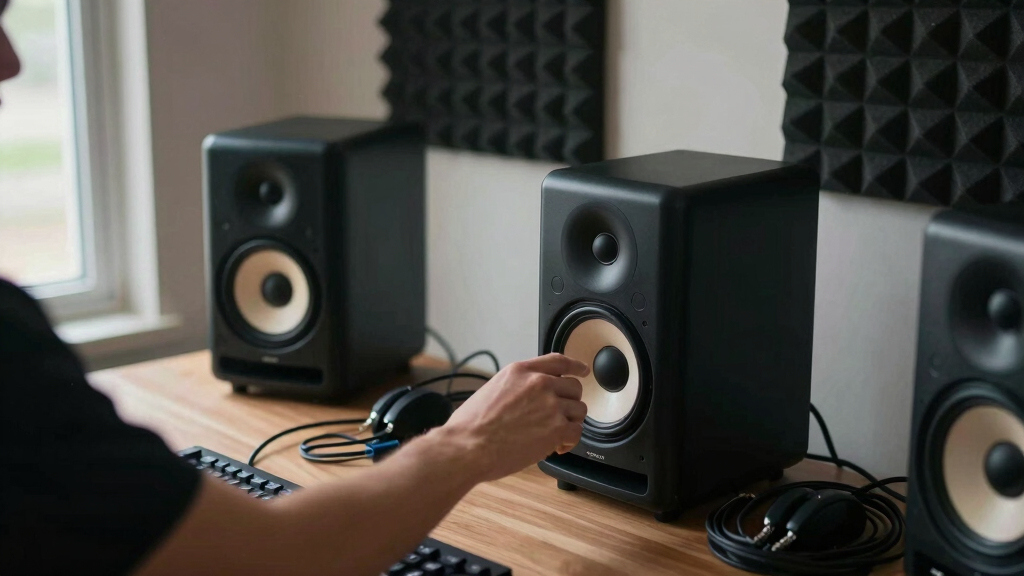

Finding the best studio monitors under $1500 a pair involves balancing sound quality, size, and versatility. The Yamaha HS7 stands out as the overall best for its accurate sound and reliable build. For those seeking compact options, the PreSonus Eris E4.5 offers great value in a smaller footprint. The JBL 305P MkII delivers impressive clarity and a wide sweet spot, ideal for versatile studio setups. These options reflect common tradeoffs: larger speakers often offer better bass but cost more, while smaller monitors excel in detail but may lack low-end punch. Continue reading for a detailed breakdown of each model and help narrowing down your choice.

Get the latest gadgets delivered free with Prime
- Fast, free delivery on millions of items
- Prime Video, Amazon Music and more included
- Member-only deals all year
Complete the kit



Key Takeaways
- The top monitors balance accuracy with affordability, with the Yamaha HS7 emerging as a clear overall favorite.
- Size matters: larger speakers like the Yamaha HS8 provide more bass but come at a higher price, while smaller models like the Eris E4.5 excel in near-field setups.
- Room correction features, such as in the IK Multimedia iLoud MTM MKII, can significantly improve sound quality in less ideal spaces.
- Sound clarity and detail are consistent strengths in models like JBL 305P MkII and PreSonus Eris E5, making them excellent for mixing.
- Tradeoffs often involve size, bass response, and price, so aligning your studio needs with monitor capabilities is key.
| Yamaha HS5 Powered Studio Monitor, Pair |  | Best Overall for Accurate Studio Monitoring | Speaker Type: Woofer | Power Output: 70 watts | Frequency Response: 54 Hz – 30 kHz | VIEW LATEST PRICE | See Our Full Breakdown |
| Yamaha HS7W 6.5-Inch Powered Studio Monitor (White, 2-Pack) |  | Best for Honest and Precise Sound in Stereo Pair | Size: 6.5 inches | Color: White | Frequency Response: up to 30 kHz | VIEW LATEST PRICE | See Our Full Breakdown |
| Yamaha HS7 7-Inch Powered Studio Monitor Pair |  | Best for Larger, Professional-Grade Mixing | Frequency Response: 43Hz – 30kHz | Power Output: 60W LF + 35W HF | Inputs: XLR and TRS | VIEW LATEST PRICE | See Our Full Breakdown |
| PreSonus Eris E5 Pair 2-Way 5.25” Near Field Studio Monitors |  | Best for Versatile Nearfield Monitoring | Woofer Size: 5.25 inches | Tweeter Type: Silk-dome | Power: 80 watts | VIEW LATEST PRICE | See Our Full Breakdown |
| IK Multimedia iLoud MTM MKII (Pair) Studio Monitors with ARC Room Correction and Speaker Emulation |  | Best for Adaptive, Room-Corrected Monitoring | Frequency Range: 36 Hz – 32 kHz | Power: 200W | Room Correction: ARC technology | VIEW LATEST PRICE | See Our Full Breakdown |
| JBL 305P MkII 5″ 2-Way Active Powered Studio Reference Monitors (Pair) |  | Best Overall for Versatile Accuracy | Number of Speakers: 2 | Driver Size: 5 inches | Amplifier Power: 41 Watts per speaker | VIEW LATEST PRICE | See Our Full Breakdown |
| PreSonus Eris E4.5 2-Way 4.5-Inch Near Field Studio Monitor (Pair) |  | Best for Budget-Conscious Creators | Woofer Size: 4.5 inches | Power: 50 Watts | Inputs: ¼-inch TRS, RCA, ⅛-inch TRS aux | VIEW LATEST PRICE | See Our Full Breakdown |
| Yamaha HS4 Powered Studio Monitor (Pair) |  | Best for Accurate Midrange and Highs | Type: 2-way bass-reflex powered speaker | Woofer Size: 4.5 inches | Tweeter Size: 1 inch | VIEW LATEST PRICE | See Our Full Breakdown |
| JBL 306P MkII 6.5″ Studio Monitoring Speakers (Pair) |  | Best for Deep Bass and Transient Response | Type: Studio Monitoring Speakers | Size: 6.5 inches | Power: Powered | VIEW LATEST PRICE | See Our Full Breakdown |
| Yamaha HS8 8-Inch Powered Studio Monitor Pair – Black |  | Best for Professional-Grade Mixing | Frequency Response: 38Hz – 30kHz | Power: 120W total (75W LF + 45W HF) | Woofer Size: 8 inches | VIEW LATEST PRICE | See Our Full Breakdown |
| Focal Alpha-Twin EVO Active 2.5-Channel Studio Monitor |  | Best for Neutral, High-Fidelity Monitoring in Larger Rooms | Type: 2.5-Channel Studio Monitor | Features: Excellent dynamics, wide dispersion, sound neutrality, no distortion, connect up to 3 audio sources | Material: Slatefiber cone | VIEW LATEST PRICE | See Our Full Breakdown |
More Details on Our Top Picks
Yamaha HS5 Powered Studio Monitor, Pair
The Yamaha HS5 stands out as the best overall choice for those needing precise sound reproduction in a compact form. Its 5-inch woofer and 1-inch dome tweeter deliver a flat frequency response from 54 Hz to 30 kHz, making it ideal for mixing and critical listening. Compared to the Yamaha HS7, the HS5 offers a smaller footprint, which is perfect for tighter spaces, though it sacrifices some low-end depth. The bi-amplification and high power output ensure clear, detailed sound across the spectrum. However, its size means it’s less suited for larger rooms, and it lacks water resistance. This monitor makes the most sense for producers working in smaller studios or home setups where accuracy outweighs bass extension.
Pros:- Highly accurate sound reproduction for mixing
- Bi-amplified with 70W output ensures clarity
- Flat frequency response delivers true sound
Cons:- No water-resistant or rugged features
- Large size may require dedicated space
Best for: Music producers and mixing engineers in small to medium home studios needing precision and compactness.
Not ideal for: Large-scale mastering facilities or outdoor use due to limited water resistance and size constraints.
- Speaker Type:Woofer
- Power Output:70 watts
- Frequency Response:54 Hz – 30 kHz
- Woofer Diameter:5 inches
- Input Connectivity:XLR and TRS
- Dimensions:24″D x 20″W x 32″H
Our verdict“This makes the most sense for professionals who need accurate, studio-grade sound in a compact package.”
Yamaha HS7W 6.5-Inch Powered Studio Monitor (White, 2-Pack)
The Yamaha HS7W pair offers a step up in size and sound fidelity, with 6.5-inch drivers providing more robust low-end response. This makes them an excellent choice for those who need a more balanced mix, especially compared to the smaller HS5. Their high-frequency response up to 30 kHz ensures clarity for detailed editing. While they require careful placement to avoid phase issues, their advanced transducers minimize distortion and provide a natural sound. These monitors are best suited for professionals or serious hobbyists working in dedicated studios, but their price may be a barrier for beginners. They are less portable and need space, making them less ideal for mobile setups.
Pros:- Provides honest and precise sound for mixing
- Advanced transducers ensure smooth response
- High-frequency extension up to 30 kHz
Cons:- Requires proper placement for optimal performance
- Higher cost may deter entry-level users
Best for: Professional or semi-professional audio engineers seeking balanced, honest sound for mixing in a dedicated studio.
Not ideal for: Beginners or those with limited space who may find larger monitors cumbersome and expensive.
- Size:6.5 inches
- Color:White
- Frequency Response:up to 30 kHz
- Quantity:2
Our verdict“Ideal for those who prioritize accurate, natural sound in a dedicated studio environment.”
Yamaha HS7 7-Inch Powered Studio Monitor Pair
The Yamaha HS7 offers a substantial 7-inch woofer, making it better suited for larger rooms or those needing deeper bass response compared to the HS5 and HS7W. Its frequency response of 43Hz to 30kHz provides a broader low end, suitable for mixing complex tracks. The bi-amp system and vibration-eliminating mounting system ensure clarity and stability, essential for professional workflows. However, these monitors are more expensive and require professional calibration to achieve their full potential, which could be overwhelming for casual users or beginners. Their size also demands more space, limiting portability. This monitor is best for serious audio professionals in bigger studios.
Pros:- Accurate, transparent sound ideal for mixing
- Bi-amp design enhances clarity and reduces phase issues
- Robust construction with vibration damping
Cons:- Requires professional setup and calibration
- Higher price point for casual users
Best for: Experienced producers and engineers working in larger studios or needing more bass authority.
Not ideal for: Beginners or those with limited space who do not require such high output or accurate low-end performance.
- Frequency Response:43Hz – 30kHz
- Power Output:60W LF + 35W HF
- Inputs:XLR and TRS
- Number of Monitors:2
Our verdict“A solid choice for seasoned professionals seeking larger-scale, accurate monitoring with deeper bass response.”
PreSonus Eris E5 Pair 2-Way 5.25” Near Field Studio Monitors
The PreSonus Eris E5 pairs are designed for nearfield use, with 5.25-inch woofers and 1-inch silk-dome tweeters that deliver balanced, minimally distorted sound. Their 80W bi-amplification and multiple input options make them flexible for various setups, from small home studios to portable rigs. The acoustic tuning controls allow users to tailor the sound to their environment, which is especially useful in less-than-ideal rooms. Compared to the Yamaha HS5, the Eris E5 offers more input flexibility and room tuning options, though it might be a bit more costly for beginners. Their size and intended nearfield use mean they’re less suitable for larger spaces or immersive mixing environments.
Pros:- Minimal distortion for accurate sound
- Multiple input options for flexible connectivity
- Acoustic tuning controls for room adjustment
Cons:- May be expensive for newcomers
- Limited to nearfield applications only
Best for: Home studio owners and musicians seeking versatile, customizable nearfield listening with multiple input choices.
Not ideal for: Large-room mixing or outdoor environments where higher SPL and water resistance are needed.
- Woofer Size:5.25 inches
- Tweeter Type:Silk-dome
- Power:80 watts
- Inputs:XLR, 1/4-inch, RCA
- Maximum SPL:102 dB
Our verdict“Perfect for small studios or musicians needing customizable, balanced nearfield monitors.”
IK Multimedia iLoud MTM MKII (Pair) Studio Monitors with ARC Room Correction and Speaker Emulation
The IK Multimedia iLoud MTM MKII pair excels in adapting to various environments thanks to ARC room correction and speaker emulation. Their flat frequency response from 36 Hz to 32 kHz ensures accurate bass and crisp highs, making them well-suited for mixing and mastering across different room sizes. Unlike traditional monitors, these speakers compensate for room acoustics, minimizing the need for extensive room treatment. The built-in ARC technology requires a mic for calibration, which is sold separately, adding an extra step. While they are versatile and packed with features, their relatively high price and limited connectivity details may deter casual users. These monitors are ideal when room acoustics are less than perfect and flexibility is a priority.
Pros:- Flat and accurate frequency response
- Built-in ARC room correction enhances sound in any room
- Flexible mounting options and speaker emulation
Cons:- Additional cost for calibration microphone
- Limited connectivity details available
Best for: Professional mixers and mastering engineers needing adaptable monitors that compensate for room acoustics.
Not ideal for: Casual hobbyists or those unwilling to invest in calibration accessories, as mic for ARC is sold separately.
- Frequency Range:36 Hz – 32 kHz
- Power:200W
- Room Correction:ARC technology
- Speaker Emulation:Yes
- Mounting Options:Desktop stands, mic stand mount
Our verdict“A smart choice for professionals seeking precise, room-adaptive monitoring with versatile setup options.”
JBL 305P MkII 5″ 2-Way Active Powered Studio Reference Monitors (Pair)
The JBL 305P MkII stands out for its combination of accuracy and broad listening sweet spot, making it ideal for a range of production environments. Its dual 41-watt amplifiers and 5-inch driver deliver a punchy, detailed sound that rivals more expensive options like the Yamaha HS8, but with a more approachable size and price. The adjustable boundary EQ and HF trim allow for room-specific calibration, which is essential for smaller or challenging spaces. However, this power and flexibility come with a need for careful placement—these monitors can sound overly dominant if not positioned properly, and they might be more than what a casual hobbyist needs. Best for professional producers or serious hobbyists who need accurate, immersive sound.
Pros:- Accurate and immersive sound with a wide sweet spot
- Powerful dual 41-watt amplifiers for dynamic range
- Adjustable controls for tailored sound in any room
Cons:- Requires ample space and proper placement for optimal sound
- May be overkill for casual or entry-level users
Best for: Producers and sound engineers who want versatile, professional-grade monitors without exceeding budget.
Not ideal for: Casual listeners or small home studios with limited space, due to their size and need for proper placement.
- Number of Speakers:2
- Driver Size:5 inches
- Amplifier Power:41 Watts per speaker
- Inputs:XLR/TRS
- Enclosure Material:MDF
- Additional Features:Boundary EQ, HF Trim
Our verdict“A well-rounded choice for those needing true studio accuracy with room for customization.”
PreSonus Eris E4.5 2-Way 4.5-Inch Near Field Studio Monitor (Pair)
The PreSonus Eris E4.5 offers reliable, studio-quality sound at a lower price point than larger monitors like the Yamaha HS4. Its 50W power and versatile input options make it a flexible choice for multimedia and music production. The high- and low-frequency tuning controls are particularly useful for tailoring sound to your space, but the smaller 4.5-inch woofer limits deep bass reproduction, making it less suitable for mixing bass-heavy genres or large rooms. It’s a practical option for beginners or those with limited space, but users needing full-range sound should consider adding a subwoofer. Best for entry-level producers, podcasters, or multimedia creators seeking clarity and flexibility.
Pros:- Delivers studio-quality, accurate sound
- Versatile connectivity options for diverse devices
- Adjustable high- and low-frequency controls for customization
Cons:- Requires external subwoofer for deep bass
- Limited woofer size may not suit large rooms or bass-heavy genres
- No built-in Bluetooth connectivity
Best for: Beginners or casual producers who want accurate sound but don’t need deep bass or high-powered performance.
Not ideal for: Large or bass-heavy projects that demand full low-end response, unless paired with a subwoofer.
- Woofer Size:4.5 inches
- Power:50 Watts
- Inputs:¼-inch TRS, RCA, ⅛-inch TRS aux
- Tuning Controls:High- and low-frequency adjustments
- Additional:Headphone output, room tuning, power saver mode
Our verdict“A cost-effective, flexible monitor ideal for beginners and multimedia creators focused on clarity.”
Yamaha HS4 Powered Studio Monitor (Pair)
The Yamaha HS4 excels in delivering clear mid and high frequencies, making it a strong contender for those focused on vocal and instrumental clarity. Its 4.5-inch woofer, combined with a 1-inch dome tweeter, offers a balanced sound that’s less bass-heavy than larger monitors like the JBL 306P MkII. The inclusion of room control and high trim response adjustments enhances its suitability for various spaces, but its limited bass response can be a drawback for genres requiring deep low frequencies. It’s best suited for small studios or nearfield listening, where accurate reproduction of mids and highs is paramount. Best for vocalists, acoustic musicians, and mixing engineers who prioritize clarity over bass.
Pros:- High-quality sound with clear mid and high frequencies
- Multiple input options for versatile connectivity
- Room control and high trim adjustments for customization
Cons:- Limited bass response due to small woofer
- No wireless or Bluetooth features
- Requires careful placement for best sound
Best for: Small studio setups and professional mixing environments requiring precise mid-high frequency reproduction.
Not ideal for: Projects or genres relying heavily on bass, or users needing wireless convenience.
- Type:2-way bass-reflex powered speaker
- Woofer Size:4.5 inches
- Tweeter Size:1 inch
- Frequency Response:60 Hz – 22 kHz
- Power Output:26 W and above
- Inputs:XLR/TRS Combo, RCA, Stereo Mini
Our verdict“Ideal for small studios and professionals emphasizing clarity in mid and high frequencies over bass depth.”
JBL 306P MkII 6.5″ Studio Monitoring Speakers (Pair)
The JBL 306P MkII offers a noticeable upgrade in bass response and transient accuracy over smaller monitors like the Yamaha HS4. Its 6.5-inch driver and boundary EQ allow for deeper low-end and more neutral response near walls, making it suitable for mixing bass-heavy genres or larger rooms. Compared with the PreSonus Eris E4.5, it provides greater low-end extension, but at a higher price point, which could be a barrier for entry-level users. Placement is critical for optimal performance, especially in smaller spaces. This monitor makes the most sense for producers who need accurate bass and a broad sweet spot for off-axis listening. Best for serious producers working in medium to large rooms who need deep, accurate low frequencies.
Pros:- Deep bass with improved transient response
- Broad sweet spot for off-axis listening
- Boundary EQ for neutral low-frequency response near walls
Cons:- Higher cost may be prohibitive for entry-level users
- Requires proper placement for best results
- Bulkier size may be less suitable for small desks
Best for: Producers and engineers focused on genres with substantial bass content or needing a broad listening area.
Not ideal for: Beginners or those with tight budgets who don’t require extended bass response or larger drivers.
- Type:Studio Monitoring Speakers
- Size:6.5 inches
- Power:Powered
- Features:Boundary EQ, Wide Sweet Spot, Improved Transducers
Our verdict“A powerful option for advanced producers needing accurate low-end and wide listening angles.”
Yamaha HS8 8-Inch Powered Studio Monitor Pair – Black
The Yamaha HS8 brings a larger 8-inch woofer and a robust bi-amp system for a truly professional sound. Its extended frequency response from 38 Hz to 30 kHz covers the full spectrum required for mixing detailed tracks, rivaling high-end monitors but within the under-$1500 range. The magnetic circuit and high power output ensure clarity and dynamics, but its size and price make it less suitable for small, casual setups. Placement is key to avoid bass boom, especially in untreated rooms. This monitor is best suited for serious producers or studios where accurate, full-range sound is non-negotiable. Best for professional mixing, mastering, and large-room studio environments.
Pros:- Highly accurate sound with wide frequency response
- Bi-amp system enhances clarity and reduces phase issues
- Robust build for demanding professional use
Cons:- High price relative to smaller monitors
- Requires ample space for optimal placement
- No built-in wireless features
Best for: Professional engineers and serious hobbyists needing accurate, full-spectrum sound reproduction.
Not ideal for: Small studios or beginners who lack space or budget for larger monitors.
- Frequency Response:38Hz – 30kHz
- Power:120W total (75W LF + 45W HF)
- Woofer Size:8 inches
- Tweeter Size:1 inch
- Bi-amp System:Yes
- Included Accessories:Speaker cable, anti-slip pad
Our verdict“A premium choice for those requiring the full-range fidelity of professional monitors in a home or studio setting.”
Focal Alpha-Twin EVO Active 2.5-Channel Studio Monitor
The Focal Alpha-Twin EVO stands out for its exceptional sound neutrality and wide dispersion, making it ideal for engineers who need consistent sound across larger or acoustically challenging rooms. Unlike the Yamaha HS5, which is more compact and suited for smaller spaces, the Alpha-Twin EVO offers a broader soundstage thanks to its advanced driver technology. Its Slatefiber cone ensures minimal distortion, providing a clean, accurate reference that’s especially valuable for mixing and mastering. While the sound quality is impressive, this model’s lack of specific size and power specs can be a drawback for those who want precise technical details upfront. Additionally, its higher price point may be a concern for budget-conscious buyers. For professionals or serious hobbyists working in larger environments, the Alpha-Twin EVO makes an excellent choice, but it might be overkill for small bedroom setups.
Pros:- Excellent dynamics and sound clarity
- Wide dispersion covers larger areas evenly
- Neutral sound profile with no distortion
- Supports multiple audio sources
Cons:- Lack of detailed size and power specifications
- Higher price may be prohibitive for some users
Best for: Professional audio engineers and mixing engineers needing accurate, neutral sound in larger or treated rooms
Not ideal for: Home studio owners with limited space or those seeking budget-friendly monitors under $1000
- Type:2.5-Channel Studio Monitor
- Features:Excellent dynamics, wide dispersion, sound neutrality, no distortion, connect up to 3 audio sources
- Material:Slatefiber cone
- Manufacture Location:France
Our verdict“This monitor is best suited for professionals in need of precise, room-filling sound at a premium price point.”

How We Picked
Our evaluation focused on performance, build quality, and value within the under $1500 budget. We prioritized monitors with transparent sound reproduction suitable for mixing and mastering, as well as those offering features like room correction or versatile connectivity. Size and power handling were also considered to ensure the options fit a range of studio environments. We ranked products based on how well they balance these factors, favoring models that deliver reliable, professional sound without excessive compromises. The selection reflects a mix of widely recommended models and those offering unique advantages for different studio setups.Factors to Consider When Choosing Best Studio Monitors Under 1500 A Pair
Choosing the best studio monitor under $1500 involves understanding some key factors that impact your overall listening experience. Beyond just raw power, considerations like room size, sound profile, and feature set can influence your decision. Knowing what matters most for your specific studio environment helps avoid common pitfalls such as overpaying for unnecessary features or selecting monitors that don’t match your space and workflow. Here are the main factors to keep in mind:Size and Frequency Response
Monitor size directly impacts bass response and overall sound dispersion. Larger speakers like the Yamaha HS8 deliver deeper lows but require more space and power. Smaller monitors, such as the Eris E4.5, excel in near-field setups and offer detailed midrange and high frequencies. Matching the size to your room and application prevents over- or under-investing in bass capabilities, ensuring your mixes translate well across different playback systems.
Room Correction and Connectivity
Features like room correction in models such as the IK Multimedia iLoud MTM MKII can compensate for acoustic anomalies, producing more accurate sound in less-than-ideal environments. Connectivity options—balanced XLR, TRS, or RCA—also matter, especially if you plan to integrate the monitors with various audio interfaces. Prioritizing these features helps create a flexible setup that adapts to your evolving needs.
Sound Profile and Transparency
Look for monitors that produce a flat, transparent sound to avoid coloring your mixes. Some models, like the JBL 305P MkII, are known for their broad sweet spot and detailed high frequencies, which are crucial for precise editing. Beware of monitors with exaggerated bass or treble, as they can mislead your mixing decisions. Listening to the monitors in your space before buying can help determine which sound profile aligns with your workflow.
Build Quality and Reliability
Durability and consistent performance are vital, especially for long-term use. Monitors with solid cabinets and quality components tend to last longer and maintain their sound integrity. Cheaper or poorly built models may introduce unwanted noise or distort over time. Investing in a well-constructed monitor ensures your workflow remains smooth and your sound remains reliable.
Price-to-Performance Ratio
Within the $1500 budget, it’s important to find monitors that offer the best value—combining features, sound quality, and durability without overspending. Sometimes, paying slightly more for a model with room correction or higher fidelity can be more cost-effective in the long run, especially if it reduces the need for additional acoustic treatment or upgrades. Focus on models that meet your core needs without unnecessary extras.
Frequently Asked Questions
Should I prioritize larger monitors or smaller near-field speakers?
The choice depends on your studio space and workflow. Larger monitors like the Yamaha HS8 provide richer bass and are better suited for larger rooms or professional mixing. Smaller models, such as the PreSonus Eris E4.5, excel in near-field setups and are ideal for compact spaces or home studios. Consider your room size, listening position, and whether you need more bass response or greater detail at close range.
Is room correction a must-have feature in studio monitors?
Room correction can significantly improve accuracy, especially in less-than-ideal acoustic environments. While not mandatory, models like the IK Multimedia iLoud MTM MKII with ARC offer a notable advantage by compensating for room irregularities. If your studio space has challenging acoustics, investing in monitors with room correction can save time and improve mix translation, but for well-treated rooms, standard monitors may suffice.
How important is the frequency response in choosing studio monitors?
Frequency response indicates how accurately a monitor reproduces the full spectrum of sound. Flat, wide responses help ensure your mixes translate well across different playback systems. Slight deviations, like boosted highs or lows, can mislead your perception of the mix. Always look for monitors with a reputation for transparency and balanced response, and consider listening tests if possible.
Can I use consumer speakers for professional mixing?
While consumer speakers can be tempting due to lower costs, they often lack the flat response needed for accurate mixing. Studio monitors are designed to provide a neutral sound profile, crucial for making precise adjustments. Relying on consumer speakers can lead to mixes that sound good on your system but poorly elsewhere. Investing in proper studio monitors ensures your work translates more reliably.
Should I buy monitors with built-in amplification or passive ones?
Most studio monitors under $1500 are active, meaning they have built-in amplifiers optimized for their drivers. This simplifies setup and reduces the need for external amplification. Passive monitors require a separate amp, adding complexity and cost. For ease of use and consistent sound quality, active monitors are generally the better choice within this budget range.
Conclusion
For most users, the Yamaha HS7 offers the best balance of accuracy, build quality, and value, making it ideal for professional or serious hobbyist studios. If you’re on a tighter budget or need a more compact setup, the PreSonus Eris E4.5 provides excellent detail at a lower price point. For those seeking advanced features like room correction, the IK Multimedia iLoud MTM MKII stands out. Beginners should focus on models with straightforward controls and reliable sound, while experienced users might prioritize larger speakers with extended bass. Ultimately, your choice hinges on your room size, workflow, and sound preferences, but this roundup ensures you’ll find a suitable, high-quality option within $1500.Black Friday Picks

Kindle Paperwhite (16 GB) – 7 Glare-Free Display, Black
As an affiliate, we earn on qualifying purchases.