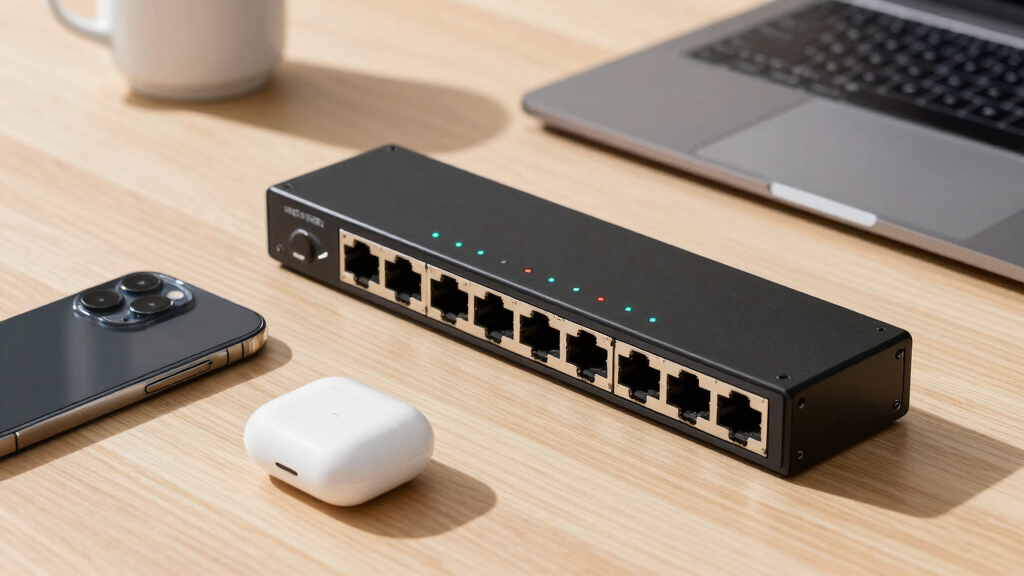

For creators working with large files, high-resolution video, or demanding workflows, a reliable 10GbE network switch can make a significant difference. The best overall pick is the MikroTik CRS304-4XG-IN — it offers robust performance and versatile ports for complex setups. The TP-Link TL-SX1008 stands out for ease of use and affordability, while the SODOLA 12 Port 10Gb Managed Switch provides extensive manageability for advanced users. Buyers often face tradeoffs between port count, manageability, and price. Continue reading for a detailed breakdown of these options and what suits your specific needs.

Get the latest gadgets delivered free with Prime
- Fast, free delivery on millions of items
- Prime Video, Amazon Music and more included
- Member-only deals all year
Complete the kit



Key Takeaways
- Top switches offer a balance of port variety, with managed options providing greater control for complex setups.
- Price varies significantly; unmanaged switches tend to be more affordable but less flexible for advanced configurations.
- The presence of SFP+ ports is a key differentiator for connecting fiber or high-speed uplinks, especially for larger networks.
- Ease of setup and user interface are often overlooked but crucial for creators without extensive network experience.
- Buyers should carefully consider future expansion needs, as many switches are designed for specific scaling scenarios.
| 10GbE Ethernet Switch Unmanaged with 2 x 10Gb RJ45 Ports and 8 x 2.5Gb Base-T Ports |  | Best Overall for Simplicity and Reliability | Number of Ports: 10 | Port Types: 2 x 10Gb RJ45, 8 x 2.5Gb Base-T | Data Transfer Rate: 60 gigabits_per_second | VIEW LATEST PRICE | See Our Full Breakdown |
| 8 Port 10G Ethernet Switch Unmanaged with 8x 10Gb Base-T Ports – NICGIGA 10Gbps Network Switch for NAS, PC, WiFi7 Router, 10G Adapter/NIC |  | Best for High-Speed Multi-Device Setups | Number of Ports: 8 | Compatible Devices: Desktops, Gaming consoles, Routers, Laptops | Upper Temperature Rating: 45 °C | VIEW LATEST PRICE | See Our Full Breakdown |
| 8 Port 10G Switch with 2 SFP+ for NAS & Gaming |  | Best for Flexible Connectivity and High Capacity | Number of Ports: 8 | Port Types: 6 RJ45 + 2 SFP+ | Switching Capacity: 160Gbps | VIEW LATEST PRICE | See Our Full Breakdown |
| TP-Link TL-SX1008 8-Port 10G/Multi-Gig Unmanaged Ethernet Switch |  | Best for Reliable High-Speed Basic Networking | Number of Ports: 8 | Port Speed: 10G/Multi-Gig | Switching Capacity: 160 Gbps | VIEW LATEST PRICE | See Our Full Breakdown |
| TRENDnet 6-Port 10G Switch, TEG-S762 |  | Best Compact Fanless Design for Desktop Use | Number of Ports: 6 | 2.5G Ports: 4 | 10G Ports: 2 | VIEW LATEST PRICE | See Our Full Breakdown |
| SODOLA 12 Port 10Gb Managed Switch, 8x10G SFP+ & 4x10G RJ-45 |  | Best Managed Switch for Flexible High-Speed Networking | Number of Ports: 12 | Compatible Devices: Desktop, Laptop, Server | Maximum Power: 96W | VIEW LATEST PRICE | See Our Full Breakdown |
| TRENDnet 5-Port 10G Switch, 100Gbps Switching Capacity TEG-S750 |  | Best Value for Compact, High-Speed Unmanaged Networking | Ports: 5 x 10G RJ-45 | Switching Capacity: 100Gbps | Supports: 2.5G-BASE-T, 10G-BASE-T | VIEW LATEST PRICE | See Our Full Breakdown |
| MikroTik CRS304-4XG-IN 10 Gigabit Ethernet Switch |  | Best Compact High-Speed Switch for Space-Constrained Setups | Number of Ports: 4 | Ethernet Speed: 10 Gigabit | Power Options: Multiple | VIEW LATEST PRICE | See Our Full Breakdown |
| TP-Link TL-SX105 5-Port 10G Multi-Gigabit Unmanaged Ethernet Switch |  | Best Easy Setup for High-Speed, No-Fuss Networks | Number of Ports: 5 | Compatible Devices: Desktop | Upper Temperature Rating: 40 °C | VIEW LATEST PRICE | See Our Full Breakdown |
More Details on Our Top Picks
10GbE Ethernet Switch Unmanaged with 2 x 10Gb RJ45 Ports and 8 x 2.5Gb Base-T Ports
This unmanaged switch stands out for its straightforward, plug-and-play setup combined with high-speed 10GbE ports, making it ideal for creators who prioritize stable performance without the complexity of managed features. Compared to the TP-Link TL-SX1008, it offers similar 10G support but includes more versatile port types, including 2.5Gb ports for broader device compatibility. Yet, its unmanaged nature means it lacks advanced network controls, which could be a limitation for users seeking granular management. This model is perfect for creators who want a reliable, silent switch that supports high data transfer rates without fuss, but it’s less suitable for those needing detailed network customization or PoE support.
Pros:- High-speed 10GbE ports for rapid data transfer
- Plug-and-play setup with no configuration needed
- Durable metal case with silent fanless operation
Cons:- Limited to unmanaged switch functionality; no network management options
- Requires compatible devices for full 10GbE benefits
Best for: Creators seeking a simple, reliable, high-performance switch for NAS, gaming PCs, and WiFi 7 routers without managing network settings.
Not ideal for: Advanced users requiring managed switch features, VLAN configurations, or PoE for powering devices.
- Number of Ports:10
- Port Types:2 x 10Gb RJ45, 8 x 2.5Gb Base-T
- Data Transfer Rate:60 gigabits_per_second
- Supported Devices:Desktop, Gaming Console, Laptop, Printer, Router
- Operating System:Unmanaged
- Warranty:1 year
Our verdict“This switch is ideal for creators who want straightforward, high-speed connectivity without the complexity of managed networking.”
8 Port 10G Ethernet Switch Unmanaged with 8x 10Gb Base-T Ports – NICGIGA 10Gbps Network Switch for NAS, PC, WiFi7 Router, 10G Adapter/NIC
This unmanaged 8-port switch excels at supporting multiple high-bandwidth devices simultaneously, thanks to its 10Gbps ports and auto-negotiation across five speeds. Compared to the TP-Link TL-SX1008, it offers similar speed but includes a rugged metal case and enhanced cooling, making it more suitable for heavy use in small office or studio setups. Its lack of management features means it’s less flexible for network customization, but for straightforward high-speed connections, it’s a solid choice. This pick makes the most sense for creators who need to connect multiple devices—such as NAS, gaming PCs, and streaming boxes—without fussing over configurations, but it might be overkill for simple home networks.
Pros:- High-speed 10G ports support multiple devices simultaneously
- Plug-and-play with auto-negotiation for broad compatibility
- Sturdy metal casing with cooling for stable operation
Cons:- No managed features for advanced network control
- Lacks PoE support which limits powering options
Best for: Creators managing multiple high-bandwidth devices needing reliable, simultaneous connections without advanced network features.
Not ideal for: Users seeking managed switches, VLAN capabilities, or PoE support for powering connected devices.
- Number of Ports:8
- Compatible Devices:Desktops, Gaming consoles, Routers, Laptops
- Upper Temperature Rating:45 °C
- Interface:RJ45
- Data Transfer Rate:160 gigabits_per_second
- Number of Layers:1
- Switch Type:Unmanaged
- Color:Black
- Case Material:Metal
- Item Weight:1.91 kg
Our verdict“This switch is best suited for creators with multiple high-bandwidth devices who want reliable, straightforward connectivity.”
8 Port 10G Switch with 2 SFP+ for NAS & Gaming
The 8 Port 10G Switch with 2 SFP+ offers a versatile mix of 6 RJ45 ports and 2 SFP+ ports, making it ideal for creators who need both copper and fiber connections for NAS, servers, or 8K streaming. Compared to the NICGIGA 10Gbps Switch, it provides additional fiber options, boosting network flexibility. Its non-blocking 160Gbps capacity ensures smooth data flow, but being unmanaged limits custom configuration options. Its quiet operation, surge protection, and rack-mount capability make it a practical choice for small studios or home labs. This switch makes sense for users who prioritize high capacity and adaptable connectivity, but it might fall short for those wanting managed features or detailed network controls.
Pros:- High switching capacity with non-blocking ports
- Supports fiber and DAC over SFP+ for versatile setups
- Quiet operation with surge protection and flexible mounting options
Cons:- Limited to unmanaged switch features; no advanced controls
- Warranty limited to 1 year
Best for: Creators who need flexible, high-capacity connections with a mix of copper and fiber options for NAS and high-resolution streaming.
Not ideal for: Those requiring managed switches, VLAN features, or PoE for powering devices directly through the switch.
- Number of Ports:8
- Port Types:6 RJ45 + 2 SFP+
- Switching Capacity:160Gbps
- MAC Address Table:16K
- Supported Speeds:10G/5G/2.5G/1G over RJ45, fiber/DAC over SFP+
- Cooling:Low-noise fan, cooling holes
- Surge Protection:6KV lightning
- Form Factor:Rack mount or desktop
Our verdict“This switch is a strong fit for creators needing flexible, high-capacity connectivity options in a simple, unmanaged package.”
TP-Link TL-SX1008 8-Port 10G/Multi-Gig Unmanaged Ethernet Switch
The TP-Link TL-SX1008 offers a straightforward 8-port 10G switch with multi-gig support and auto-negotiation, making it suitable for creators who want reliable high-speed connections without managing complex settings. Compared to the Unmanaged 10GbE Switch with mixed port types, the TL-SX1008 emphasizes durability with a 3-year warranty and a sturdy metal case, but it lacks detailed management features that power users might desire. Its plug-and-play nature and low noise make it easy to deploy, especially in a desktop or rackmount environment. This switch fits creators who need high-speed connectivity in a simple, reliable package, but it may not satisfy those seeking advanced network control or PoE capabilities.
Pros:- Reliable 10G/Multi-Gig ports support high-speed data transfer
- Auto-negotiation ensures compatibility across devices
- Durable metal case with 3-year warranty
Cons:- No managed features for advanced control
- Limited to unmanaged operation with no PoE support
Best for: Small studios or home offices needing a dependable, high-speed switch with minimal setup complexity.
Not ideal for: Advanced network setups requiring VLANs, detailed management, or PoE for powering devices.
- Number of Ports:8
- Port Speed:10G/Multi-Gig
- Switching Capacity:160 Gbps
- Auto-Negotiation:Yes
- Power Supply:Not specified
- Form Factor:Desktop/Rackmount
- Warranty:3 years
Our verdict“This switch is suitable for creators looking for simple, consistent high-speed networking without the need for management features.”
TRENDnet 6-Port 10G Switch, TEG-S762
The TRENDnet TEG-S762 offers a compact, fanless design with two 10G ports and four 2.5G ports, making it ideal for creators who need high-speed connections in a small, quiet form factor. Compared with larger switches like the NICGIGA, it’s more space-efficient and easier to mount on a wall or desk, but its limited port count constrains expansion. Its fanless, metal housing ensures silent operation, perfect for quiet studios or home setups. However, achieving true 10G speeds depends on compatible line and network adapters, which may require additional investment. This switch is perfect for those who value space-saving design and silence over extensive port options or managed features.
Pros:- High-speed 10G and 2.5G ports for versatile connectivity
- Fanless, silent operation with durable metal housing
- Compact, wall-mountable design
Cons:- Requires compatible 10G line and network adapters for full speed
- Limited port count may restrict future expansion
Best for: Creators who need a small, silent, high-speed switch for desktop or wall-mount placement with limited but essential ports.
Not ideal for: Large-scale networks or users requiring managed features, VLANs, or PoE capabilities.
- Number of Ports:6
- 2.5G Ports:4
- 10G Ports:2
- Switching Capacity:60Gbps
- Device Interface:4 x 2.5G RJ-45, 2 x 10G RJ-45
- Housing:Metal
- Design:Fanless
Our verdict“This switch is best for creators who want a space-saving, silent, high-speed solution for limited device setups.”
SODOLA 12 Port 10Gb Managed Switch, 8x10G SFP+ & 4x10G RJ-45
This SODOLA switch stands out for users who need versatile high-speed connectivity combined with advanced management features. Unlike the simpler TRENDnet TEG-S750, which offers unmanaged operation, this model provides web GUI control over VLANs, QoS, and SNMP, making it ideal for complex setups. Its 8 SFP+ ports support fiber connections, offering future-proof scalability, while the 4 RJ-45 ports handle direct Ethernet connections. The compact 1U rack-mount design is perfect for small labs or studio environments where space is limited, and fan cooling ensures stable operation during intensive use. However, its managed features introduce complexity, which might be overwhelming for beginners, and it lacks included transceivers or rack accessories, adding to setup costs.
Pros:- Supports high-speed 10G connectivity with multiple port options
- Web GUI allows detailed network configuration (VLAN, QoS, SNMP)
- Compact 1U rack-mount design saves space and facilitates installation
- Fan cooling maintains stable performance during demanding workloads
Cons:- Requires rack-mount setup, which may not suit all environments
- Managed interface can be complex for less experienced users
- No included rack or transceivers, increasing initial setup costs
Best for: Professional creators or small studios needing a flexible, managed switch for expanding high-speed networks.
Not ideal for: Home users seeking plug-and-play simplicity, as the configuration complexity may be unnecessary and intimidating.
- Number of Ports:12
- Compatible Devices:Desktop, Laptop, Server
- Maximum Power:96W
- Interface:RJ45, SFP+
- Data Transfer Rate:10 gigabits_per_second
- Switch Type:managed
Our verdict“This switch is best suited for creators who need flexible, managed high-speed networking with room to grow, despite some setup complexity.”
TRENDnet 5-Port 10G Switch, 100Gbps Switching Capacity TEG-S750
Compared with the MikroTik CRS304-4XG-IN, which offers more ports but less simplicity, the TRENDnet TEG-S750 excels as a straightforward high-speed solution. Its 5 unmanaged ports deliver reliable 10G connections over Cat6a wiring, perfect for small setups or upgrading existing equipment without added complexity. The fanless design ensures silent operation, ideal for quiet environments like editing suites or home offices. While it lacks advanced management features, this makes it easier for creators who just want dependable high-speed connectivity without configuration fuss. Its NDAA and TAA compliance also appeal to professional or government users who need straightforward, secure equipment. The main tradeoff is that, without managed features, it can’t handle network segmentation or advanced controls, which might limit growth or customization.
Pros:- High-speed 10G and 2.5G support over Cat6a cabling
- Fanless design for silent, energy-efficient operation
- NDAA and TAA compliance suitable for professional and government environments
- Simple plug-and-play setup for quick deployment
Cons:- Limited to unmanaged features; no VLAN or QoS controls
- Requires compatible 10G network adapters for full performance
- Small number of ports may limit scalability
Best for: Creators seeking a simple, reliable 10G switch for direct connections with minimal fuss or configuration.
Not ideal for: Users needing advanced network management or multiple VLANs, as this switch is unmanaged and lacks these capabilities.
- Ports:5 x 10G RJ-45
- Switching Capacity:100Gbps
- Supports:2.5G-BASE-T, 10G-BASE-T
- Design:Fanless
- Compliance:NDAA, TAA
Our verdict“This switch offers dependable, high-speed connections for creators who prefer a plug-and-play approach without management complexity.”
MikroTik CRS304-4XG-IN 10 Gigabit Ethernet Switch
The MikroTik CRS304-4XG-IN shines for creators who need a high-performance, space-saving switch with versatile mounting options. Its four 10G ports provide ample bandwidth for connecting multiple devices or servers in a small studio or edit suite. Compared to the TRENDnet TEG-S750, which is unmanaged, this model offers more flexibility through its potential for configuration via MikroTik’s RouterOS, though this adds complexity. Its dual-core ARM CPU and multiple power sources make it reliable and quiet, ideal for continuous operation. The limited port count may be a downside for larger setups, but for space-conscious creators, this compact design fits perfectly. Lack of detailed managed features might be a hurdle for advanced network customization, but its silent operation and high-speed ports make it a strong choice for focused, small-scale environments.
Pros:- Compact, space-efficient design fits small environments
- High-speed 10G ports support demanding workflows
- Versatile mounting options for flexible placement
- Silent operation with dual-power options for reliability
Cons:- Limited port count may restrict larger setups
- No integrated managed features or advanced controls
- Requires some technical knowledge for configuration
Best for: Small studios or creators with space constraints needing a high-speed, versatile switch with potential for basic management.
Not ideal for: Large networks requiring many ports or advanced management features, as its port count and capabilities are limited.
- Number of Ports:4
- Ethernet Speed:10 Gigabit
- Power Options:Multiple
- Mounting Options:Versatile
- Operation:Silent
Our verdict“This switch makes the most sense for creators with limited space who want high-speed, reliable connectivity with optional basic management.”
TP-Link TL-SX105 5-Port 10G Multi-Gigabit Unmanaged Ethernet Switch
The TP-Link TL-SX105 offers a straightforward solution for creators who want high-speed connections without the complexities of management features. Its five 10G ports support rapid data transfer, ideal for connecting high-performance devices directly. In comparison to the MikroTik CRS304-4XG-IN, which offers more ports but requires some configuration, the TL-SX105 emphasizes plug-and-play simplicity, making it perfect for quick setups or environments where ease of use is paramount. Its fanless design ensures quiet operation, and the durable metal casing provides reliable durability. However, the lack of management features limits flexibility for network segmentation or QoS, making it less suitable for larger or more complex networks. This switch is best for creators who prioritize speed and simplicity over advanced features.
Pros:- High-speed 10G ports enable quick data transfer
- Fanless, silent operation ideal for quiet spaces
- Durable metal case for long-term reliability
- Plug-and-play setup for quick deployment
Cons:- No managed features for network customization
- Limited ports for expanding networks
- No PoE support for powering devices
Best for: Creators who want a fast, reliable high-speed connection with minimal setup effort and no management complexity.
Not ideal for: Users needing detailed network controls or VLAN segmentation, as this unmanaged switch offers no configuration options.
- Number of Ports:5
- Compatible Devices:Desktop
- Upper Temperature Rating:40 °C
- Interface:RJ45
- Data Transfer Rate:100 gigabits_per_second
- Switch Type:unmanaged
Our verdict“This switch is perfect for creators who want high-speed, reliable connections without the hassle of management features.”

How We Picked
These switches were evaluated based on performance benchmarks, build quality, ease of installation, manageability, and value for creators. We prioritized models that deliver consistent 10GbE speeds, reliable connectivity, and compatibility with creative workflows such as NAS, video editing, and large file transfers. Managed switches were included for users seeking advanced control, while unmanaged options focus on plug-and-play simplicity. Our ranking reflects a combination of these factors, aiming to highlight options suitable for both small setups and more complex networks. Cost-effectiveness was also considered, ensuring options are accessible without sacrificing core performance features.Factors to Consider When Choosing Best 10gbe Network Switches For Creators
Choosing the right 10GbE switch involves understanding several key factors that impact performance, usability, and value. Creators should focus on features that support their current needs while allowing room for future growth. Avoiding common pitfalls, such as underestimating port requirements or overlooking manageability, can save time and money. Below are the main considerations to keep in mind when selecting a switch tailored for creative workflows.Port Count and Types
The number of ports directly affects how many devices or connections you can support simultaneously. For most creators, an 8- or 12-port switch offers enough flexibility, but larger setups may require more. Also, consider port types—RJ-45 for Ethernet cables and SFP+ for fiber connections—since mixing these can future-proof your network and improve scalability. Overestimating your needs can lead to unnecessary costs, so match port count to your current setup with an eye on expansion possibilities.
Managed vs. Unmanaged
Managed switches provide control over network settings, VLANs, and traffic prioritization, which can be essential for larger or more complex environments. Unmanaged switches are simpler, offering plug-and-play functionality suitable for straightforward setups. Creators working with multiple devices or requiring reliable performance across various applications should lean toward managed options, while hobbyists or those just starting out can often get by with unmanaged models. The tradeoff is typically cost and complexity—managed switches are more expensive and require some network knowledge.
Speed and Uplink Capabilities
While all switches in this roundup support 10GbE, the uplink options matter for larger networks. SFP+ ports enable fiber connections, which are vital for long-distance, high-speed uplinks to servers or storage. Some switches include multi-gig ports that support speeds beyond 1Gbps, offering more flexibility. Ensuring your switch’s uplinks match your infrastructure’s capacity prevents bottlenecks and maintains workflow efficiency, especially when transferring large video files or working with high-bandwidth applications.
Build Quality and Reliability
For creators, hardware durability and consistent performance are non-negotiable. Look for switches with solid build quality, good ventilation, and stable power supplies. Cheap models may save money upfront but can lead to frequent disconnects or failures under sustained load. A reliable switch minimizes downtime and ensures your creative projects are not interrupted by network issues. Also, consider brands with good support and firmware update policies to keep your network secure and optimized.
Future Proofing and Compatibility
As your creative setup evolves, so will your network demands. Choose switches with room for expansion—additional ports, fiber support, or higher speeds. Compatibility with your existing hardware, such as NAS devices or high-end workstations, is also crucial. Investing slightly more in a switch that can grow with your needs often pays off by avoiding premature upgrades and network redesigns. Think about your next 2-3 years of growth when selecting a switch.
Frequently Asked Questions
Do I need managed switches for my creative setup?
Managed switches are not a necessity for all creators, but they become valuable when you need greater control over network traffic, VLAN segmentation, or prioritize specific devices. For small setups with just a few devices, unmanaged switches often suffice, offering simplicity and lower cost. However, if your workflow involves multiple devices, large data transfers, or you want to optimize performance, managed switches provide the tools to fine-tune your network. Consider your current needs and potential growth to decide if managing your network is worthwhile.
Can I connect fiber optic devices to these switches?
Many switches in this roundup include SFP+ ports, which support fiber connections. This is particularly useful if you require longer-distance links or higher bandwidth uplinks to servers or storage. If fiber connectivity is part of your setup plan, verify that the switch has SFP+ ports and that your fiber modules are compatible. Using fiber can significantly improve network stability and speed, especially in larger or more complex environments.
Is it worth investing in a 12-port switch instead of an 8-port?
Opting for a 12-port switch provides extra capacity for future expansion, which is a wise move if you plan to add more devices over time. It can also prevent the need for additional hardware upgrades in the near future. However, larger switches tend to cost more and may be more complex to configure. If your current setup is small, an 8-port switch may be sufficient, but consider your long-term growth to avoid bottlenecks later on.
How important is switch brand reputation?
The reputation of the brand can impact reliability, firmware updates, and customer support. Well-known brands like MikroTik, TP-Link, and TRENDnet generally offer more consistent quality and better after-sales service. Cheaper, lesser-known brands might save money upfront but could lead to issues with durability or firmware stability. For creative workflows where downtime can be costly, choosing a reputable brand adds peace of mind and long-term value.
Should I prioritize speed over manageability?
Speed is certainly vital for high-bandwidth tasks like video editing and large file transfers, but manageability allows you to optimize network performance and troubleshoot issues more effectively. For most creators, a balance between the two is ideal. If you handle complex networks, managed switches with advanced features can prevent bottlenecks and improve workflow stability. If your setup is simple, a high-speed unmanaged switch might be sufficient and easier to set up.
Conclusion
For creators seeking the best overall performance and flexibility, the MikroTik CRS304-4XG-IN is the top choice, offering extensive port options and advanced management features. Budget-conscious users or those just starting out will appreciate the TP-Link TL-SX1008 for its ease of use and affordability. For large or complex setups requiring maximum expandability, the SODOLA 12 Port 10Gb Managed Switch provides comprehensive manageability and fiber support. Beginners should prioritize simplicity, while advanced users should focus on manageability and future-proofing. Your ideal switch depends on your current setup and plans for growth—choose accordingly.