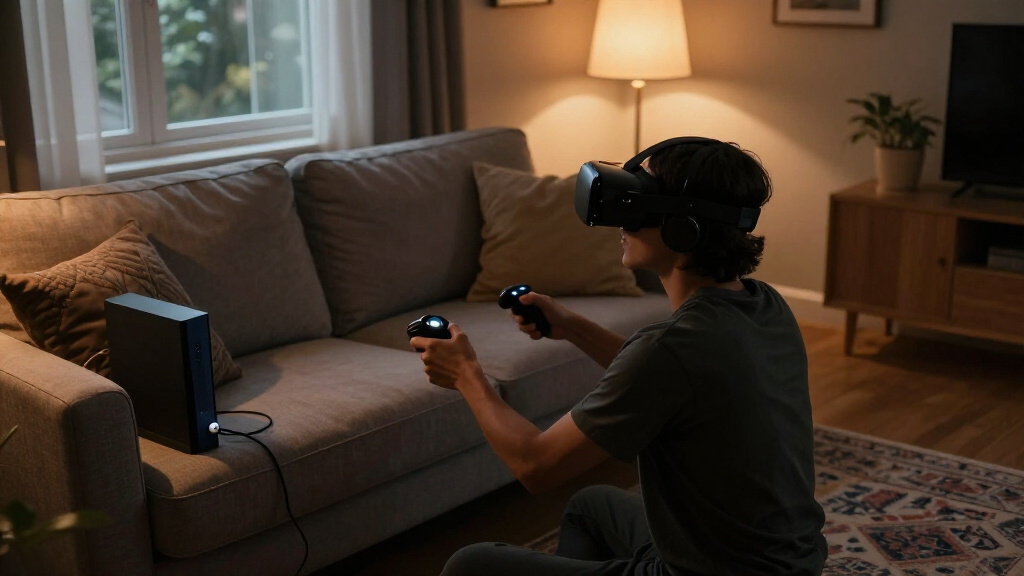
For most players, the Meta Quest 3 512GB is the best overall VR headset for gaming in this lineup, pairing standalone play with PC VR support and more storage than the entry-level picks. The PlayStation VR2 is a strong match for PS5 owners who want console-focused games, while the Pimax Crystal Super targets PC players who put visual detail and a wide field of view first. The main tradeoffs are whether you need a separate gaming PC or console, how much comfort and setup effort you’ll accept, and whether a newer standalone headset is worth choosing over an older or renewed model. Read on for the full breakdown of how these 12 options differ and who each one suits.

Get the latest gadgets delivered free with Prime
- Fast, free delivery on millions of items
- Prime Video, Amazon Music and more included
- Member-only deals all year
Complete the kit

Key Takeaways
- Quest 3 is the broadest fit: The 512GB model combines standalone gaming with PC VR support, making it more flexible than the Quest 2 and 3S options.
- Console ownership narrows the choice: PlayStation VR2 makes the most sense for PS5 players, while the older PlayStation VR Iron Man bundle belongs to buyers who already have compatible PlayStation hardware.
- PC-focused headsets ask more of the setup: Pimax Crystal Super, Pimax Crystal Light, and HTC VIVE Focus Vision are aimed at buyers prepared to check PC requirements and spend time configuring their play space.
- Quest 3S is the entry-level standalone route: Its lower storage and more basic positioning suit casual or first-time players, while Quest 3 offers more room for a wider game library.
- Renewed and bundled listings need extra scrutiny: The Quest 3 renewed and Quest 2 renewed picks may appeal to value-seekers, but condition, included accessories, and bundle contents can vary.
| Meta Quest Pro 256GB VR Headset with Optima Academy Online Field Trips |  | Best for Mixed-Reality Gaming | Storage: 256 GB | RAM: 12 GB | Sensors: 10 VR/MR sensors | VIEW LATEST PRICE | See Our Full Breakdown |
| Meta Quest 2 128GB All-in-One VR Headset with Silicone Cover and Knuckle Straps |  | Best for Entry-Level Standalone Gaming | Storage: 128GB | Display resolution: 1832 × 1920 pixels per eye | Controllers: Two Touch controllers | VIEW LATEST PRICE | See Our Full Breakdown |
| Pimax Crystal Super VR Headset, 3840 × 3840 per Eye, 140° FOV, Eye Tracking, PC DisplayPort |  | Best for High-Detail PC Simulation | Resolution: 3840 × 3840 per eye | Field of view: 140° | Pixel density: 50 PPD | VIEW LATEST PRICE | See Our Full Breakdown |
| Meta Quest 3 512GB VR Headset (Renewed) |  | Best Renewed Standalone Pick | Storage capacity: 512 GB | Memory: 8 GB RAM | Processor: Snapdragon XR2 Gen 2 | VIEW LATEST PRICE | See Our Full Breakdown |
| PlayStation VR2 Horizon Call of the Mountain Bundle |  | Best for PlayStation 5 Exclusives | Platform: PlayStation 5 | Included game: Horizon Call of the Mountain | Display: OLED | VIEW LATEST PRICE | See Our Full Breakdown |
| Meta Quest 3S 128GB VR Headset with Gorilla Tag Bundle |  | Best Standalone Gaming Pick | Platform: Standalone Meta Quest | Processor: Snapdragon XR2 Gen 2 | RAM: 8 GB | VIEW LATEST PRICE | See Our Full Breakdown |
| Meta Quest 2 All-in-One VR Headset, 256 GB (Renewed) |  | Best for a Larger Standalone Game Library | Platform: Standalone | Storage: 256 GB | Display: LCD | VIEW LATEST PRICE | See Our Full Breakdown |
| HTC VIVE Focus Vision Mixed Reality and PC VR Headset with Controllers |  | Best for Standalone and PC VR Flexibility | Platform: Standalone mixed reality and PC VR | Resolution: 2448 × 2448 pixels per eye | Field of view: Up to 120 degrees | VIEW LATEST PRICE | See Our Full Breakdown |
| Pimax Crystal Light PC VR Headset |  | Best for High-Detail PC VR | Platform: PC VR | Resolution: 2880 × 2880 per eye | Display: QLED with local dimming and HDR | VIEW LATEST PRICE | See Our Full Breakdown |
| Sony PlayStation VR Marvel’s Iron Man Bundle |  | Best Console Bundle for Iron Man VR | Compatible platforms: PlayStation 4, PlayStation 5 | Display: OLED | Display resolution: 1920 × 1080 | VIEW LATEST PRICE | See Our Full Breakdown |
| Meta Quest 3 512GB VR Headset with Gorilla Tag Monkenaut Bundle |  | Best for Standalone Gaming and Mixed Reality | Platform: Standalone | Storage: 512 GB | Memory: 8 GB RAM | VIEW LATEST PRICE | See Our Full Breakdown |
| Meta Quest 3S 128GB VR Headset (Renewed Premium) |  | Best Renewed Entry to Standalone VR | Condition: Renewed Premium | Storage: 128 GB | Memory: 8 GB RAM | VIEW LATEST PRICE | See Our Full Breakdown |
| VR headsets for gaming | Refresh rate | Field of view | Storage | Display |
|---|---|---|---|---|
| Meta Quest Pro 256GB VR Headse | — | — | 256 GB | — |
| Meta Quest 2 128GB All-in-One | — | — | 128GB | — |
| Pimax Crystal Super VR Headset | Up to 90 Hz and beyond | 140° | — | QLED with Mini-LED local dimming |
| Meta Quest 3 512GB VR Headset | 120 Hz | 110 degrees | — | — |
| PlayStation VR2 Horizon Call o | 120 Hz | 110 degrees | — | OLED |
| Meta Quest 3S 128GB VR Headset | — | 110 degrees | 128 GB | LCD |
| Meta Quest 2 All-in-One VR Hea | 90 Hz | 90 degrees | 256 GB | LCD |
| HTC VIVE Focus Vision Mixed Re | 90 Hz | Up to 120 degrees | 128 GB; expandable up to 2 TB with MicroSD | — |
| Pimax Crystal Light PC VR Head | Up to 120 Hz | — | — | QLED with local dimming and HDR |
| Sony PlayStation VR Marvel’s I | 90 Hz | 110 degrees | — | OLED |
| Meta Quest 3 512GB VR Headset | Up to 120 Hz | — | 512 GB | LCD |
| Meta Quest 3S 128GB VR Headset | 90 Hz | 96 degrees | 128 GB | — |
More Details on Our Top Picks
Meta Quest Pro 256GB VR Headset with Optima Academy Online Field Trips
I’d choose the Meta Quest Pro for gaming that blends virtual worlds with the room around you, rather than as the simplest all-purpose headset. Its full-color passthrough and Touch Pro controllers with self-tracking and advanced haptics give mixed-reality games more room for natural interaction. The pancake lenses, local dimming, and quantum dot technology also target visual quality, while 12GB of RAM and 256GB of storage provide room for apps and games. Compared with the Meta Quest 3 512GB, this bundle offers less storage and includes a short educational field-trip subscription instead of making gaming the sole focus. The subscription lasts one month, and the supplied details don’t state battery life or weight, so I’d favor it for buyers drawn to mixed-reality features, not those prioritizing a clearly documented play session length.
Pros:- Full-color passthrough supports mixed-reality play that incorporates the physical room
- Touch Pro controllers use self-tracking cameras and advanced haptics
- Pancake lenses, local dimming, and quantum dot technology are designed for detailed visuals
- 256GB of storage and 12GB of RAM
Cons:- The included educational field-trip subscription lasts only one month
- The product details do not specify battery life or headset weight
- Has less storage than the 512GB Meta Quest 3
Best for: Players interested in mixed-reality games, expressive avatar interactions, and Touch Pro controller tracking
Not ideal for: Buyers who want the largest game library storage or need confirmed battery-life and weight details before choosing
- Storage:256 GB
- RAM:12 GB
- Sensors:10 VR/MR sensors
- Audio:Spatial audio
- Controllers:Meta Quest Touch Pro controllers with self-tracking cameras and advanced haptics
- Included subscription:One month of Optima Academy Online VR field trips
Our verdict“Choose the Quest Pro if mixed-reality interaction matters more to you than maximum storage or a gaming-only bundle.”
Meta Quest 2 128GB All-in-One VR Headset with Silicone Cover and Knuckle Straps
This Meta Quest 2 bundle is the straightforward pick for a buyer who wants standalone VR gaming with useful controller accessories included. Its 1832 × 1920-pixel-per-eye display provides the visual foundation for immersive play, while hand tracking offers an alternative to using the two Touch controllers in supported experiences. The silicone grips help guard against sweat and dust, and the adjustable knuckle straps keep controllers secured during active games. Compared with the Meta Quest 3 512GB, this listing gives you less storage and doesn’t specify newer-generation hardware or the Quest 3’s mixed-reality features. That makes it a better fit for buyers focused on basic, untethered VR and a ready-to-use accessory bundle than for players seeking the latest display and processing capabilities. The supplied product data also leaves battery life and refresh rate unspecified.
Pros:- Standalone all-in-one design does not require a gaming PC or console
- 1832 × 1920-pixel-per-eye display
- Hand tracking is available alongside two Touch controllers
- Silicone grip covers and adjustable knuckle straps are included
Cons:- 128GB of storage is less than the 512GB offered by the Meta Quest 3 listing
- Product details do not specify battery life or refresh rate
- Does not list the newer-generation processor and full-color passthrough features of the Quest 3
Best for: First-time VR players who want a standalone headset bundled with controller grips, straps, and a glasses spacer
Not ideal for: Players prioritizing newer hardware, high storage capacity, or documented refresh-rate and battery specifications
- Storage:128GB
- Display resolution:1832 × 1920 pixels per eye
- Controllers:Two Touch controllers
- Included accessories:Silicone cover, adjustable knuckle straps, glasses spacer, charging cable, power adapter, and two AA batteries
- Hand tracking:Supported
- Headset type:All-in-one VR headset
Our verdict“Pick this Quest 2 bundle for accessible standalone gaming and useful controller accessories, not for the latest hardware.”
Pimax Crystal Super VR Headset, 3840 × 3840 per Eye, 140° FOV, Eye Tracking, PC DisplayPort
For PC gamers who put visual detail and cockpit coverage ahead of easy setup, the Pimax Crystal Super is the specialist choice in this group. Its 3840 × 3840 resolution per eye, 50 PPD, and 140° field of view are aimed at making distant scenery and instrument panels easier to see while drawing more of the virtual world into view. QLED displays with Mini-LED local dimming add another visual advantage over the standalone Meta Quest 3, but this headset must connect to a PC through DisplayPort. That tether and PC dependency make it less convenient for casual room-scale play than an all-in-one Quest. Inside-out tracking avoids the need for external tracking stations, and replaceable facial interfaces support adjustment for longer sessions. The listed refresh rate is up to 90 Hz and beyond, so I would confirm the intended configuration and PC compatibility before buying.
Pros:- 3840 × 3840 resolution per eye and 50 PPD target fine visual detail
- 140° field of view provides broad scene coverage
- QLED displays use Mini-LED local dimming
- Inside-out tracking, integrated spatial audio, and a noise-canceling microphone
Cons:- Requires a PC and DisplayPort connection, unlike the standalone Meta Quest 3
- The product details do not specify compatibility requirements or headset weight
- The stated refresh-rate information does not give a single clear maximum
Best for: PC simulator players who want high per-eye resolution, a wide field of view, and detailed virtual cockpits
Not ideal for: Casual players seeking untethered setup, or buyers without a compatible PC and DisplayPort connection
- Resolution:3840 × 3840 per eye
- Field of view:140°
- Pixel density:50 PPD
- Display:QLED with Mini-LED local dimming
- Refresh rate:Up to 90 Hz and beyond
- Tracking:Inside-out tracking
- Audio:Integrated 3D spatial audio and noise-canceling microphone
- Connection:DisplayPort to PC
- Comfort features:Balanced weight distribution and replaceable facial interfaces
Our verdict“Choose the Crystal Super for detail-heavy PC simulation if you accept a wired setup and can confirm your system’s compatibility.”
Meta Quest 3 512GB VR Headset (Renewed)
The Meta Quest 3 512GB is my most flexible pick here for players who want a standalone headset with room for a substantial game library. Its Snapdragon XR2 Gen 2 processor, 8GB of RAM, and 120Hz refresh rate support responsive play, while built-in Wi-Fi and untethered operation avoid the PC connection required by the Pimax Crystal Super. Dual RGB passthrough cameras add full-color mixed reality, giving this headset broader use beyond fully virtual games. The 512GB capacity also doubles the storage of the 128GB Quest 2 bundle. The tradeoff is a stated battery life of about 2.2 hours, which can limit longer sessions without a break. This is a renewed unit, so buyers should also be comfortable choosing refurbished hardware rather than a new headset.
Pros:- 512GB of storage provides more room for games than the 128GB Quest 2 bundle
- Snapdragon XR2 Gen 2 processor and 8GB RAM
- 120Hz refresh rate and 110-degree field of view
- Standalone Wi-Fi play with dual RGB full-color passthrough cameras
Cons:- Listed battery life is about 2.2 hours
- Renewed condition may not suit buyers who want a new headset
- Unlike the Pimax Crystal Super, it does not list 3840 × 3840 resolution per eye
Best for: Players who want a renewed, standalone headset with ample storage for games and mixed-reality experiences
Not ideal for: Gamers who need long uninterrupted sessions, want a new unit, or prefer a PC-connected headset’s stated high-resolution display
- Storage capacity:512 GB
- Memory:8 GB RAM
- Processor:Snapdragon XR2 Gen 2
- Display resolution:4K+
- Refresh rate:120 Hz
- Field of view:110 degrees
- Battery life:2.2 hours
- Controller type:Touch Plus
- Connectivity:Wi-Fi
Our verdict“Choose this renewed Quest 3 if you want a roomy standalone game library and accept shorter sessions and refurbished condition.”
PlayStation VR2 Horizon Call of the Mountain Bundle
I’d point PlayStation 5 owners toward the PlayStation VR2 Horizon Call of the Mountain Bundle when they want a console-based VR setup with a game included. Eye tracking, headset haptics, and adaptive triggers add ways for supported games to respond to attention and actions, while OLED displays, 120Hz refresh, and 3D audio support immersion. The bundled Horizon title gives buyers a specific game to start with; that makes this a more focused console package than the standalone Meta Quest 3 512GB, which does not require a console. The PS VR2’s USB-C connection and PlayStation 5 requirement limit its flexibility, however, and the listed 2.36 kg weight is a notable figure to check against your comfort preferences. I’d choose it for a PS5-centered gaming setup, not for portable or cross-platform use.
Pros:- Includes Horizon Call of the Mountain
- Eye tracking, headset haptics, and adaptive triggers add supported-game feedback
- OLED display with a 120Hz refresh rate
- 3D audio and finger-touch detection
Cons:- Requires a PlayStation 5, unlike the standalone Meta Quest 3
- Listed weight is 2.36 kg
- USB Type-C connection means it is not an untethered standalone headset
Best for: PlayStation 5 owners who want a console-connected VR headset, immersive controls, and Horizon Call of the Mountain included
Not ideal for: Players without a PS5, or those who want standalone wireless play and a lighter headset
- Platform:PlayStation 5
- Included game:Horizon Call of the Mountain
- Display:OLED
- Resolution per eye:1920 × 1080
- Refresh rate:120 Hz
- Field of view:110 degrees
- Connectivity:USB Type-C
- Sensors and feedback:Eye tracking, headset haptics, spatial audio, adaptive triggers, and finger-touch detection
- Weight:2.36 kg
Our verdict“Choose PS VR2 if you already own a PS5 and want its included Horizon game and immersive controller features.”
Meta Quest 3S 128GB VR Headset with Gorilla Tag Bundle
The Quest 3S is the most flexible gaming choice here for players who want to start playing without a PC or PlayStation console. Its Snapdragon XR2 Gen 2 processor and 8GB of RAM support standalone games, while color passthrough lets you see your room without taking off the headset. The included Gorilla Tag items give fans a bonus, and the game-catalog trial offers a way to sample more titles, subject to its eligibility and auto-renewal terms.
Compared with the renewed Meta Quest 2, this model has newer processing hardware and color passthrough, but less listed storage. Its 128GB capacity calls for more selective game installs, and battery life of up to 2.5 hours may cut short longer sessions. I’d choose it for wireless convenience, not for uninterrupted marathon play.
Pros:- Standalone wireless play avoids a gaming PC or console
- Snapdragon XR2 Gen 2 and 8GB RAM power its standalone platform
- Color passthrough helps blend game content with the room
- Gorilla Tag bundle includes a suit, helmet, and Shiny Rocks
Cons:- Battery life is up to about 2.5 hours
- 128GB storage can constrain a large installed game library
- Game-catalog trial eligibility and auto-renewal terms apply
Best for: Players seeking a wireless, self-contained headset for standalone games, mixed-reality features, and Gorilla Tag bonuses.
Not ideal for: Gamers who want long sessions between charges, a large game library installed at once, or the sharpest PC VR visuals.
- Platform:Standalone Meta Quest
- Processor:Snapdragon XR2 Gen 2
- RAM:8 GB
- Storage:128 GB
- Display:LCD
- Resolution:1832 × 1920 pixels per eye
- Field of view:110 degrees
- Battery life:Up to 2.5 hours
Our verdict“Choose the Quest 3S for flexible standalone gaming and color passthrough, provided its battery life and 128GB storage fit your play habits.”
Meta Quest 2 All-in-One VR Headset, 256 GB (Renewed)
This renewed Meta Quest 2 makes a practical case for players who want standalone gaming with room for more installed titles: its 256GB storage is double the capacity of the Quest 3S in this roundup. The 1832 × 1920-per-eye LCD display and 90 Hz refresh rate provide the core visual and motion specs for VR play, while included grip covers and knuckle straps help keep the controllers secure during active games.
Compared with the newer Quest 3S, the Quest 2 lacks the listed newer processor and color passthrough, so it’s the more storage-focused rather than feature-forward option. The main compromise is condition: this is a renewed unit, backed by a 90-day limited warranty. I’d favor it for capacity, but skip it if you want a new headset or longer warranty coverage.
Pros:- 256GB storage provides more room for installed games than the Quest 3S 128GB
- Standalone operation does not require a gaming PC or console
- 1832 × 1920 resolution per eye and 90 Hz refresh rate
- Includes controller grip covers and adjustable knuckle straps
Cons:- Renewed condition may not suit buyers seeking new hardware
- Limited warranty lasts 90 days
- Does not list the Quest 3S’s color passthrough or Snapdragon XR2 Gen 2 processor
Best for: Players who want a standalone headset with 256GB for keeping more games installed and are comfortable buying renewed hardware.
Not ideal for: Buyers who want a new unit, color passthrough, newer listed processing hardware, or warranty coverage beyond 90 days.
- Platform:Standalone
- Storage:256 GB
- Display:LCD
- Resolution:1832 × 1920 pixels per eye
- Refresh rate:90 Hz
- Field of view:90 degrees
- Included items:Headset, controllers, knuckle straps
- Warranty:90-day limited
Our verdict“Pick this renewed Quest 2 if 256GB of standalone game storage matters more to you than newer features and a longer warranty.”
HTC VIVE Focus Vision Mixed Reality and PC VR Headset with Controllers
The VIVE Focus Vision suits players who want one headset to serve both standalone gaming and a PC VR setup. Its 2448 × 2448 resolution per eye, up-to-120-degree field of view, and 90 Hz refresh rate target a more expansive, detailed view than the Quest 3S’s listed 1832 × 1920 per eye and 110-degree field of view. Eye and hand tracking add input options, while expandable storage and a hot-swappable battery support longer or more varied sessions.
That versatility comes with setup friction. PC VR streaming requires a direct Ethernet connection between the PC and Wi-Fi router, and some tracking features need separately sold accessories. Compared with the Pimax Crystal Light, the Focus Vision can also run standalone, but it does not match that model’s listed QLED local dimming and HDR display. I’d choose it when platform flexibility matters more than a simple plug-in PC setup.
Pros:- Supports both standalone mixed reality and PC VR
- High per-eye resolution and up-to-120-degree field of view
- Built-in eye and hand tracking
- MicroSD expansion and hot-swappable battery support longer play flexibility
Cons:- PC VR streaming requires a direct Ethernet connection from PC to Wi-Fi router
- Some tracking features require separately sold accessories
- LCD display does not offer the listed QLED local dimming and HDR of the Pimax Crystal Light
Best for: VR players who want standalone games as well as PC VR, with room to expand storage and swap batteries.
Not ideal for: Gamers seeking a straightforward PC VR setup, or those unwilling to buy accessories for certain tracking features.
- Platform:Standalone mixed reality and PC VR
- Resolution:2448 × 2448 pixels per eye
- Field of view:Up to 120 degrees
- Refresh rate:90 Hz
- Storage:128 GB; expandable up to 2 TB with MicroSD
- Memory:12 GB RAM
- Tracking:Built-in eye and hand tracking
- Battery:Hot-swappable battery with reserve front battery
- Connectivity:DisplayPort, USB, Wi-Fi
Our verdict“Choose the VIVE Focus Vision if you want standalone and PC VR in one system and can accommodate its network and accessory requirements.”
Pimax Crystal Light PC VR Headset
For PC players who put visual detail ahead of portability, the Pimax Crystal Light is the specialist pick in this group. Its 2880 × 2880 resolution per eye, QLED display with local dimming and HDR, and glass aspheric lenses are aimed at making game scenes and fine details easier to see. A refresh rate up to 120 Hz supports a smoother presentation when a PC can drive it, and SteamVR compatibility gives players access to a broad PC VR library.
Unlike the standalone Meta Quest 3S or VIVE Focus Vision, this headset requires a PC VR setup; it cannot serve as a self-contained gaming system. At approximately 815 g, its weight may also become tiring during long sessions. Compared with the VIVE Focus Vision, it trades standalone flexibility and hot-swappable batteries for a higher listed per-eye resolution and QLED local dimming. I’d choose it for a dedicated PC gaming space, not casual wireless play.
Pros:- 2880 × 2880 resolution per eye targets fine visual detail
- QLED display with local dimming and HDR
- Refresh rate up to 120 Hz
- SteamVR compatibility, including support for Valve Index Knuckles and HTC VIVE controllers
Cons:- Requires a PC VR setup and is not a standalone headset
- Approximately 815 g may feel heavy during extended sessions
- Does not offer the VIVE Focus Vision’s standalone mode or hot-swappable battery
Best for: PC VR enthusiasts prioritizing high resolution, HDR-capable display features, and SteamVR compatibility over standalone use.
Not ideal for: Players without a capable PC VR setup, or those who prioritize a lighter headset and wireless standalone gaming.
- Platform:PC VR
- Resolution:2880 × 2880 per eye
- Display:QLED with local dimming and HDR
- Lenses:Glass aspheric
- Refresh rate:Up to 120 Hz
- Tracking:Inside-out camera tracking
- Compatibility:SteamVR; Valve Index Knuckles and HTC VIVE controllers
- Weight:Approximately 815 g (28 oz)
Our verdict“Choose the Crystal Light for a dedicated PC VR setup where high-resolution visuals matter more than weight or wireless freedom.”
Sony PlayStation VR Marvel’s Iron Man Bundle
This original PlayStation VR Iron Man bundle is the most game-specific option here: it includes the headset, camera, two Move controllers, and Marvel’s Iron Man VR. The motion controls are central to the experience, letting players fly and fight with their hands, while in-game armor and ability customization adds a progression hook. Its OLED display and 110-degree field of view distinguish it from the LCD-based standalone Quest 2 and Quest 3S.
The tradeoff is a console-bound setup. It works with PlayStation 4 and PlayStation 5, but requires a compatible console and relies on the included PlayStation Camera and Move controllers. Compared with the newer PlayStation VR2 Horizon Call of the Mountain Bundle, this is the older PlayStation VR system, so players seeking that newer headset’s generation of hardware should look elsewhere. I’d pick it specifically for a PS4/PS5 owner who wants the included Iron Man game.
Pros:- Includes headset, PlayStation Camera, two Move controllers, and Iron Man VR
- Motion controls support flying and combat
- OLED display and 110-degree field of view
- Compatible with PlayStation 4 and PlayStation 5
Cons:- Requires a compatible PlayStation console
- Depends on the included camera and Move controllers for its motion-control setup
- Uses the original PlayStation VR system rather than the newer PS VR2 platform
Best for: PS4 or PS5 owners who want a complete motion-control bundle built around Marvel’s Iron Man VR.
Not ideal for: Players without a compatible PlayStation console, or buyers seeking a newer PlayStation VR system or standalone headset.
- Compatible platforms:PlayStation 4, PlayStation 5
- Display:OLED
- Display resolution:1920 × 1080
- Refresh rate:90 Hz
- Field of view:110 degrees
- Connectivity:HDMI, USB
- Included items:Headset, PlayStation Camera, 2 Move controllers, Marvel’s Iron Man VR, Demo Disc 3.0, cables, headphones, earpieces, cleaning cloth
- Sensors:Proximity, gyroscope, accelerometer
Our verdict“Choose this bundle if you own a compatible PlayStation console and specifically want Iron Man VR with its motion controllers included.”
Meta Quest 3 512GB VR Headset with Gorilla Tag Monkenaut Bundle
I’d rank this Quest 3 bundle ahead of the Quest 3S for players who want more room for a growing game library and sharper per-eye resolution. Its 512GB storage helps reduce the need to uninstall games, while the 2064 × 2208 resolution per eye and refresh rates up to 120 Hz support clearer, smoother play. It runs wirelessly without a PC or console, and full-color passthrough makes mixed-reality games feel more connected to the room around you. The included Gorilla Tag bonus items and three-month Horizon+ trial add an easy starting point, though the trial is temporary. The main drawback is runtime: about 2.2 hours per charge can interrupt longer sessions. Compared with the Quest 3S, this is the stronger pick for capacity and visual detail, but not for buyers focused on keeping the setup simple and compact.
Pros:- Standalone wireless play does not require a PC or console
- 512GB storage leaves room for a larger installed game library
- High-resolution display with refresh rates up to 120 Hz
- Full-color passthrough supports mixed-reality experiences
Cons:- Approximately 2.2 hours of battery life limits longer sessions
- The Horizon+ trial is temporary, so its catalog access does not continue automatically
- Gorilla Tag bonus items are less useful to players who do not play that game
Best for: Standalone VR players who want generous storage, higher-resolution visuals, and mixed-reality games without connecting a PC or console.
Not ideal for: Players who regularly game for long uninterrupted stretches or want to avoid charging between sessions; battery life is about 2.2 hours.
- Platform:Standalone
- Storage:512 GB
- Memory:8 GB RAM
- Processor:Snapdragon XR2 Gen 2
- Display:LCD
- Resolution:2064 × 2208 pixels per eye
- Refresh rate:Up to 120 Hz
- Battery life:Approximately 2.2 hours
- Connectivity:Bluetooth, USB Type-C
Our verdict“Choose this Quest 3 bundle for a roomy standalone game library and sharper visuals, provided you can work around its short battery life.”
Meta Quest 3S 128GB VR Headset (Renewed Premium)
This renewed Quest 3S makes the most sense for players who want a wireless headset for gaming and mixed reality, and are comfortable buying a refurbished unit. Its Snapdragon XR2 Gen 2 processor and 8GB of RAM match the Quest 3’s core platform, while hand tracking and Touch controllers offer flexible ways to play. Dual RGB passthrough cameras support mixed-reality experiences, but the listed 90 Hz refresh rate and 96-degree field of view give it a more modest spec profile than the Quest 3, which reaches up to 120 Hz. Storage is another clear divide: 128GB suits a selective library better than the Quest 3’s 512GB. Battery figures vary in the listing, but both indicate only a few hours of play. Renewed Premium condition and a one-year warranty may reassure some buyers, though it is not a new headset.
Pros:- Standalone wireless operation needs no PC or console
- Snapdragon XR2 Gen 2 processor and 8GB of RAM
- Dual RGB passthrough cameras support mixed-reality gaming
- Includes hand tracking, Touch controllers, and a one-year warranty
Cons:- Renewed Premium condition may not suit buyers who want a new unit
- 128GB storage is limiting for players who keep many games installed
- Battery lasts only a few hours, and the listed estimates are inconsistent
Best for: Budget-conscious players who want standalone VR, mixed-reality features, and a one-year warranty and are comfortable choosing a renewed headset with a smaller game library.
Not ideal for: Buyers who want a new headset, large storage for many installed games, or the Quest 3’s higher refresh-rate ceiling.
- Condition:Renewed Premium
- Storage:128 GB
- Memory:8 GB RAM
- Processor:Snapdragon XR2 Gen 2
- Display type:LCD
- Refresh rate:90 Hz
- Field of view:96 degrees
- Battery life:2+ hours; item information also lists 3 hours average
- Warranty:1 year
Our verdict“Pick this renewed Quest 3S for wireless gaming and mixed reality with a warranty, but choose the Quest 3 if storage and a higher refresh rate matter more.”
How We Picked
I ranked these headsets around their usefulness for gaming rather than treating resolution or feature lists as the whole story. I weighed platform access, game-library fit, setup demands, tracking and display capabilities, comfort-related design considerations, storage, and how much flexibility each model offers between standalone, console, and PC play. A headset that suits a broad range of players ranks ahead of a specialized device unless the specialized model offers a clear advantage for its intended audience.
That logic puts the Meta Quest 3 512GB first for its mix of standalone convenience and PC VR compatibility. The PlayStation VR2 follows for PS5 owners, while the high-spec Pimax Crystal Super sits among the premium PC options rather than being treated as a universal choice. Quest 3S models and older Quest 2 headsets rank as accessible alternatives, with renewed products judged more cautiously because purchase condition and included items matter. Bundles do not earn a higher position just for adding a game or accessory; the headset’s platform fit and gaming strengths carry more weight.
| VR headsets for gaming | Display | Platform |
|---|---|---|
| Meta Quest Pro 256GB VR Headse | — | — |
| Meta Quest 2 128GB All-in-One | — | — |
| Pimax Crystal Super VR Headset | QLED with Mini-LED local dimming | — |
| Meta Quest 3 512GB VR Headset | — | — |
| PlayStation VR2 Horizon Call o | OLED | PlayStation 5 |
| Meta Quest 3S 128GB VR Headset | LCD | Standalone Meta Quest |
| Meta Quest 2 All-in-One VR Hea | LCD | Standalone |
| HTC VIVE Focus Vision Mixed Re | — | Standalone mixed reality and PC VR |
| Pimax Crystal Light PC VR Head | QLED with local dimming and HDR | PC VR |
| Sony PlayStation VR Marvel’s I | OLED | — |
| Meta Quest 3 512GB VR Headset | LCD | Standalone |
| Meta Quest 3S 128GB VR Headset | — | — |
Factors to Consider When Choosing VR Headsets For Gaming
Before choosing a headset, I’d start with the system you already own and the games you want to play. The following factors can prevent a mismatch that specifications alone won’t reveal.
Match the Headset to Your Gaming Platform
Standalone headsets are convenient because they do not require a gaming PC or console for supported games, but their libraries and graphics differ from PC or console VR. PC-tethered options can suit players seeking demanding visuals, yet they depend on a compatible computer, ports, and enough space for the chosen setup. PlayStation VR2 is tied to the PS5 gaming ecosystem, so it is a poor fit if you do not own that console. Before buying, check whether the specific games you want are available on the headset’s platform rather than assuming a title works across VR systems. A common mistake is buying for a headset feature and only later discovering that the game library does not match your preferences.
Budget for the Whole Setup, Not Just the Headset
For PC VR, the headset is only one part of the gaming setup: the computer, required connections, controllers, and play area all affect the experience. Console VR has its own platform requirement, while standalone systems reduce extra hardware but still need charging space and a suitable room. Check what comes in the exact listing, especially when a title names controllers, straps, covers, or a game bundle. Bundled content can be useful if you already want that game, but it should not outweigh a poor platform match. Compare the complete setup you will need, not just the headset name or advertised bundle.
Choose Storage Around Your Game Habits
Storage matters most when you plan to keep several large games installed and switch between them without managing files. A higher-capacity Quest model offers more room, while 128GB versions may suit players who keep a smaller library or are comfortable removing and reinstalling titles. Cloud saves and re-downloads can reduce the sting of limited space, but they do not remove download time or the need to manage installed games. Think about whether you tend to replay a few favorites or collect a broad library. Avoid paying for extra storage solely because the number looks safer if you mostly play a small rotation.
Treat Visual Specifications as Part of a Bigger Picture
Resolution and field of view can affect clarity and immersion, but they do not alone determine how enjoyable a game feels. Rendering performance, tracking, lens design, comfort, and the capabilities of the connected PC or console all shape the result. A high-resolution PC headset may be a better match for simulation or visually demanding play, while a simpler standalone model can be more appealing for quick sessions. Check the system requirements and connection method before choosing a headset built around PC performance. Do not assume that the largest specification figure automatically means the best experience for your games.
Weigh Convenience Against Setup and Play Space
Wireless standalone play makes it easier to start a session in different rooms, while a wired PC or console connection may limit movement but suit a fixed gaming space. Room dimensions, furniture, lighting, and the ability to move safely can shape which games are practical. Consider where you will store and charge the headset, and whether you need to reset the play area often. Players who want short, casual sessions may value a simple setup more than advanced PC features. If you expect to play seated or in a compact room, verify that your intended games support that style before committing.
Inspect Renewed Products and Bundle Details
Renewed headsets can make an older or higher-tier model more accessible, but the listing’s condition and included parts deserve close attention. Confirm whether controllers, cables, facial interfaces, charging equipment, and any advertised software are included and compatible. Check the seller’s return terms and warranty coverage before buying, since headset fit and controller condition are hard to judge from a product title. Bundles with branded games may have redemption or account restrictions, so read the offer details instead of assuming every item is ready to use. If a predictable setup matters more than saving on an older device, a new current-generation headset may be the simpler choice.
Frequently Asked Questions
Do I need a gaming PC to use a VR headset for gaming?
No. Standalone models such as the Meta Quest 3 and Quest 3S can run supported games without a separate PC. A gaming PC is needed for PC-focused headsets such as the Pimax options, and the HTC VIVE Focus Vision can also serve PC VR players depending on the chosen connection and setup. PlayStation VR2 is intended for the PS5 ecosystem. Check the requirements for both the headset and the specific games you want before choosing.
Is the Quest 3 worth choosing over the Quest 3S for gaming?
The Quest 3 is the stronger fit if you want more storage and a broader set of gaming options in one headset. The Quest 3S is a sensible alternative for buyers who want standalone VR and expect to keep a smaller library or play casually. Your game habits matter: frequent downloads and a large installed collection make extra capacity more useful. Also compare the exact listing, since bundle contents and renewed status can change what is included. Choose based on the headset and storage you need, not just an included game.
Can I use PlayStation VR2 without a PS5?
PlayStation VR2 is primarily a PS5 gaming headset, so buyers without a PS5 should not treat it as a standalone alternative to Quest. Compatibility and available features can depend on the specific device and connection method, and they may not match its console gaming use. Check Sony’s current compatibility information for the exact setup you plan to use. If you want a headset that can play games without a console or PC, a Quest model is a more direct fit. A headset’s name alone does not guarantee access to every platform’s library.
Should I buy a renewed VR headset for gaming?
A renewed headset can suit buyers who are comfortable checking the condition, seller terms, and included accessories before purchase. These details matter because controllers, cables, face interfaces, and charging equipment affect whether the headset is ready for play. Confirm the return window and warranty, and check whether any included game code is still redeemable. Compare the renewed model with a current headset on platform support and storage, not only on the headset’s original tier. If you want the least uncertainty, choose a listing with clear condition details and a reliable return path.
Which type of headset is best for PC VR games?
PC VR players should begin with their computer’s capabilities, available ports, and the games they intend to run. The Pimax Crystal Super and Crystal Light are PC-focused options, while the HTC VIVE Focus Vision offers another route for PC VR alongside mixed-reality features. High-end display specifications can be attractive, but they may demand a powerful computer and more setup work. Check system requirements, connection options, and space needs before buying. If you do not want a tethered or PC-dependent setup, a standalone Quest is usually the simpler starting point.
Conclusion
My best overall pick is the Meta Quest 3 512GB for players who want standalone gaming, room for a larger library, and the option of PC VR. For best value among entry-level choices, I’d look at the Meta Quest 3S 128GB, especially for a first headset and a modest game collection. The Pimax Crystal Super is the best premium PC-focused choice for buyers prioritizing detailed visuals and a wide field of view who can support its setup. Beginners who want a simple, self-contained route should start with a Quest 3S; PS5 owners focused on console VR should choose PlayStation VR2. For specific needs, consider the HTC VIVE Focus Vision for mixed-reality and PC VR flexibility, or the Pimax Crystal Light for PC-focused play without treating a standalone headset as the default. If you are considering a renewed Quest or an older PlayStation bundle, verify condition, platform compatibility, and included accessories before deciding.
Halloween Picks
halloween
As an affiliate, we earn on qualifying purchases.