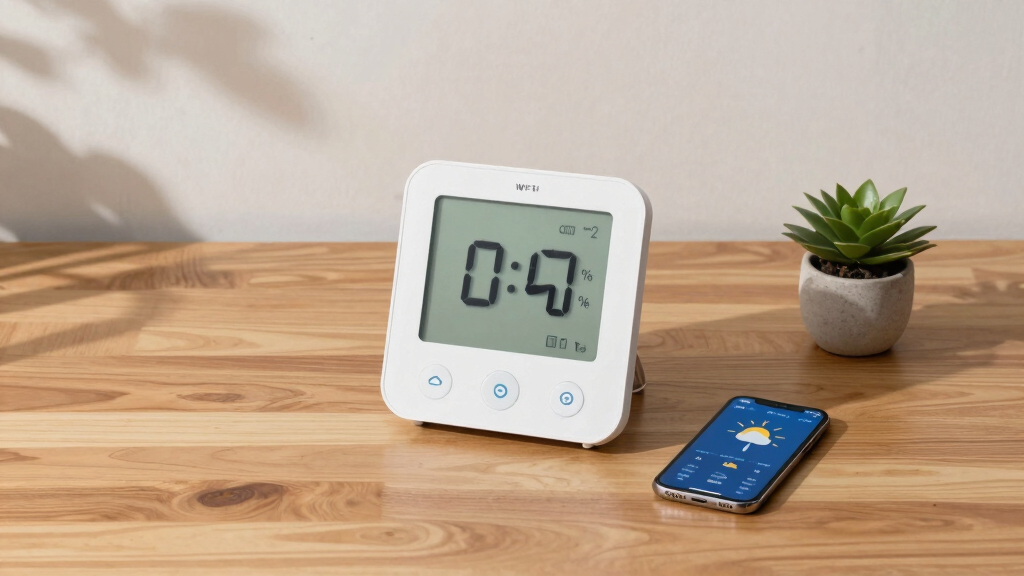

Finding the best home weather station with Wi-Fi means balancing detailed data, ease of use, and connectivity features. The VEVOR YT60234 stands out for its comprehensive 7-in-1 sensor suite, perfect for serious weather enthusiasts. The Ambient Weather WS-2902 offers extensive data access and integration options, ideal for tech-savvy users. Meanwhile, the Newentor Wireless Weather Station provides a user-friendly setup suitable for beginners. All options come with tradeoffs—more advanced models might be pricier and complex, while simpler ones could lack detailed metrics. Continue reading to explore these options and find the best fit for your weather monitoring needs.
Key Takeaways
- Top-tier models like the Ambient Weather WS-2902 excel in data versatility and integration with smart home systems.
- Entry-level options, such as the Newentor, prioritize ease of use over extensive data, making them suitable for beginners.
- Weather stations with additional sensors (wind, rain, UV) tend to be more accurate but also more expensive and complex to install.
- Wi-Fi stability and app compatibility are critical for reliable remote monitoring and data access.
- Choosing between a comprehensive station and a simpler setup depends largely on your technical comfort and specific monitoring needs.


More Details on Our Top Picks
VEVOR YT60234 WiFi Weather Station 7-in-1, Weather Stations WiFi Indoor Outdoor, 7.5″ Color Display for Weather Forecast, Temperature, Humidity, UV, Air Pressure, Wind Speed&Direction, Rain, Alarm
This VEVOR weather station stands out for its extensive 7-in-1 sensor array, providing detailed data on wind, rain, UV, and more, making it ideal for users who want a fully integrated weather picture. Compared to the Newentor, which offers a simpler indoor/outdoor display, the VEVOR’s long-range sensors (150m) and real-time Wi-Fi updates support more flexible outdoor placement, especially on larger properties. Its large 7.5″ display with adjustable brightness enhances usability, while the solar power reduces ongoing costs. However, it requires the adapter to stay plugged in for Wi-Fi, which might limit placement options, and initial setup can be fiddly, especially for the rain gauge. This pick is best suited for serious hobbyists or those managing larger outdoor spaces who value detailed data, but less so for casual users needing quick weather checks.
Pros:- Comprehensive 7-in-1 sensor data including wind, rain, UV, and more
- Long-range sensor transmission up to 150 meters
- Large, customizable 7.5″ HD color display with dimming
Cons:- Requires the power adapter to stay plugged in for Wi-Fi connectivity
- Initial setup and sensor calibration can be challenging
Best for: Homeowners with large gardens or farms seeking detailed, real-time outdoor weather data via Wi-Fi.
Not ideal for: Casual users or apartment dwellers who need quick weather updates without complex setup or extensive sensors.
- Power Source:Solar-powered with AC adapter
- Connectivity:Wi-Fi
- Display Size:7.5 inches
- Wireless Transmission:150 meters
- Sensor Technology:7-in-1
- Weather Data Compatibility:Weather Underground & WeatherCloud
Bottom line: Ideal for dedicated weather enthusiasts who want detailed outdoor data with flexible sensor placement.
Newentor Weather Station Wireless Indoor Outdoor Thermometer, Color Display Digital Weather Thermometer with Atomic Clock, Barometric Pressure, Forecast Station with Adjustable Backlight, Black
This Newentor model excels for users who prefer a straightforward, easy-to-read display with multi-sensor support. Unlike the VEVOR’s extensive outdoor sensors, it offers a clean 7.5″ color LCD with support for up to three remote sensors, making it perfect for monitoring multiple rooms or areas inside and outside. Its atomic clock adds a reliable timekeeping feature, and customizable alerts enhance usability for daily planning. The forecast predictions based on barometric pressure give a decent short-term outlook, though they lack the hyper-local accuracy of specialized weather stations like Tempest. Its simple setup and power options make it accessible for most users, but it lacks detailed wind or rainfall data, limiting its usefulness for serious weather tracking. This station is best for homeowners who want an attractive, functional display for multiple indoor/outdoor zones without complex features.
Pros:- Supports up to 3 remote sensors for multiple zones
- Large, colorful display with adjustable backlight
- Includes atomic clock and alarm functions
Cons:- Limited detailed weather metrics (no wind or rainfall data)
- Forecast accuracy may vary depending on barometric trends
Best for: Homeowners seeking a multi-zone indoor-outdoor thermometer with a clear display and basic weather forecast.
Not ideal for: Weather enthusiasts needing detailed wind, rainfall, or lightning data for serious outdoor monitoring.
- Display Size:7.5 inches
- Sensors Supported:Up to 3
- Power Source:AC adapter or batteries
- Forecast Range:12-24 hours
- Additional Features:Atomic clock, alarms
Bottom line: Perfect for users wanting a multi-zone indoor/outdoor display with basic forecast and clock features.
Tempest Weather Station with Built-in Wind Meter, Rain Gauge, and Accurate Weather Forecasts, Wireless, App and Alexa Enabled
The Tempest Weather Station is favored for its advanced sensors and integration with smart home systems, making it ideal for tech-savvy users who want hyper-local, real-time weather updates. It monitors a wide array of data points, including lightning strikes, UV, dew point, and solar radiation, offering a comprehensive weather profile. Its wireless outdoor sensor transmits reliably over long distances (up to 1,000+ feet), and the app interface provides detailed historical data and forecasts with proprietary machine learning technology—the most accurate forecast here. Compared to the simpler AcuRite models, Tempest’s sophisticated sensors and cloud-based analytics provide a level of detail and precision that appeals to serious hobbyists or professionals. The main tradeoff is its higher cost and slightly more complex setup process, which may deter casual users. It’s best suited for those who want precision and smart home automation integration.
Pros:- Monitors comprehensive weather data including lightning and UV
- Wireless outdoor sensor with 1,000+ feet range
- Integrates with Alexa, IFTTT, and smart home platforms
Cons:- Higher price point compared to basic models
- Requires app setup and some initial configuration
Best for: Tech enthusiasts and smart home users demanding hyper-local weather data with seamless app integration.
Not ideal for: Casual users seeking a simple, plug-and-play weather station without smart home features.
- Wireless Range:Over 1,000 feet
- Data Points Monitored:Temperature, humidity, wind, lightning, UV, dew point
- Connectivity:Wi-Fi, app, Alexa
- Forecast Technology:Proprietary machine learning
- Power Source:Solar and battery
Bottom line: Best for users who want hyper-local, detailed weather insights combined with smart home connectivity.
AcuRite Optimus Weather Station with Wi-Fi HD Display, Built-in Barometer, Lightning Detection, Indoor/Outdoor Temperature and Humidity, Wind Speed/Direction, and Rainfall Measurements (01216MCB)
This AcuRite model offers a highly integrated weather station with a sleek, HD display and built-in lightning detection, making it suitable for users who want an all-in-one, easy-to-maintain system. Unlike Tempest or VEVOR, the Optimus’s built-in sensors cover basic weather data with an attractive compact design, fitting well in smaller outdoor spaces or decks. Its internal aspirating fan boosts temperature and humidity accuracy, a feature that surpasses simpler sensors like Newentor. While it doesn’t match Tempest’s hyper-local precision, it provides over 20 data points and smart home integration, making it a strong candidate for those who want a versatile device without complexity. The main drawbacks are limited sensor range and the absence of extensive rainfall or wind data compared to more advanced stations, which might be a dealbreaker for weather buffs needing extreme detail. This station is best for stylish, all-in-one weather monitoring for smaller spaces.
Pros:- Sleek, high-definition display with built-in sensors
- Includes lightning detection and barometer
- Easy to set up and integrate with smart home devices
Cons:- Limited outdoor sensor range and fewer data points than Tempest
- No support for additional remote sensors
Best for: Homeowners or small businesses seeking a compact, stylish weather station with smart home features.
Not ideal for: Serious weather enthusiasts requiring detailed wind, lightning, or rainfall data for outdoor management.
- Display:HD LCD
- Sensors:Built-in barometer, lightning, temperature, humidity, wind, rain
- Connectivity:Wi-Fi
- Data Points:Over 20
- Power:AC with optional battery backup
Bottom line: Great for style-conscious users wanting an all-in-one weather station with smart features and moderate data depth.
AcuRite Atlas Professional Weather Station with Direct-to-Wi-Fi HD Display, Lightning Detection, Built-In Barometer, and Temperature, Humidity, Wind Speed/Direction and Rainfall Measurements (01001M)
The AcuRite Atlas stands out as a professional-grade weather station, offering a comprehensive set of measurements comparable to Tempest but with a focus on remote monitoring and integration. Unlike the simpler AcuRite Optimus, it supports direct Wi-Fi access with a high-definition display and over 20 data points, including lightning detection, wind, and rainfall, making it suitable for serious hobbyists or small-scale operations. Its ability to connect directly to the web and share data via Weather Underground enhances its appeal for those wanting community sharing or detailed historical records. Although setup is more involved and the price is higher, its precise measurements and smart alerts justify the investment for dedicated weather observers. It’s perfect for those who want professional-level data without the expense of high-end commercial stations but still demand reliable, real-time information.
Pros:- High-definition display with real-time updates
- Supports lightning, wind, rain, temperature, humidity, and barometric pressure
- Connects directly to Wi-Fi and Weather Underground
Cons:- Requires careful installation and setup
- Higher cost compared to basic models
Best for: Weather hobbyists and small-scale professionals seeking detailed, reliable data with remote access and community sharing.
Not ideal for: Casual users who prefer simple displays or minimal setup, or those on a tight budget.
- Display:HD LCD
- Data Points:20+” including lightning, wind, rain
- Connectivity:Wi-Fi, Weather Underground
- Wireless Range:Indoor/outdoor sensors
- Power:AC with backup
Bottom line: Ideal for dedicated weather enthusiasts or small operations needing professional-level data with remote access capabilities.
Sainlogic Smart WiFi Weather Stations Wireless Indoor Outdoor SA6 Plus,24/7 AI Weather Forecast by Weatherseed®,APP Alert,Weather Station with Rain Gauge and Wind Speed,2-Year Data Storage(Only 2.4G)
The Sainlogic SA6 Plus stands out for its user-friendly setup, especially with the 2.4G WiFi connection, which simplifies installation and ensures reliable data transmission. Its AI weather forecasting, powered by Weatherseed®, provides accurate, real-time updates, perfect for home gardeners or outdoor enthusiasts. The large, bold display makes quick weather checks effortless, even for users with declining vision. Compared to the La Crosse V42-PRO-INT, it offers a simpler interface with comparable long-term data storage and alerts. However, its reliance on 2.4G WiFi limits compatibility with some modern routers, and the outdoor sensor placement needs careful manual setup for optimal accuracy. This pick makes the most sense for those who want comprehensive, long-term weather insights without complex features. The weather station supports long-term data export, rain gauge accuracy within ±1mm, wind speed measurement, and easy outdoor sensor mounting.Pros:- Reliable 2.4G WiFi connection with broad coverage
- 2-year data storage with easy export features
- Large, easy-to-read display for quick weather checks
- AI-driven accurate weather forecasts and alerts
Cons:- Limited to 2.4G WiFi, which may cause connectivity issues with some routers
- Outdoor sensor installation requires manual effort for optimal accuracy
Best for: Homeowners and hobbyist weather enthusiasts who prioritize reliable long-term data and straightforward operation.
Not ideal for: Tech-savvy users wanting dual-band WiFi support or those with complex network setups, as it only works on 2.4G WiFi.
- WiFi Connectivity:2.4G only
- Data Storage:2 years
- Rain Gauge Accuracy:±1mm
- Display Type:High-contrast LCD
- Outdoor Sensor:Wireless, rain gauge, wind speed
- Sensors Included:Rain, wind, temperature, humidity
Bottom line: Ideal for users seeking a straightforward, reliable weather station with long-term data and smart alerts.
La Crosse Technology Professional Smart Wi-Fi Weather Station with Remote Monitoring (400 Foot Range), Wind and Rain Gauges, Temperature and Humidity Sensors, and Forecasting – V42-PRO-INT
The La Crosse V42-PRO-INT offers a robust 400-foot wireless range, making it suitable for larger properties or farms. Its vibrant color icons and multiple forecast views provide a clear picture of upcoming weather, ideal for outdoor professionals or serious hobbyists. Compared to the simpler Sainlogic model, this station excels in detailed wind and rainfall data, with customizable alerts and advanced forecast icons. The setup is more complex, requiring patience and possibly multiple power sources, but the detailed, professional-grade data justifies it. Its primary tradeoff is the higher cost and larger size, which may be less suitable for compact spaces. This station makes sense for those needing precise wind, rain, and temperature data across a large area, with extended range capabilities. Features include real-time wind speed/direction, rainfall measurements, detailed weather forecasts, and remote monitoring via app.Pros:- Extended 400 ft wireless range for large properties
- Detailed wind and rainfall data with real-time updates
- Vibrant forecast icons and multiple view options
- Customizable alerts for weather thresholds
Cons:- Higher price point and larger size may be impractical for small spaces
- Setup complexity requires patience and careful installation
Best for: Farmers, landscapers, or outdoor event planners needing extensive range and professional-level weather data.
Not ideal for: Casual users or apartment dwellers seeking a compact, simple weather station, as this is larger and more complex.
- Wireless Range:Up to 400 ft
- Forecast Icons:8 plus seasonal foliage
- Sensors Included:Wind, rain, temperature, humidity
- Display Type:Color LCD
- Data Connectivity:Wi-Fi with app control
- Indoor/Outdoor Temperature Range:-40°F to 140°F
Bottom line: Best suited for professionals or serious hobbyists needing extensive coverage and detailed weather analytics.
WiFi Weather Station Wireless Indoor Outdoor, Thermometer with Rain Gauge and Wind Speed/Direction, Large Display for Weather Forecast, Temperature, Humidity, Clock, Alarm, UV, Air Pressure, Black
The WiFi Weather Station with 7.5-inch HD VA display makes weather monitoring accessible with its large, bright screen and rapid refresh rates. Its rich data sections include wind, rain, UV, and air pressure, all viewable at a glance. The intuitive app control simplifies setup and customization, perfect for users who want detailed historical data and remote access. Compared to the La Crosse V42-PRO-INT, it offers a more modern, large display and adjustable brightness, but it lacks the same extended wireless range and professional-grade sensors. Its main tradeoff is that it only supports 2.4GHz WiFi and requires continuous power, limiting portability. This station suits users who want an all-in-one, easy-to-read display with remote app management, ideal for homes or offices.Pros:- Large 7.5-inch HD display with adjustable brightness
- Wide range of weather data including UV and air pressure
- App control for customization and remote monitoring
- Rapid updates and clear visuals
Cons:- Limited to 2.4GHz WiFi, potentially causing connectivity issues
- Requires constant AC power, reducing portability
Best for: Homeowners or small business owners needing a comprehensive, easy-to-read weather display with remote control options.
Not ideal for: Outdoor professionals requiring long-range or higher precision sensors, as this is designed mainly for indoor and nearby outdoor use.
- Display Size:7.5 inch HD VA
- WiFi Support:2.4GHz
- Sensors:Wind, rain, UV, air pressure
- Power:AC powered
- Temperature Accuracy:±1°C
- Connectivity:Wireless with app
Bottom line: Excellent for users who want a large, easy-to-read display with comprehensive weather info and app control, suitable for indoor or nearby outdoor use.
Ambient Weather WS-1965 WiFi Weather Station w/Remote Monitoring and Ambient Weather Network Access
The Ambient WS-1965 offers a complete weather monitoring solution with real-time data from its all-in-one sensor array, coupled with seamless WiFi connectivity. Its compatibility with Ambient Weather Network allows users to share hyperlocal conditions and create personalized dashboards, which makes it ideal for weather enthusiasts who enjoy community data sharing. The console’s color LCD provides a clear, detailed view of temperature, humidity, wind, and rainfall, with simple setup compatible with smart home systems like Alexa and Google Home. Compared to the more professional La Crosse V42-PRO-INT, it emphasizes social sharing and cloud access over extended range. Its main tradeoff is that it requires internet access and may have subscription or account setup for full features. This station is perfect for hobbyists who value community interaction and remote access.Pros:- Cloud-based data sharing via Ambient Weather Network
- All-in-one sensor array with real-time updates
- Compatibility with smart home devices
- Color LCD display with detailed weather info
Cons:- Dependent on internet connectivity for full features
- Subscription or account setup may be required for sharing
Best for: Weather hobbyists interested in sharing data and creating custom dashboards, or those integrating with smart home systems.
Not ideal for: Users needing long-range outdoor coverage or professional-grade sensors, as this focuses on community sharing and cloud features.
- Sensors:Temperature, humidity, wind, rain
- Display Type:Color LCD
- WiFi Support:WiFi-enabled
- Community Sharing:Ambient Weather Network
- Smart Home Compatibility:Alexa, Google
- Updates:Real-time 16 sec
Bottom line: Best suited for hobbyists who want to share and access hyperlocal weather data remotely via community networks.
AcuRite Iris (5-in-1) Home Weather Station with Wi-Fi Connection to Weather Underground with Temperature, Humidity, Wind Speed/Direction, and Rainfall (01540M), Black
The AcuRite Iris 5-in-1 offers a straightforward setup with Wi-Fi support for Weather Underground, making it an excellent choice for users who want reliable data without complexity. Its built-in sensors provide detailed readings for wind, rain, temperature, and humidity, with a large color LCD that displays current conditions and forecasts. It is praised for its ease of installation, especially for those new to weather stations, and its ability to share data with a broad community via Weather Underground. Compared to the more advanced Ambient Weather WS-1965, it provides less customization but excels in simplicity and affordability. Its main drawbacks include limited range and fewer advanced features, making it less suitable for large properties or professional use. This station is ideal for casual homeowners who want basic, reliable weather info and seamless online sharing.Pros:- Easy setup with Wi-Fi support for Weather Underground
- Large color LCD display with forecast and current conditions
- Built-in sensors for wind, rain, temperature, and humidity
- Affordable and user-friendly
Cons:- Limited wireless range, suitable mainly for home use
- Fewer advanced features than higher-end models
Best for: Homeowners seeking a simple, reliable Wi-Fi weather station with easy Weather Underground integration.
Not ideal for: Outdoor professionals or large property owners needing extended range or detailed sensor arrays, as this focuses on simplicity.
- Sensors:Wind, rain, temperature, humidity
- Display Type:Color LCD
- WiFi Support:Weather Underground
- Connectivity:Wi-Fi
- Setup:Plug and play
- Community Integration:Weather Underground
Bottom line: Perfect for casual users who want a straightforward, online-connected weather station with community sharing.
Ambient Weather WS-2902 WiFi Smart Weather Station
This weather station stands out for its comprehensive sensor array that provides hyper-local data on wind, rain, UV, solar radiation, temperature, and humidity. Compared to simpler models like the Newentor, the WS-2902 offers more detailed readings and integrates seamlessly with smart home systems such as Alexa and Google Home. Its ability to connect to Ambient Weather Network allows for remote access, social sharing, and future forecast customization, which is a step above basic stations. However, the setup process, while straightforward, requires downloading multiple apps and some initial Wi-Fi troubleshooting, which might frustrate first-time users. The LCD display is easy to read, and the included sensor array is durable, but batteries are not included, adding a minor inconvenience. The support from Ambient is highly responsive, making it suitable for tech-savvy homeowners who want detailed, customizable data and community features. This pick makes the most sense for users who value detailed hyper-local weather data, smart home integration, and community sharing.
Pros:- Comprehensive sensor array with detailed measurements
- Seamless Wi-Fi connectivity with remote access and alerts
- Supports smart home integrations like Alexa and Google Home
- Community features for sharing hyper-local data
Cons:- Initial setup can be complex for non-technical users
- Batteries not included, requiring additional purchase
- Requires multiple app downloads and some Wi-Fi troubleshooting
Best for: Tech-savvy homeowners who want detailed hyper-local weather data, smart home integration, and community features
Not ideal for: Casual users seeking a simple, plug-and-play weather station without app or community features
- Power Source:3 AAA batteries (not included)
- Connectivity:Wi-Fi 2.4 GHz
- Measurement Range:Temperature: -14°F to 149°F
- Display Type:LCD color display
- Sensor Technology:Wireless RF sensor array
- Compatibility:Alexa, Google Home, IFTTT
Bottom line: This station is ideal for users who want in-depth weather data and smart home connectivity, accepting a slightly more involved setup process.
How We Picked
I evaluated these weather stations based on a combination of performance, ease of setup, build quality, and connectivity features. Priority was given to models that offer reliable Wi-Fi integration, accurate sensors, and user-friendly apps. Cost was also a factor, with a balanced approach to value versus features. I compared the models’ versatility, sensor types, data storage options, and compatibility with smart home systems. The ranking reflects how well each product balances these factors for different user needs, from casual monitoring to professional-grade weather tracking.Factors to Consider When Choosing Best Home Weather Stations With Wi Fi
When selecting a home weather station with Wi-Fi, consider your specific goals—whether you want basic temperature readings or comprehensive weather data. Look at sensor accuracy, ease of setup, and app integration to ensure a smooth experience. Reliability of Wi-Fi connection is essential to avoid data gaps, especially if remote access is critical. Also, think about expandability; some models support additional sensors or smart home integration, which can be valuable as your needs evolve. Budget constraints will influence your choice, but investing in a slightly more advanced station can provide far better long-term value.Sensor Accuracy and Range
High-quality sensors are the backbone of reliable weather data. Pay attention to how precise temperature, humidity, wind, and rain measurements are, especially if you rely on this data for gardening, outdoor activities, or safety alerts. A wider sensor range can improve accuracy across different environments, such as shaded yards or exposed rooftops. Cheaper models often compromise on sensor quality, leading to inconsistent readings. Investing in a station with proven sensor accuracy ensures your weather data remains trustworthy and actionable.
Wi-Fi Stability and Connectivity
A weather station’s value hinges on stable Wi-Fi connectivity. Frequent disconnections or slow data updates can frustrate users and limit remote monitoring. Ensure the station supports dual-band Wi-Fi (2.4 GHz and 5 GHz) for better stability. Also, check the compatibility with your home network and whether the device supports cloud access or local data storage. Reliable connectivity means you can access weather information anytime without interruptions, making this a key consideration in your purchase.
Ease of Use and Setup
User-friendly setup and intuitive interfaces can significantly reduce frustration, especially for beginners. Look for models with straightforward installation processes and clear app instructions. An easy-to-understand display or companion app helps you interpret data quickly. Some stations offer guided setup or automatic calibration, saving time and reducing errors. Remember that complex setups might offer more features but can be overwhelming if you’re not tech-savvy, so match the complexity to your comfort level.
Data Access and Integration
Consider how you prefer to access your weather data—via smartphone apps, web portals, or smart home integrations. Models with open API support or compatibility with platforms like Alexa, Google Home, or Weather Underground expand your options for automation and detailed analysis. Data logging capabilities are also valuable if you want to analyze historical trends. Be aware that some stations may require subscription services for full features, so evaluate the cost and convenience of these plans before purchasing.
Price and Expandability
Prices for home weather stations vary widely, often reflecting their feature sets and build quality. While basic models are affordable, they may lack sensor density or app features. Higher-end stations tend to offer more sensors, better build quality, and advanced data options, making them suitable for serious weather enthusiasts or professionals. Think about your future needs—if you plan to expand your station with additional sensors or smart home devices, choose a model that supports such upgrades. Balance your budget with the desired level of detail and reliability.
Frequently Asked Questions
Can I use these weather stations without Wi-Fi?
Many Wi-Fi-enabled weather stations have offline modes or local data storage, but their primary advantage is remote access and real-time updates via Wi-Fi. Without a stable internet connection, you can still use the station locally, but you’ll miss out on remote monitoring, cloud features, and app notifications. If Wi-Fi drops frequently or your setup is in an area with poor signal, consider a model with robust local display options or backup data storage to avoid losing critical information.
Are more expensive weather stations worth the extra cost?
Higher-priced models typically offer more sensors, greater accuracy, and better build quality. They often support advanced features like integration with smart home systems, extensive data logging, and weather alert customization. If you need detailed, reliable data for professional or serious hobbyist use, investing in a premium station makes sense. However, for casual monitoring or basic outdoor temperature checks, a budget-friendly model can suffice, and you won’t lose much in usability.
How difficult is it to install and calibrate these stations?
Most modern weather stations aim for straightforward installation, often involving mounting sensors outdoors and connecting the main unit to Wi-Fi. Calibration varies; some models auto-calibrate, while others might require manual adjustments for optimal accuracy. Reading user instructions carefully and choosing a model with guided setup can reduce frustration. Usually, initial calibration takes a few minutes, and regular maintenance involves cleaning sensors and updating firmware to keep readings precise.
Can I integrate these weather stations with my smart home devices?
Many of the top models support integration with popular smart home platforms like Alexa, Google Home, or IFTTT, allowing you to automate alerts or control compatible devices based on weather data. Compatibility varies, so checking the product specifications is crucial. Some stations also support API access or third-party apps, providing more advanced customization options. This integration can enhance your smart home setup by providing real-time weather info for outdoor automation or safety alerts.
What is the best way to ensure the sensors stay accurate over time?
Consistent maintenance and calibration are key to maintaining sensor accuracy. Regularly clean outdoor sensors to prevent dirt or debris from affecting readings. Some models offer auto-calibration features, but manual calibration might be necessary periodically. Keep firmware updated via the app, as manufacturers often release improvements. Position sensors away from heat sources or obstructions to get the most accurate data, and verify readings against local weather reports occasionally to catch any drift in sensor accuracy.
Conclusion
The best overall choice for most users is the Ambient Weather WS-2902, thanks to its comprehensive data and smart home compatibility. For those seeking value without sacrificing core features, the Newentor Wireless Weather Station offers ease of use at an attractive price point. If premium features and detailed data are your priority, the AcuRite Atlas or Tempest Weather Station deliver professional-grade precision. Beginners or casual users will find the simpler models sufficient, while advanced users benefit from stations supporting extensive sensors and integrations. Consider your monitoring goals and budget to find the best fit among these top picks.