
For gamers and streamers seeking seamless 4K120 passthrough, finding the right HDMI 2.1 capture card can be challenging. The best options combine high resolution, low latency, and reliable performance, but tradeoffs often exist between price, features, and ease of use. The AVerMedia Live Gamer Ultra 2.1 stands out as the overall top pick, thanks to its robust 4K60 support and excellent passthrough performance. Meanwhile, the Elgato 4K X offers ultra-low latency at higher resolutions, ideal for professional setups. The Portta DX20R delivers impressive value for its features, though it lacks some advanced connectivity. Continue reading for a detailed breakdown to help you choose the best fit for your streaming or gaming setup.
Key Takeaways
- The top picks balance high resolution passthrough with ultra-low latency, critical for competitive gaming and professional recording.
- Price varies significantly; premium models often add features like internal PCIe cards or advanced HDR support, while budget options focus on core performance.
- Connectivity and ease of setup differ; external USB capture cards are more portable but may have limitations compared to internal PCIe options.
- Not all devices support 4K120 passthrough at the same quality level; some excel at 4K60 with HDR, while others push for 4K120 with VRR and HDR support.
- Build quality and cooling features matter, especially for prolonged use or high-performance settings, reducing overheating and signal degradation.



More Details on Our Top Picks
AVerMedia 4K HDMI Capture Card, USB Game Capture Card for Streaming and Recording with True Low Latency on PS5/Pro, Xbox, Switch 2, PC on Twitch, OBS, for Win11, Mac-GC553Pro Live Gamer Ultra S Black
This capture card stands out for its effortless plug-and-play setup, making it ideal for streamers who want quick, reliable results without technical hassle. Unlike the more advanced AVerMedia Live Gamer ULTRA 2.1, it doesn’t support 4K120 passthrough but still delivers stunning 4K60 HDR/VRR pass-through, ensuring smooth gameplay on PS5 and Xbox Series X/S. Its compatibility across Windows, Mac, and iPadOS broadens its appeal, especially for users who stream from multiple devices. The low latency ensures real-time gameplay and streaming synchronization, although it lacks built-in software, requiring external apps like OBS. This makes it perfect for newcomers and casual streamers who prioritize simplicity but is less suited for high-end professional setups demanding 4K120.
Pros:- Plug-and-play setup with no drivers needed
- Broad device compatibility including iPadOS
- True 4K60 HDR/VRR pass-through for smooth gameplay
- Ultra-wide screen support with RGB color fidelity
Cons:- Does not support 4K120 passthrough
- Limited software features, no onboard recording controls
- Lacks advanced customization options for professional streams
Best for: Beginners, casual streamers, and gamers seeking an easy-to-setup device with broad compatibility.
Not ideal for: Professional content creators needing 4K120 passthrough or integrated streaming software for advanced production.
- Capture Resolution:4K60 HDR/VRR Pass-through
- Compatibility:Windows, Mac, iPadOS
- Latency:Low latency
- Connectivity:USB 3.0
- Supported Devices:PS5, Xbox Series X/S, Switch 2
- Size:Small and portable
Bottom line: This option is ideal for entry-level users who want reliable 4K streaming with minimal setup effort.
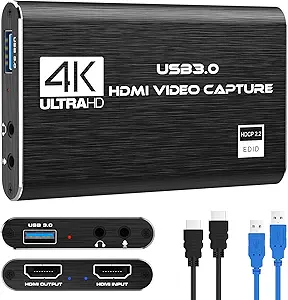
Capture Card Nintendo Switch, 4K HDMI Video Capture Card, 1080P 60FPS, HDMI to USB 3.0 Capture Card for Streaming Work with Camera/Xbox/PS4/PS5/PC/OBS
Compared with higher-end options like the AVerMedia Live Gamer Ultra 2.1, this card is more budget-friendly but limits recording to 1080p at 60FPS, which may be enough for many streamers. It excels in ease of use, with true plug-and-play operation and compatibility across Windows and Mac, making it suitable for casual gamers and streamers who don’t require 4K120. Its HDMI loop-out feature minimizes lag, and the built-in microphone input offers added convenience. However, it doesn’t support 4K120 passthrough, limiting its appeal for those wanting the latest high-refresh-rate gameplay. Its simplicity and affordability make it a strong choice for beginners or users on a budget.
Pros:- Plug-and-play with no drivers required
- HDMI loop-out reduces input lag
- Supports 1080P 60FPS streaming with broad device compatibility
- Includes microphone input for commentary
Cons:- Limited to 1080p capture, not 4K120
- Does not support 4K passthrough or HDR at higher refresh rates
- Output maxes at 2K30Hz, limiting future-proofing
Best for: Entry-level streamers, casual gamers, and those requiring broad compatibility without the need for 4K120 passthrough.
Not ideal for: Professional streamers or high-end gamers who want ultrahigh refresh rates or 4K120 gameplay passthrough.
- Capture Resolution:1080p 60FPS
- Input Support:4K30/60Hz
- Output:up to 2K30Hz
- Connectivity:USB 3.0
- Compatibility:Windows, Mac
- Features:HDMI Loop-out, Mic-in
Bottom line: This card offers excellent value for casual streaming and broad device support without the need for high-end features.
acer USB 3.0 Video Capture Card, HDMI Capture Card for Streaming with 4K Loop-Out & USB A/C | 1080P 60Hz HD | Video Audio Game Capture for PS5/PS4/Switch2/Xbox/Camera/PC/Mac – Black
This capture card makes a compelling choice for content creators who need reliable 4K60 HDR/VRR pass-through while streaming or recording in 1080P at 60Hz. Its rich color technology delivers more lifelike video than MJPEG-based devices like the Elgato HD60 X, producing vivid, detailed streams. It supports direct microphone input, making it a versatile option for streaming with commentary. Unlike the AVerMedia Live Gamer Ultra 2.1, it lacks 4K120 passthrough but compensates with excellent 4K60 performance, making it suitable for most console and PC setups. Its plug-and-play nature and compatibility across macOS and Windows simplify setup for users who want high-quality output without complicated installation. However, it’s less suited for demanding esports or professional production that needs higher refresh rates or built-in streaming controls.
Pros:- Supports 4K60 HDR/VRR pass-through
- Rich color technology for vivid streaming
- Plug-and-play with broad OS compatibility
- Includes mic-in for commentary
Cons:- No 4K120 passthrough
- Limited to 1080P output at 60Hz
- Lacks built-in streaming controls
Best for: Content creators and streamers who prioritize high-quality 4K60 pass-through and easy setup.
Not ideal for: Professional esports or streamers needing 4K120 passthrough or advanced streaming features.
- Capture Resolution:4K60 HDR/VRR
- Output Resolution:1080p60
- Connectivity:USB 3.0
- Supported Devices:PS5, Switch 2, PC, Mac
- Color Technology:YUY2
- Size:Compact
Bottom line: This device is best suited for content creators seeking reliable 4K60 pass-through and simple operation without 4K120 support.
AVerMedia 4K60 Capture Card with HDMI 2.1, Low Latency, 4K144/4K120 Passthrough, Game Capture Device for PS5, PS5 Pro, Xbox, Switch, Streaming on Twitch, OBS on Mac & PC, GC553G2 Live Gamer Ultra 2.1
This capture card is designed for gamers and streamers who demand the highest fidelity and refresh rates, supporting 4K144/120Hz passthrough on PS5, Xbox Series X/S, and Switch 2. Its advanced HDMI 2.1 interface ensures ultra-low latency, critical for fast-paced esports titles. While it offers 4K60 recording, the real standout is its high-refresh-rate passthrough, making it a top choice for competitive players who want smooth gameplay without sacrificing streaming quality. Its compatibility with both Mac and PC, along with customizable RGB lighting, enhances aesthetic appeal for gaming setups. The tradeoff is that it’s more expensive and slightly bulkier than more basic models, making it less ideal for portable or casual use.
Pros:- Supports 4K144/120Hz HDR/VRR passthrough
- Ultra-low latency for fast-paced gaming
- Compatible with Mac & PC
- Customizable RGB lighting for aesthetics
Cons:- Higher price point
- Bulkier design limits portability
- Primarily aimed at high-end gaming setups
Best for: High-level gamers and streamers who need 4K120/144Hz passthrough for competitive titles and streaming.
Not ideal for: Casual gamers or content creators who do not require ultra-high refresh rates or are on a tighter budget.
- Capture Resolution:4K60 HDR/VRR
- Passthrough:4K144/120Hz
- Latency:Ultra-low
- Connectivity:HDMI 2.1 USB-C
- Supported Devices:PS5, Xbox Series X/S, Switch 2
- Size:Medium
Bottom line: This capture card is best suited for gamers who prioritize ultra-high refresh rates and minimal latency for competitive play.
Portta DX20R HDMI Video Capture Card, Stream & Record in 4K 60Hz with Ultra-Low Latency, Passthrough for 1080p@240Hz & 2K@120Hz, USB 3.0 to PC, Support HDR, VRR, Compatible with PS5, Xbox, OBS
This capture card excels in providing ultra-low latency streaming with passthrough support for 4K at 60Hz, and high refresh rates up to 240Hz at 1080p, making it perfect for competitive gamers on PS5, Xbox, and PC. It supports HDR and VRR, ensuring high visual fidelity during fast action gameplay. Its broad compatibility with Windows, macOS, and Linux simplifies setup for various users, and the onboard utility software allows adjustment of video settings for optimized output. While it doesn’t support 4K120 passthrough, its focus on ultra-low latency and high refresh rates at 1080p makes it ideal for esports and fast-paced titles. The main tradeoff is that it doesn’t handle 4K120, limiting future-proofing for cutting-edge games.
Pros:- Ultra-low latency for real-time response
- Supports 1080p@240Hz and 2K@120Hz
- Supports HDR and VRR for high visual quality
- Broad OS compatibility
Cons:- No 4K120 passthrough
- Limited to 4K60 recording
- Focuses on high refresh rates at lower resolutions
Best for: Esports enthusiasts and competitive gamers needing ultra-low latency with high refresh rates.
Not ideal for: Casual streamers or content creators who prioritize higher resolution recording over high refresh rates.
- Capture Resolution:4K60 HDR
- Passthrough:1080p@240Hz, 2K@120Hz
- Latency:Ultra-low
- Connectivity:USB 3.0
- Supported Devices:PS5, Xbox, PC
- Size:Small
Bottom line: This capture card is perfect for gamers who need ultra-low latency and high refresh rates for competitive play.
Guermok 4K HDMI Capture Card with Touch LED, Dual HDMI in/Loop-Out, USB 3.0, 4K@60Hz/ 2K@144Hz Video Capture, Mic/Line in, 4K60 Passthrough, Efficient Cooling, Streaming and Gaming for Switch2/1
This capture card stands out for its straightforward plug-and-play setup and support for 4K@60Hz capture, making it an attractive option for streamers who don’t want to fuss with drivers. Compared to the Elgato HD60 X, it lacks 4K120 passthrough but still offers reliable 4K60 output with minimal latency thanks to its USB 3.0 interface. Its dual HDMI ports enable real-time loop-out to an external monitor, perfect for dual-screen setups. The inclusion of mic and line-in ports adds versatility for commentary and external audio. The all-aluminum casing ensures passive cooling during long sessions, avoiding overheating issues common in fan-cooled devices. The touch-sensitive power button and ambient lighting add a sleek aesthetic. However, the device’s 4K60 passthrough may not satisfy gamers wanting 4K120 or higher refresh rates, and high-end streaming features are limited. This pick makes the most sense for budget-conscious streamers seeking reliable 4K60 passthrough without extra complexity.
Pros:- Supports 4K@60Hz capture and 144Hz high-frame-rate input
- Dual HDMI in/loop-out enables real-time external display output
- No drivers required; plug-and-play with Windows and macOS
- Efficient all-metal casing provides passive cooling for long sessions
Cons:- Limited to 4K60 passthrough, not 4K120 or higher
- Video capture resolution capped at 1080p in some modes
- Basic feature set lacks advanced streaming tools
Best for: Streamers and content creators seeking affordable 4K60 passthrough with dual HDMI support.
Not ideal for: Gamers needing full 4K120 or 4K144 passthrough for high-refresh-rate consoles or PCs.
- Video Capture Resolution:1080p, 4K@60Hz
- Video Input:Dual HDMI
- Video Output:HDMI Loop-Out, 4K@60Hz
- Interface:USB 3.0
- Operating System:Windows, macOS
- Cooling:Passive aluminum casing
Bottom line: Ideal for budget-conscious streamers who prioritize reliable 4K60 passthrough over higher refresh rates.
Elgato 4K Pro Internal Capture Card, Black, HDMI, 8K60 Passthrough/4K60 HDR10, Ultra-Low Latency for PS5 Pro, Xbox Series S, Nintendo Switch 2, for Streaming & Recording, Single & Dual PC Setups
This internal PCIe card excels for users needing professional-grade 4K60 HDR capture alongside 8K60 passthrough, making it suitable for high-end streamers and content creators. Its seamless integration with popular streaming software like OBS and Streamlabs ensures a smooth workflow, akin to the AVerMedia Live Gamer Ultra 2.1, but with the added benefit of ultra-low latency and HDR10 support for superior color fidelity. The PCIe interface offers stable, high-bandwidth data transfer, ideal for long recording sessions without dropping frames. The card’s build quality and low profile design fit neatly into compact PC setups. Nonetheless, its internal installation is less user-friendly than external options, and it’s significantly more expensive than USB alternatives, which could deter casual users. This device makes the most sense for professionals or enthusiasts who demand top-tier image quality and future-proofing.
Pros:- Supports 8K60 passthrough and 4K60 HDR10 capture
- Ultra-low latency for real-time streaming and gaming
- NDAA & TAA compliant, suitable for US government use
- Plug-and-play with Windows 10/11
Cons:- Requires internal PCIe slot installation, less portable
- Higher cost compared to external USB cards
- Limited to Windows; no macOS support
Best for: High-end streamers and professionals needing 8K passthrough and HDR10 support in a PCIe form factor.
Not ideal for: Casual streamers or those with limited PC upgrade options due to internal installation complexity.
- Video Capture Resolution:1080p240, 1440p120
- Passthrough:8K60 HDR10
- Interface:PCIe Gen 3 x4
- Operating System:Windows 10/11
- Latency:Ultra-Low
- Dimensions:4.76 x 6.32 x 0.83 inches
Bottom line: Best suited for high-end users seeking professional 4K HDR capture and future-proof 8K passthrough in a PCIe card.
4K HDMI Capture Card USB 3.0 – 1080P 60FPS Gaming & Streaming Video Capture Card with HDMI Loop-Out, Plug & Play, Low-Latency Recording for PS5/PS4/Xbox/Switch/OBS/PC/Mac
This USB 3.0 capture card offers a versatile solution for gamers and streamers who need reliable 1080p60 recording with occasional 4K passthrough. It’s more affordable than high-end PCIe cards like the AVerMedia Live Gamer Ultra 2.1 or Elgato HD60 X, making it suitable for casual or beginner content creators. Its plug-and-play design ensures quick setup with no drivers needed, compatible with OBS, Streamlabs, and other popular software. While it supports 4K passthrough, it’s limited to 1080p60 for recording, which may not meet the demands of professional streamers. The HDMI loop-out allows for real-time external display without lag. Its compact, lightweight design makes it perfect for on-the-go content creation, but it doesn’t support higher refresh rates or HDR for gaming, which could be a drawback for serious players.
Pros:- Plug-and-play with no drivers needed
- Supports 4K pass-through and 1080p60 recording
- HDMI loop-out for real-time external display
- Compact and portable for on-the-go use
Cons:- Limited to 1080p60 for recording, not 4K120 or higher
- Basic feature set without HDR or high refresh rate support
- Limited to Windows and Mac, no Linux or consoles
Best for: Casual gamers and streamers looking for a portable, easy-to-use capture device for 1080p streaming with occasional 4K passthrough.
Not ideal for: Pro-level streamers or gamers requiring 4K120 or higher refresh rate passthrough for fast-paced games.
- Video Capture Resolution:1080p60
- Passthrough:4K@60Hz
- Interface:USB 3.0
- Operating System:Windows, Mac
- Size:Compact
- Features:HDMI Loop-Out
Bottom line: Perfect for entry-level streamers and gamers needing reliable 1080p capture with portable convenience.
Elgato HD60 X – Stream and Record in 1080p60 HDR10 or 4K30 with Ultra-low Latency on PS5|Pro, PS4|Pro, Xbox Series X/S, Xbox One X|S, Nintendo Switch 2, in OBS and More, Works with PC and Mac
The Elgato HD60 X earns the top spot for its blend of versatility and performance, supporting 4K30 HDR10 passthrough while capturing at 1080p60 HDR. It offers seamless compatibility with a variety of platforms and streaming apps, making it a go-to choice for gamers and streamers who want reliable, high-quality output. Its ultra-low latency ensures real-time gameplay without noticeable lag, comparable to the AVerMedia Live Gamer Ultra 2.1 but with a more user-friendly external design. The device’s plug-and-play setup and robust build quality make it accessible for beginners yet powerful enough for professional use. The main tradeoff is the 4K30 capture resolution—if 4K60 or higher is critical, a device like the AVerMedia Live Gamer Ultra 2.1 might be better. Still, this is an excellent all-rounder for most streaming needs.
Pros:- Supports 4K30 HDR10 passthrough and 1080p60 HDR capture
- Ultra-low latency for seamless gameplay
- Compatible with Windows and Mac, works with OBS and other apps
- No subscriptions or watermarks
Cons:- Limited to 4K30 passthrough, not 4K60 or 8K
- Higher price than basic USB options
- No internal PCIe support, less upgrade flexibility
Best for: Gamers and streamers seeking a balance of 4K HDR passthrough and 1080p60 capture with ultra-low latency.
Not ideal for: Users requiring full 4K60 or higher refresh rate capture and recording capabilities.
- Video Capture Resolution:1080p60, 4K30 HDR
- Passthrough:4K30 HDR10
- Interface:USB 3.0
- Compatibility:Windows, Mac
- Latency:Ultra-Low
- Form Factor:External
Bottom line: Best for gamers and streamers wanting flexible 4K30 HDR passthrough combined with reliable 1080p60 recording and ultra-low latency.
AVerMedia HDMI 2.1 Internal PCIe Capture Card for Streaming and Recording 4K60 with Ultra-Low Latency on PS5, PS4 Pro, Xbox Series X/S, Xbox One X, Switch Games – GC575 Live Gamer 4K 2.1
This internal PCIe card is designed for high-end PC builds, supporting 4K60 HDR and ultra-low latency, making it ideal for gamers who want the best quality and performance. Its PCIe interface offers a stable and high-bandwidth connection, comparable to the AVerMedia Live Gamer Ultra 2.1 but with the added benefit of internal installation for cleaner setups and potentially better heat dissipation. It supports HDR and high refresh rates up to 240Hz, appealing to competitive gamers who want to capture at high frame rates while playing at ultra-high resolutions. The setup is more complex than external cards, making it less suitable for casual users. Its higher cost reflects its professional-grade features, which are best utilized by serious gamers and streamers with compatible PC hardware.
Pros:- Supports 4K60 HDR and 240Hz high refresh rate capture
- Ultra-low latency for real-time gameplay
- NDAA & TAA compliant, suitable for professional use
- Internal PCIe installation for clean setup
Cons:- Requires internal PCIe slot installation, less portable
- More expensive than external options
- Limited to Windows; no Mac support
Best for: Enthusiast gamers and streamers with high-end PCs seeking internal 4K60 HDR capture and ultra-low latency.
Not ideal for: Casual users or those preferring simple plug-and-play external devices.
- Video Capture Resolution:1080p240, 1440p120
- Passthrough:4K60 HDR, 240Hz
- Interface:PCIe Gen 3 x4
- Operating System:Windows 10/11
- Latency:Ultra-Low
- Dimensions:4.76 x 6.32 x 0.83 inches
Bottom line: Best for PC enthusiasts who need internal, high-performance 4K HDR capture with ultra-low latency for competitive gaming and professional streaming.
Elgato 4K X – Capture Up to 4K144 with Ultra-Low Latency on PS5|Pro, Xbox Series X|S, Nintendo Switch 2, OBS and More, HDMI 2.1, VRR, HDR10, USB 3.2 Gen 2, for Streaming & Recording, PC|Mac|iPad
The Elgato 4K X stands out as the most versatile and powerful option among HDMI 2.1 capture cards, offering up to 4K at 144fps and HDMI 2.1 in/out. Compared to the AVerMedia 4K60, it supports higher frame rates and has ultra-low latency with VRR passthrough, making it ideal for competitive gamers and professional streamers. Its compatibility with multiple platforms like PS5, Xbox Series X, Switch 2, and even iPad, provides unmatched flexibility. However, this power comes with a tradeoff: it’s slightly bulkier and more expensive than simpler models like the capture cards with lower resolutions. Its setup is straightforward, but the high performance requires a modern system and good bandwidth. This pick makes the most sense for dedicated content creators who demand top-tier quality and features without compromise.
Pros:- Supports up to 4K144fps, ideal for high-refresh-rate gaming
- HDMI 2.1 in/out with VRR passthrough, reducing tearing and latency
- Ultra-low latency with USB 3.2 Gen 2, ensuring responsive streaming
Cons:- Higher cost compared to basic 4K or 1080p capture cards
- Slightly larger and less portable than simpler models
Best for: High-end streamers and content creators aiming for maximum quality, especially those who stream or record at 4K144fps across multiple platforms.
Not ideal for: Casual gamers or streamers on a tight budget who only need 1080p60 or less demanding setups, as the premium price might not justify the benefits for them.
- Maximum Recording Resolution:4K at 144fps
- Input/Output:HDMI 2.1
- Passthrough Support:4K120, VRR, HDR10
- Connectivity:USB 3.2 Gen 2
- Dimensions:112 x 72 x 18 mm
- Weight:91 g
- System Requirements:Windows 10, macOS 11, iPadOS 17+
- Compatibility:PS5, Xbox Series X|S, Switch 2, PC, Mac, iPad
Bottom line: This is the best choice for serious streamers and gamers who need the highest resolution, frame rates, and low latency with broad device compatibility.

How We Picked
These products were evaluated based on their ability to deliver true 4K120 passthrough with minimal latency, ensuring smooth gameplay and high-quality recording. Performance benchmarks focused on latency, resolution support, and compatibility across gaming consoles and PCs. Build quality and ease of setup were also key, with an emphasis on durability and user-friendly features. Cost-effectiveness played a role, but priority was given to devices that offer reliable, consistent performance for demanding streaming and recording environments. The rankings reflect a balance of these factors, highlighting options suitable for various user needs and budgets.Factors to Consider When Choosing Best Hdmi 2.1 Capture Cards With 4k120 Passthrough
Choosing the best HDMI 2.1 capture card with 4K120 passthrough involves considering several technical and practical factors. Not all devices are created equal, and understanding your specific needs can prevent overspending on features you won’t use or buying a device that doesn’t meet your performance standards. The following sections break down key considerations to help you make an informed decision.Performance and Resolution Support
Prioritize devices that genuinely support 4K120 passthrough with low latency, especially if you plan to stream or record high-frame-rate gameplay. Some capture cards advertise 4K120 but may default to 4K60 or have higher latency, which can impact gameplay and viewer experience. Ensure the device supports HDR and VRR if those features matter to your setup, as they enhance visual quality and synchronization during gameplay. Compatibility with your console or PC is just as important, so check for supported operating systems and connection types before purchasing.
Connectivity and Compatibility
External USB 3.0 or 3.2 capture cards offer portability and ease of setup but may have bandwidth limitations, especially for 4K120. Internal PCIe cards typically provide more stable connections and higher bandwidth, suitable for professional setups. Confirm that the device supports the input/output ports on your gaming console, PC, or camera. Also, consider whether the capture card supports loop-out or passthrough features, which allow you to play on your monitor while recording or streaming simultaneously without lag.
Latency and Streaming Quality
Latency is critical for live gameplay, especially in competitive environments. Devices with ultra-low latency will ensure your gameplay remains smooth and responsive. Check for features like passthrough at the same resolution and frame rate, as some devices reduce output quality to lower latency. Additionally, consider if the capture card supports HDR, VRR, and other enhancements that improve the visual fidelity of your streams and recordings, especially at 4K resolutions.
Build Quality and Ease of Use
Durability and cooling features are often overlooked but are vital for long-term reliability. Devices with robust construction and effective cooling prevent overheating during extended sessions. Ease of setup varies; external devices with plug-and-play USB connections are more straightforward for beginners, whereas internal PCIe cards might require more technical knowledge but offer better performance. User interface and software compatibility should also factor into your decision, ensuring smooth operation with your preferred streaming software like OBS or Streamlabs.
Price and Value
While premium devices deliver advanced features like 8K passthrough and internal PCIe options, they come at a higher cost. Budget-friendly options can handle 4K120 passthrough adequately but may lack some advanced features or have higher latency. Consider your primary use—gaming, professional streaming, or content creation—and choose a device that offers the best value for your specific needs. Sometimes, investing slightly more can significantly improve your overall experience, especially for demanding setups or professional use.
Frequently Asked Questions
Do I need an internal PCIe capture card for 4K120 passthrough?
An internal PCIe capture card generally offers higher bandwidth, lower latency, and more stable connections, making it ideal for professional or high-performance setups. PCIe cards tend to support higher resolutions and faster refresh rates more reliably than external USB options, especially at 4K120. However, they require installation inside your PC, which might not suit everyone. For most casual and even semi-professional streamers, a well-rated external USB 3.0 or 3.2 device can suffice, provided it explicitly supports 4K120 with low latency.Can I record 4K120 gameplay with these capture cards?
Most of the capture cards listed support passthrough at 4K120, but recording at that resolution and frame rate can be more demanding on your hardware. Many devices excel at 4K60 recording but may not handle 4K120 recording directly due to bandwidth or hardware limitations. If recording at 4K120 is essential, look for models explicitly stating this feature and ensure your PC has a powerful GPU and storage solution to handle large file sizes. Otherwise, capturing at 4K60 is a reliable alternative.Are there any compatibility issues with gaming consoles?
Most HDMI 2.1 capture cards are designed to work with current generation consoles like PS5, Xbox Series X/S, and Switch, supporting high-resolution passthrough. However, compatibility can vary based on the device’s firmware and the specific HDMI standards supported. Always verify that the capture card explicitly lists compatibility with your console model and firmware version. Firmware updates can also resolve initial compatibility issues, so check the manufacturer’s support page if problems arise.Is HDR support necessary on a capture card?
HDR support enhances the visual quality of your streams and recordings by capturing vibrant colors and better contrast. If your content involves HDR gameplay or streaming HDR video, a capture card with HDR support is beneficial. Keep in mind that capturing HDR requires compatible hardware and software, and not all streaming platforms support HDR at the moment. If HDR is a priority for your content, ensure the device supports HDR passthrough and recording without compromising performance.How important is low latency for streaming?
Low latency is essential if you are involved in live gameplay, competitive streaming, or interactive content creation. It ensures that your actions are reflected immediately on your stream without noticeable delay, keeping viewers engaged and reducing input lag. Devices advertised as ultra-low latency or with passthrough at the same resolution and frame rate are typically better suited for live streaming. For casual content, slightly higher latency might be acceptable, but for competitive gaming, minimizing delay is critical.Conclusion
For users seeking the best overall experience, the AVerMedia Live Gamer Ultra 2.1 offers a balanced mix of high-quality passthrough, low latency, and broad compatibility. Budget-conscious streamers can opt for the Portta DX20R, which provides solid 4K60 support at a more accessible price point. Professionals or those requiring internal PCIe solutions should consider the Elgato 4K X or AVerMedia GC575, both capable of handling demanding workflows with minimal lag. Beginners should prioritize simple, plug-and-play external options, while advanced users will benefit from internal cards with features like HDR support and higher resolutions. Matching your specific needs with these options will ensure a smoother streaming or gaming experience in 2026.