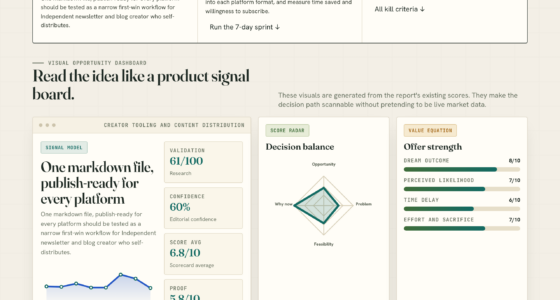

📊 Full opportunity report: What I Gained From Building An AI-Native Finance Department on ThorstenMeyerAI.com — validation score, market gap, and execution plan.

Get the latest gadgets delivered free — and shop member deals
- Fast, free delivery on millions of items
- Access to Prime Big Deal Days deals on October 6–7
- Prime Video, Amazon Music and more included
TL;DR
OpenAI released a report on lessons from developing an AI-native finance function. The details are limited, but it signals interest in integrating AI deeply into finance operations. Confirmed results or benefits are not yet available.
OpenAI has published an article titled “What building an AI-native finance function taught me,” offering insights into the experience of creating a finance department centered around artificial intelligence. The publication is a firsthand account, but details about the specific organization, systems used, or measurable outcomes remain undisclosed. This development highlights ongoing interest in embedding AI more deeply into core financial operations, as detailed in the original analysis.
The article does not specify whether the AI-native finance function was implemented within OpenAI itself or another organization, nor does it provide concrete figures on cost savings, efficiency gains, or accuracy improvements. It appears to be a lessons-based report rather than a formal case study, with the focus on sharing insights rather than verified data.
Key points include the potential for AI to reshape workflows, automate routine tasks, and support decision-making processes in finance. For more on AI’s role in finance, see this detailed report. However, the report emphasizes that detailed implementation specifics, including models used, governance, and control measures, are not publicly available. As a result, the actual impact, such as error reduction or efficiency gains, cannot be confirmed at this stage.
Implications of AI-Driven Finance Transformation
This publication signals a growing interest among technology leaders in integrating AI deeply into financial functions, which could reshape operational models across industries. While concrete benefits are not yet proven or quantified, the emphasis on lessons learned provides a framework for other organizations considering similar approaches. The development underscores the importance of establishing clear controls, accountability, and auditability when deploying AI in sensitive financial contexts.
As an affiliate, we earn on qualifying purchases.
Lack of Detailed Evidence and Definitions
The available information does not clarify what constitutes an AI-native finance department, nor does it specify the scope of AI integration—whether it involves automation of routine tasks, decision support, or end-to-end workflow redesign. Prior to this, many finance teams have used software tools for automation; this initiative appears to go beyond that, aiming for a fundamental reorganization around AI.
Furthermore, no independent validation or benchmarking has been provided, and the specific systems, models, or data governance frameworks involved remain undisclosed. The report’s insights are therefore preliminary and should be interpreted as a perspective rather than a proven case study.
Unverified Claims and Missing Implementation Details
It remains unclear which organization built the AI-native finance department, what specific AI tools or models were used, and whether the project involved live operational data. There are no published benchmarks, performance metrics, or independent reviews to confirm claimed benefits. The scope, scale, and governance of the initiative are also undisclosed, making it difficult to assess its replicability or safety in regulated environments.
Need for Detailed Reports and Independent Validation
The next step is the publication of comprehensive details, including methodology, specific workflows, control measures, and performance metrics. Independent review or case studies from organizations adopting similar models will be necessary to validate claims and assess real-world impact. Stakeholders should monitor for further disclosures from OpenAI or other industry leaders exploring AI-native finance.
Key Questions
What exactly is an AI-native finance department?
Currently, there is no formal definition. It likely refers to a finance operation designed around AI-driven workflows, automation, and decision support, but details vary and are not yet standardized.
Did OpenAI report measurable benefits from this approach?
No, the available information does not include verified metrics or performance data. The report is focused on lessons learned rather than documented results.
Will other companies adopt AI-native finance models?
Potentially, but adoption will depend on the availability of detailed implementation frameworks, proven benefits, and regulatory compliance. Further evidence and case studies are needed.
Are there risks associated with AI in finance?
Yes, risks include errors in AI outputs, data leakage, lack of transparency, and compliance issues. Proper controls and audit mechanisms are essential when deploying AI in sensitive financial roles.
Source: ThorstenMeyerAI.com
Halloween Picks
halloween
As an affiliate, we earn on qualifying purchases.