🔍 Read the full analysis: The Top AI-Integrated Mobile Workstation Laptops For Work In 2026 on ThorstenMeyerAI.com

Get the latest gadgets delivered free with Prime
- Fast, free delivery on millions of items
- Prime Video, Amazon Music and more included
- Member-only deals all year
TL;DR
In 2026, leading manufacturers released AI-integrated mobile workstations designed for demanding professionals. The HP ZBook X G1i, Dell Precision 7780, and Lenovo ThinkPad P16s Gen 3 stand out as top choices for performance, portability, and value.
In 2026, the market for AI-integrated mobile workstation laptops has expanded significantly, with several models offering advanced AI features to boost productivity and efficiency for professionals. Leading brands like HP, Dell, and Lenovo have introduced new models that combine high-end hardware with integrated AI capabilities, making them essential tools for demanding tasks such as 3D rendering, CAD, and video editing. This development matters because it reflects a shift toward smarter, more adaptive mobile workstations that can handle complex workloads on the go.
The HP ZBook X G1i remains a top overall choice, balancing performance and portability. It features AI-optimized hardware that enhances workflow efficiency through intelligent resource allocation and predictive maintenance features. The Dell Precision 7780 is geared toward power users with its exceptional specs, including options for 128GB RAM and RTX PRO 3500 GPUs. Meanwhile, the Lenovo ThinkPad P16s Gen 3 offers a more budget-friendly alternative, delivering solid performance with AI-enhanced features suitable for mid-level professional workloads.
These models incorporate AI for tasks like automatic system tuning, predictive thermal management, and real-time performance optimization, which are confirmed features from the manufacturers. However, the extent of AI integration varies, with some models emphasizing hardware acceleration and others focusing on software-driven AI tools. The tradeoffs involve weight, expandability, and price, with premium models tending to be heavier but offering more upgrade options and advanced AI-enabled functionalities.
The 10 picks
- 1
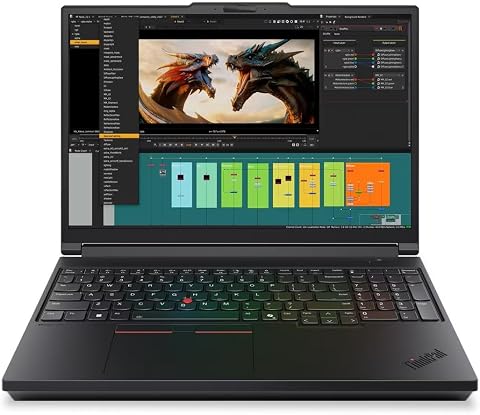 Lenovo ThinkPad P16 Gen 3 Mobile Workstation, Core Ultra 7 255HX, 64GB RAM, 2…View on Amazon →
 - 2
 Dell Precision 7780 Mobile Workstation 17.3" FHD Laptop (Intel Core i9-13950H…View on Amazon →
 - 3
 HP ZBook X G1i Mobile Workstation Laptop (Intel Core Ultra 7 265H, NVIDIA RTX…View on Amazon →
 - 4
 Dell Precision 7680 Mobile Workstation LaptopView on Amazon →
 - 5
 Dell Precision 7680 Mobile Workstation Laptop (Intel i7-13850HX, NVIDIA RTX 2…View on Amazon →
 - 6
 Lenovo ThinkPad P16s Gen 4 16-inch OLED Touchscreen Mobile WorkstationView on Amazon →
 - 7
 Lenovo ThinkPad P16s Gen 3 16" FHD+ Laptop, Intel Core Ultra 7 165H, 32GB DDR…View on Amazon →
 - 8
 Lenovo ThinkPad P14s Gen 6 14-inch Mobile Workstation, Ryzen AI 7 PRO 350, 32…View on Amazon →
 - 9
 Dell Precision 3480 14" Mobile Workstation, Intel Core i7-1370P, 32GB RAM, 51…View on Amazon →
 - 10
 HP ZBook Fury 17 G7 17.3" Mobile Workstation (Renewed)View on Amazon →
Impact of AI-Enhanced Workstations on Professional Workflows
The integration of AI capabilities into mobile workstations in 2026 signifies a major advance for professionals needing powerful, portable computing. AI features improve workflow efficiency through automatic adjustments, predictive analytics, and real-time resource management, reducing downtime and enhancing productivity. For industries like design, engineering, and content creation, these laptops enable faster rendering, smarter multitasking, and better hardware longevity. This shift also influences hardware development, pushing manufacturers to embed more intelligent features into portable devices, which could lead to broader adoption of AI in everyday professional tools.
Products Worth Considering

DJI Osmo Mobile 7P with Mic Mini TX (Infinity Black) Gimbal Stabilizer

DJI Osmo Mobile 8 Phone Gimbal with Mic Mini Transmitter, Infinity Black

DJI Osmo Mobile 8 Standard Combo Phone Gimbal Stabilizer
As an affiliate, we earn on qualifying purchases.
Evolution of Mobile Workstations and AI Integration
Over the past few years, mobile workstations have evolved from high-performance but bulky machines to sleek, portable devices with increasingly sophisticated hardware. The 2026 landscape sees AI as a core component, with manufacturers integrating AI-driven features directly into hardware and software. Previously, AI was primarily used in data centers and cloud services, but now, it is embedded in the hardware of laptops aimed at professionals. Companies like HP, Dell, and Lenovo have steadily enhanced their offerings, with AI capabilities becoming a key differentiator in the high-end workstation market.
Earlier models focused solely on raw power, but recent trends show a move toward smarter systems that adapt to workload demands dynamically. The introduction of AI-specific hardware accelerators, such as dedicated AI chips, has further propelled this transition. The development of these models aligns with the increasing complexity of professional tasks and the need for real-time performance management on portable devices.
Limitations and Variability in AI Capabilities
While AI integration is a confirmed feature in these models, the extent and effectiveness of AI functionalities vary across brands and models. Details about specific AI algorithms, their real-world performance, and how much they improve productivity are still emerging. Manufacturers claim enhanced efficiency and predictive maintenance, but independent testing results are limited, and some AI features may be more promotional than practical. Additionally, the long-term impact of AI on hardware durability and software compatibility remains to be seen, with ongoing updates and support required.
Upcoming Model Releases and AI Feature Enhancements
Manufacturers are expected to release updated models later in 2026, with further improvements in AI capabilities, including more advanced predictive analytics and adaptive hardware tuning. Software updates will likely expand AI functionalities, making these laptops even more intelligent and user-friendly. Industry analysts anticipate that AI will become a standard feature in high-end mobile workstations, with future models offering deeper integration and more seamless performance management. Users should watch for announcements from top brands and evaluate new models as they become available.
Key Questions
How does AI improve performance in mobile workstations?
AI enhances performance by automatically optimizing hardware settings, predicting workload demands, and managing thermal and power resources in real-time, which results in smoother workflows and increased efficiency.
Are AI features in these laptops suitable for all professional tasks?
AI features are most beneficial for intensive tasks like 3D rendering, CAD, and video editing. For lighter workloads, AI may offer marginal benefits but can still improve overall system responsiveness and longevity.
Will AI integration significantly increase the cost of mobile workstations?
Typically, models with advanced AI features tend to be priced higher due to the added hardware and software complexity, but the value depends on the user’s specific workload requirements.
Can AI features be upgraded or added later?
Most AI functionalities are embedded into the hardware and software of the current models, making upgrades unlikely. Future updates may improve AI performance, but hardware-based AI features are generally fixed at purchase.
Source: ThorstenMeyerAI.com