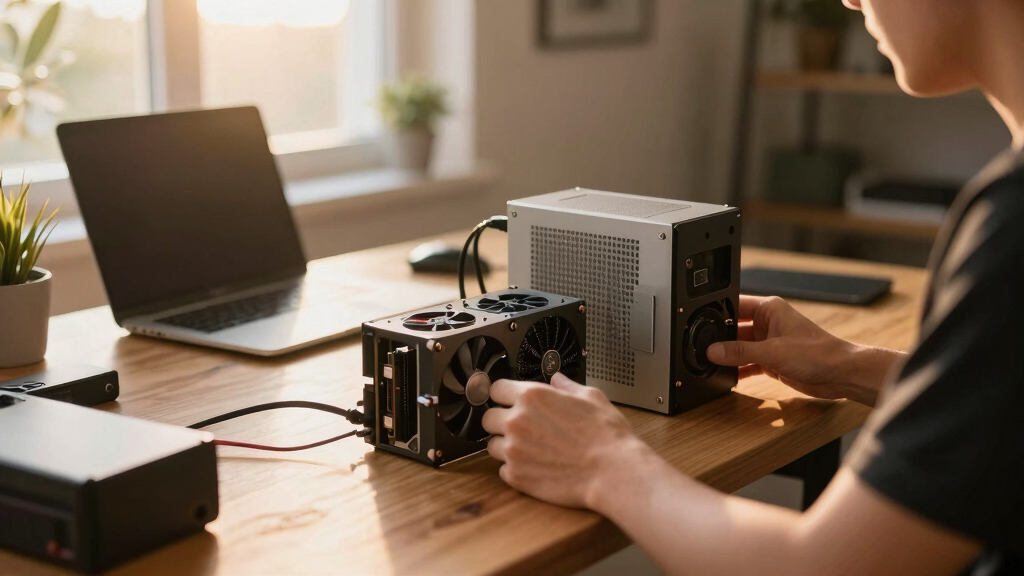

📊 Full opportunity report: The Real Cost Of A Local-Inference Rig In 2026 on ThorstenMeyerAI.com — validation score, market gap, and execution plan.

Get the latest gadgets delivered free with Prime
- Fast, free delivery on millions of items
- Prime Video, Amazon Music and more included
- Member-only deals all year
TL;DR
In 2026, building a local inference rig involves significant hardware costs, dominated by VRAM limitations. The most cost-effective options depend on model size and VRAM-per-dollar value, not raw performance. Buyers should focus on capacity and budget, not just latest hardware.
In 2026, the cost of building a local inference rig for AI models has become more predictable, yet still complex, driven primarily by VRAM limitations and hardware prices. The most affordable and effective solutions depend on the size of the models you intend to run and the capacity of your GPU, not just raw compute power. This shift underscores a focus on VRAM-per-dollar as the key metric for inference hardware investments.
Recent analyses reveal that the most expensive consumer GPUs, like the RTX 5090, do not always offer the best value for inference tasks. Instead, used older-generation cards such as the RTX 3090, with 24GB of VRAM, provide a better VRAM-per-dollar ratio—often five times more cost-effective—despite being a generation behind. This is because inference is primarily bandwidth-bound, making VRAM capacity more critical than raw GPU speed.
The VRAM cliff is a decisive factor: models fitting entirely within VRAM run at high speeds (>40 tokens/sec), while spilling into system RAM drops performance drastically (<2 tokens/sec). For models above 70 billion parameters, multiple GPUs or large unified memory systems are necessary, significantly increasing costs. For example, a multi-RTX 3090 setup can pool nearly 100GB VRAM for under $3,200, enabling the operation of larger models at a fraction of the cost of flagship single cards.
Model size and quantization also influence costs: a 7–8B model requires around 6–8GB of RAM, easily handled by most modern GPUs, whereas 70B models need over 40GB VRAM. The choice of hardware tiers aligns with the intended model class, from entry-level (7–14B) to frontier (100B+), with the latter demanding multi-GPU or large unified memory systems. The article emphasizes that the value metric is not the newest hardware but VRAM capacity per dollar spent.
The real cost of a local-inference rig
Owning beats renting for steady AI work — so what does a local rig cost in 2026? The unintuitive, good news: the most expensive build is almost never the smartest one. It all comes down to one rule.
The difference is only whether the weights fit. LLM inference is memory-bandwidth-bound — VRAM capacity is the hard limit you build around. Compute specs are mostly noise.
The squeeze reframes the rig like everything else in this series: discipline beats maximalism. VRAM is exactly the memory under most pressure, so over-buying it is the 128GB-“to-be-safe” trap, only worse per gigabyte. Take the cheap, high-value step to 24GB (the gateway to the 30B class), reach for used 3090s and MoE models, and use quantization to climb a tier without buying silicon. Sized right, the rig pays for itself against the cloud’s ever-rising hidden bill. Next: Apple Silicon’s quiet memory advantage.
Why VRAM Capacity and Cost-Effectiveness Matter in 2026
Understanding the true costs of local inference rigs in 2026 is crucial for AI practitioners and organizations aiming to control expenses while maintaining performance. As cloud costs rise and model sizes grow, investing in hardware with optimal VRAM-per-dollar can dramatically reduce long-term operational costs. This approach shifts the focus from chasing the latest GPU models to strategic hardware choices that maximize capacity and value, enabling more scalable and private AI deployment.
As an affiliate, we earn on qualifying purchases.
Hardware Trends and Model Size Growth in 2026
Over the past few years, AI model sizes have expanded rapidly, with models like 70B and 100B+ parameters becoming more common. Simultaneously, GPU hardware has evolved, but the key bottleneck remains VRAM capacity due to the memory-bandwidth-bound nature of inference. In 2026, the market sees a shift toward used and multi-GPU setups, as these provide better value than the latest flagship cards. The series of analyses from Thorsten Meyer and community benchmarks highlight that VRAM capacity, rather than raw compute power, determines practical inference performance and cost efficiency.
Previously, the focus was on GPU speed and CUDA cores, but current data shows that for inference, bandwidth and VRAM are paramount. This understanding influences purchasing decisions, favoring older, larger VRAM cards or multi-GPU configurations over newer, faster cards with less VRAM. The availability of large unified memory systems, like Apple Silicon Macs, also offers alternative pathways for large models, further diversifying options in 2026.
“For inference, the key is VRAM capacity and the VRAM-per-dollar ratio, not just the newest GPU models.”
— Thorsten Meyer
Remaining Questions About Hardware Scalability and Future Prices
It is still unclear how rapidly hardware prices will change in 2026, especially for used GPUs. The longevity of older cards like the RTX 3090 and their availability on the secondhand market remains uncertain. Additionally, the impact of emerging unified memory architectures and new GPU releases on VRAM costs and performance is still developing, making precise future planning challenging.
Next Steps for Building Cost-Effective Local Inference Setups
Practitioners should monitor GPU resale markets and benchmark current hardware for VRAM-per-dollar efficiency. As new hardware launches, assessing whether they offer meaningful improvements in VRAM capacity relative to cost will be vital. Additionally, exploring multi-GPU configurations and unified memory options, including Apple Silicon Macs, will be key strategies for scaling inference without prohibitive expenses. Continued community benchmarking and analysis will inform optimal hardware choices for 2026 and beyond.
Key Questions
What is the most cost-effective GPU for local inference in 2026?
Used RTX 3090 cards, with 24GB VRAM, currently offer the best VRAM-per-dollar ratio for inference tasks, making them the most cost-effective option for many users.
How does VRAM capacity impact inference performance?
If the model fits entirely within VRAM, inference runs at high speed (>40 tokens/sec). Spilling into system RAM causes drastic performance drops, making VRAM capacity the critical factor.
Are newer GPUs always the best choice for inference?
Not necessarily. The latest GPUs often have less VRAM per dollar and may lack features like NVLink, which are important for large models. Older, larger VRAM cards or multi-GPU setups often provide better value.
Can Apple Silicon Macs handle large models effectively?
Yes, thanks to unified memory, Macs with large RAM (e.g., 64GB) can run models that would otherwise require multiple GPUs, offering a different, cost-effective pathway for large-scale inference.
What future developments could change inference hardware costs?
Emerging GPU architectures, changes in secondhand market prices, and advances in unified memory systems could all influence the cost landscape, but current trends favor capacity and value over raw speed.
Source: ThorstenMeyerAI.com
Halloween Picks
halloween
As an affiliate, we earn on qualifying purchases.