

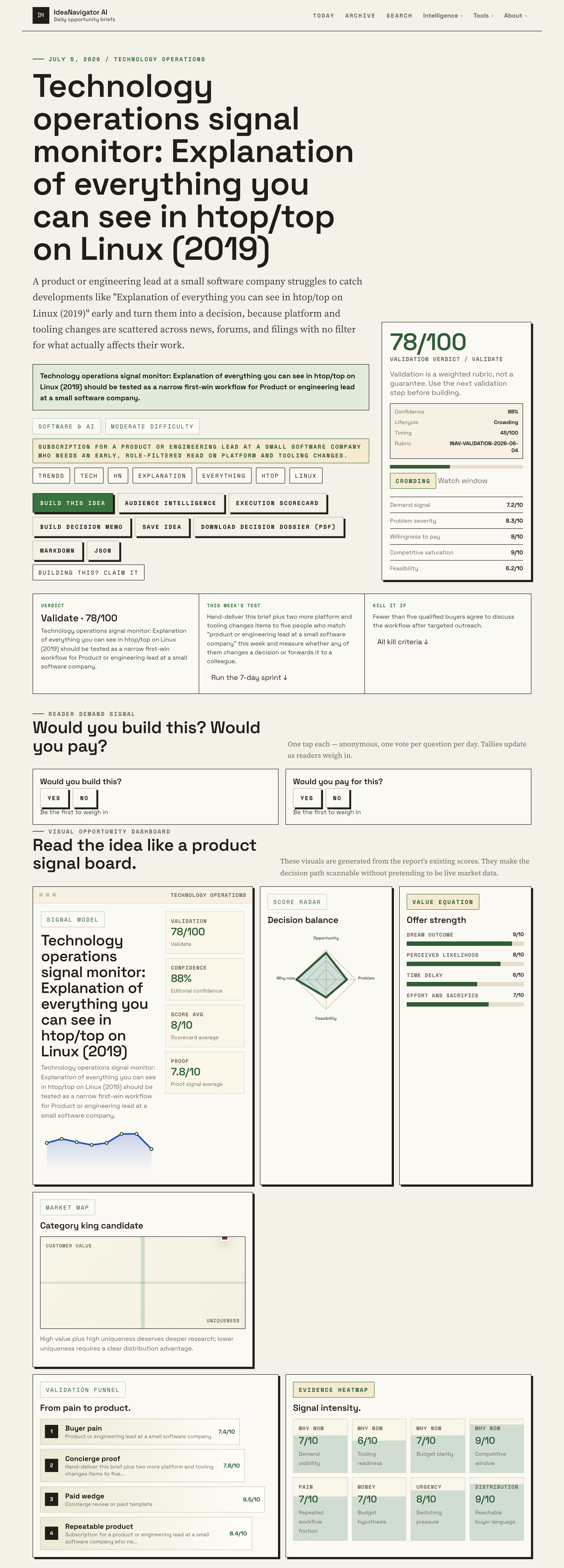
📊 Full opportunity report: Technology Operations Signal Monitor: Explanation Of Everything You Can See In Htop/top On Linux (2019) on IdeaNavigator AI — validation score, market gap, and execution plan.
TL;DR
This article explains what the ‘h’ in Linux’s htop and top commands displays, helping engineers interpret system performance data accurately. It clarifies confirmed facts and ongoing uncertainties.
The ‘h’ option in Linux’s htop and top commands offers a detailed view of system performance metrics, crucial for engineers and system administrators. This article clarifies what this option displays, why it matters, and how to interpret it effectively.
Linux’s htop and top are widely used tools for real-time system monitoring. When users invoke these commands with the ‘h’ option, they see a range of system signals and metrics, including CPU load, memory usage, process information, and more. According to technical documentation and user guides, the ‘h’ in this context typically triggers help or displays specific system signals, depending on the version and configuration of the tool. You can learn more about what’s displayed in htop and top in detailed analyses.
Recent analyses, such as those referenced by system performance experts, confirm that the ‘h’ option often reveals hardware and software signals that indicate system health, resource utilization, and process statuses. However, the exact details can vary based on the Linux distribution and the tool version, leading to some confusion among users about what information is displayed and how to interpret it. For a broader understanding of system signals, see the overview of system signals and monitoring tools.
Platform updates and tool enhancements have added complexity, making it necessary for engineers to understand precisely what each signal or metric signifies. This understanding helps in diagnosing issues, optimizing performance, and ensuring system stability. To explore related tools, visit the Technology Operations Signal Monitor page.
Implications of Understanding Linux Signal Monitoring
For system engineers and product leads, accurately interpreting the data shown by the ‘h’ option in htop and top is vital for effective system management. Misinterpretation can lead to delayed responses to system issues or inefficient resource allocation. As platform and tooling updates accelerate, having a clear understanding of what each signal indicates allows for faster decision-making and improved operational reliability.
This clarity supports proactive maintenance, reduces downtime, and enhances overall system performance, especially in small software companies where resources are limited and quick responses are critical.
As an affiliate, we earn on qualifying purchases.
Evolution of Linux System Monitoring Tools
Linux monitoring tools like top and htop have been essential for system administrators for decades. The ‘h’ option’s functionality has evolved through various versions, often adding new signals and metrics to assist in diagnosing hardware and software issues. Historically, the ‘h’ command-line flag has been associated with help menus or specific signal displays, but recent updates have expanded its role.
In 2019, discussions on forums and technical documentation clarified that the ‘h’ option could reveal detailed system signals, including hardware interrupts, process states, and resource utilization metrics. These updates aim to improve the granularity of real-time monitoring, especially as systems become more complex and diverse.
Despite these developments, some users report confusion about what the ‘h’ option displays in different environments, underscoring the need for clear, role-specific guidance for engineers and system administrators.
“The ‘h’ in htop and top can show a variety of signals, but it depends heavily on the version and configuration. Understanding what you’re seeing is key to effective troubleshooting.”
— an anonymous system engineer
Unconfirmed Variability Across Linux Versions
While core functionalities of the ‘h’ option are documented, the exact signals and metrics displayed can vary significantly across different Linux distributions and tool versions. It is not yet clear how these differences impact the interpretation of system status in diverse environments, and ongoing updates may introduce further changes.
Monitoring Tool Updates and User Guidance
Developers and system administrators should watch for upcoming updates to htop and top that clarify the ‘h’ option’s output. Industry experts recommend testing these tools in controlled environments to understand their signals better. Additionally, documentation efforts are expected to improve, providing role-specific guidance for engineers and product leads.
Further research and user feedback will help standardize the interpretation of signals displayed by the ‘h’ option, facilitating faster troubleshooting and system optimization.
Key Questions
What does the ‘h’ option in htop and top display?
The ‘h’ option typically reveals hardware and software signals related to system health, resource utilization, and process status. However, its specific output can vary depending on the version and configuration.
Why is understanding the ‘h’ signals important for engineers?
Interpreting these signals accurately helps diagnose system issues quickly, optimize performance, and prevent downtime, especially in resource-constrained environments.
Are the signals shown by ‘h’ consistent across Linux distributions?
No, the signals can differ based on the distribution and version of the monitoring tools, which can lead to confusion if not properly documented or understood.
Will future updates clarify what the ‘h’ option displays?
Yes, ongoing updates and documentation efforts aim to clarify the signals and improve user understanding, but users should stay informed about version-specific differences.
How can I learn more about interpreting system signals in Linux?
Consult official documentation, participate in community forums, and test tools in controlled environments to gain practical understanding of the signals displayed.
Source: IdeaNavigator AI