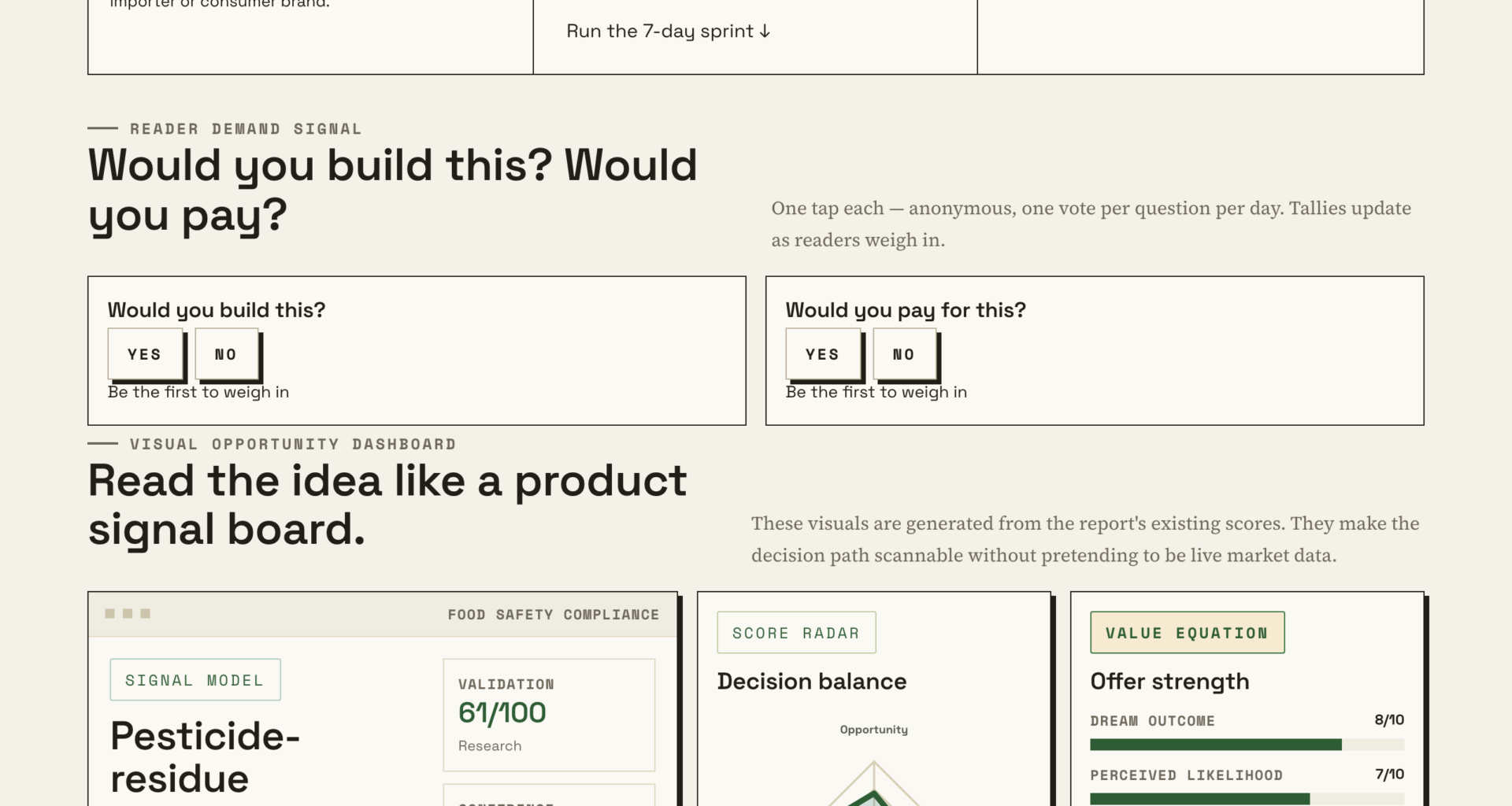

📊 Full opportunity report: Standards And Solutions For Pesticide-Residue Monitoring In Food Trade on IdeaNavigator AI — validation score, market gap, and execution plan.

Get the latest gadgets delivered free with Prime
- Fast, free delivery on millions of items
- Prime Video, Amazon Music and more included
- Member-only deals all year
TL;DR
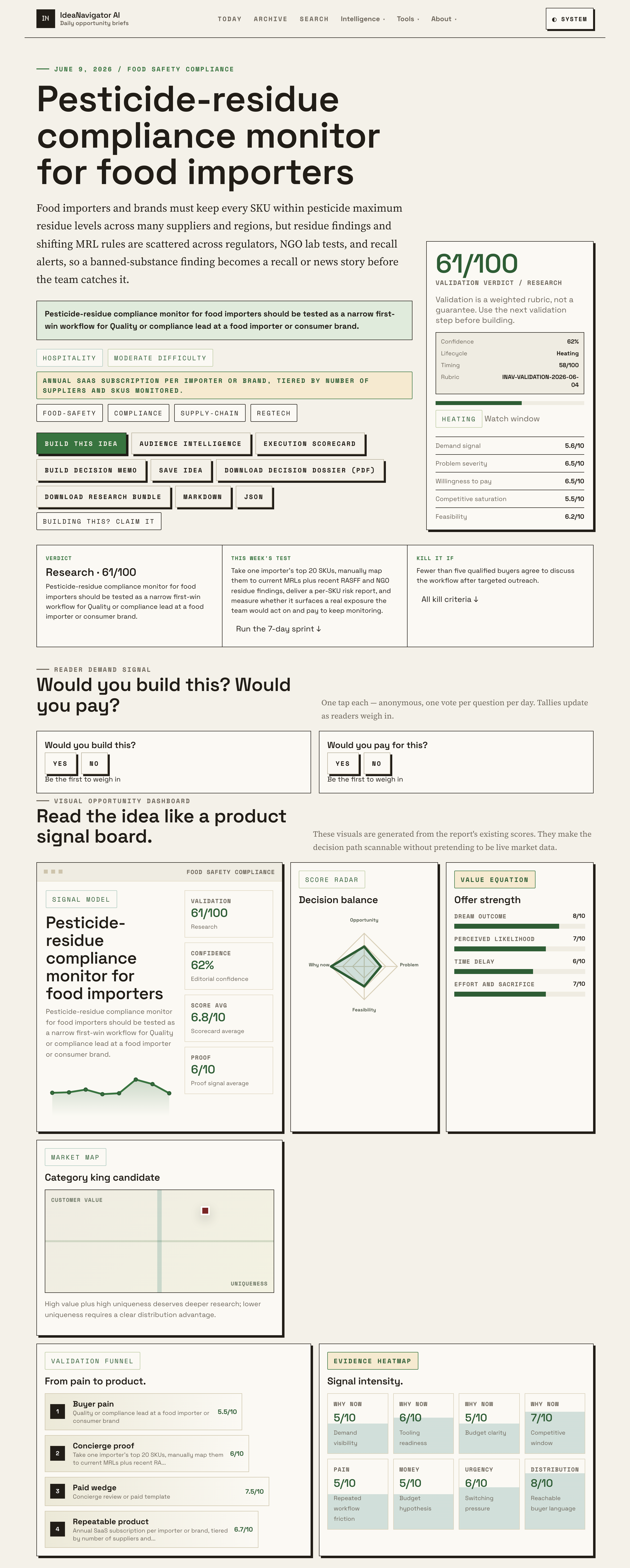
A new framework for pesticide-residue monitoring is emerging to assist food importers in ensuring compliance across multiple regions. It maps suppliers, SKUs, and residue data, offering an audit-ready report. The development responds to increased NGO and regulator findings of banned pesticides.
A new pesticide-residue monitoring framework for food importers is being developed to streamline compliance tracking amid increasing regulatory scrutiny and NGO findings of banned pesticides. This initiative aims to help importers and brands maintain SKUs within legal residue limits, reducing the risk of recalls and reputational damage.
The proposed solution focuses on creating a SaaS-based monitor that maps a brand’s suppliers and SKUs to existing EU and regional maximum residue levels (MRLs) and current residue findings, including alerts from the Rapid Alert System for Food and Feed (RASFF) and NGO tests. It will generate audit-ready compliance briefs for each SKU, highlighting potential risks.
According to sources familiar with the project, the platform would enable importers to proactively identify products at risk of exceeding MRLs, thereby preventing violations before they escalate into recalls or public scandals. The initial validation involves testing on a subset of an importer’s top SKUs, comparing mapped data with recent residue findings to assess the system’s effectiveness in surfacing real exposure risks.
Funding models are expected to include annual SaaS subscriptions, tiered by the number of monitored suppliers and SKUs. The approach aims to provide a scalable and cost-effective solution for food safety compliance across diverse markets.
Implications for Global Food Safety and Trade
This development is significant because it addresses the challenge of scattered and often outdated residue data, which complicates compliance efforts for importers and brands. By providing a centralized, real-time monitoring tool, the framework could reduce the incidence of banned pesticide residues in imported foods, thereby protecting consumer health and maintaining market access. As regulations tighten and NGO findings increase, such tools are increasingly vital for proactive compliance management.
As an affiliate, we earn on qualifying purchases.
Growing Regulatory Pressure and NGO Findings Drive Innovation
Over recent years, authorities across regions such as the European Union have intensified testing for pesticide residues, especially in staples like rice, tea, and spices. NGO reports frequently surface EU-banned pesticides in imported foods, prompting recalls and damaging brand reputations. Meanwhile, regulatory MRLs are becoming more stringent, with frequent updates that complicate compliance efforts. Food importers face the ongoing challenge of keeping track of multiple sources of residue data, which are often scattered across different agencies and NGOs.
This environment has accelerated the need for integrated monitoring solutions that can provide timely, actionable insights. The proposed pesticide-residue compliance monitor aims to fill this gap by mapping current residue findings against existing MRLs and supplier data, offering a proactive approach to compliance management.
“This new monitoring approach could significantly reduce the risk of non-compliance and help importers stay ahead of tightening regulations.”
— an anonymous researcher
Uncertainties About Implementation and Effectiveness
Details remain unclear regarding the full scope of the platform’s capabilities, its integration with existing compliance systems, and how quickly it can be scaled for diverse markets. The effectiveness of the initial validation process is also still being evaluated, and it is not yet confirmed how well the system will perform in real-world scenarios or how quickly it can prevent violations.
Next Steps in Development and Validation
The project is currently in early testing phases, focusing on validating the mapping and risk detection features with pilot importers. Future steps include refining the platform based on initial results, expanding pilot programs, and establishing partnerships with regulatory agencies and NGOs for data integration. Broader rollout is expected within the next 12-18 months, pending successful validation.
Key Questions
How will this monitoring system improve compliance for food importers?
The system will provide real-time mapping of residue findings against MRLs, flagging at-risk SKUs before violations occur, and generating audit-ready reports to streamline compliance management.
Will this solution cover all regions and types of foods?
The initial focus is on EU and regional MRLs for staples like rice, tea, and spices, but the platform aims to expand coverage as it matures, incorporating additional regions and food categories.
Is this monitoring tool mandatory for importers?
Currently, it is not mandated but is designed to help importers meet increasingly strict regulations and respond proactively to NGO findings, reducing the risk of non-compliance.
When can importers expect to access this monitoring platform?
Early pilot programs are underway, with broader availability anticipated within 12 to 18 months, depending on validation outcomes and market readiness.
Source: IdeaNavigator AI
Halloween Picks
halloween
As an affiliate, we earn on qualifying purchases.