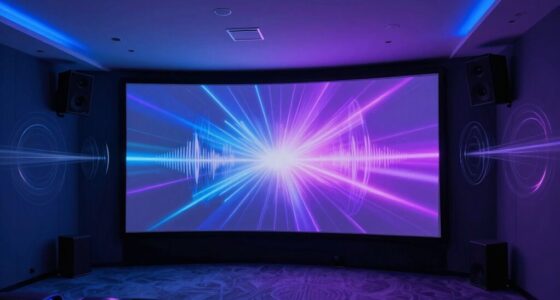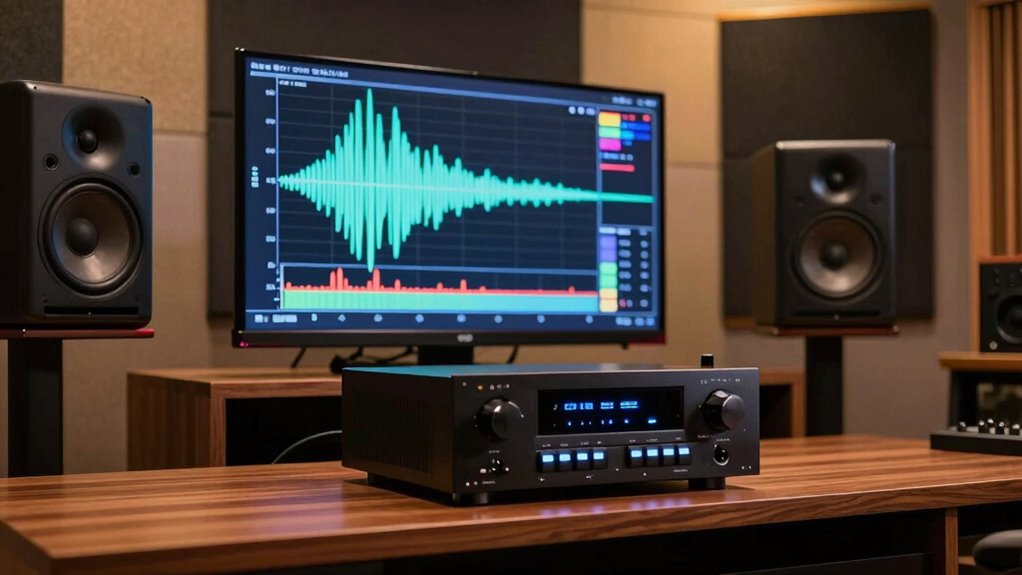

Room correction systems like Dirac and Audyssey can improve your sound by fixing issues caused by your room’s shape and reflections. They analyze your space and apply equalization to smooth out frequency response and enhance clarity. However, they have limits—they can’t fully fix severe problems like standing waves or poor speaker placement. Understanding these tools helps you get the best results, and there’s more you can do to optimize your setup.
Key Takeaways
- Room correction systems analyze acoustics and apply equalization to improve frequency response and sound clarity.
- They can reduce muddiness, tame resonances, and enhance natural sound, but can’t fix severe acoustic issues.
- Physical room setup and acoustic treatments are essential; correction systems work best with proper calibration.
- They cannot compensate for poor recordings, low-quality speakers, or significant room design flaws.
- Overall, room correction tools are complementary, not replacements, for good room design and physical acoustic treatments.
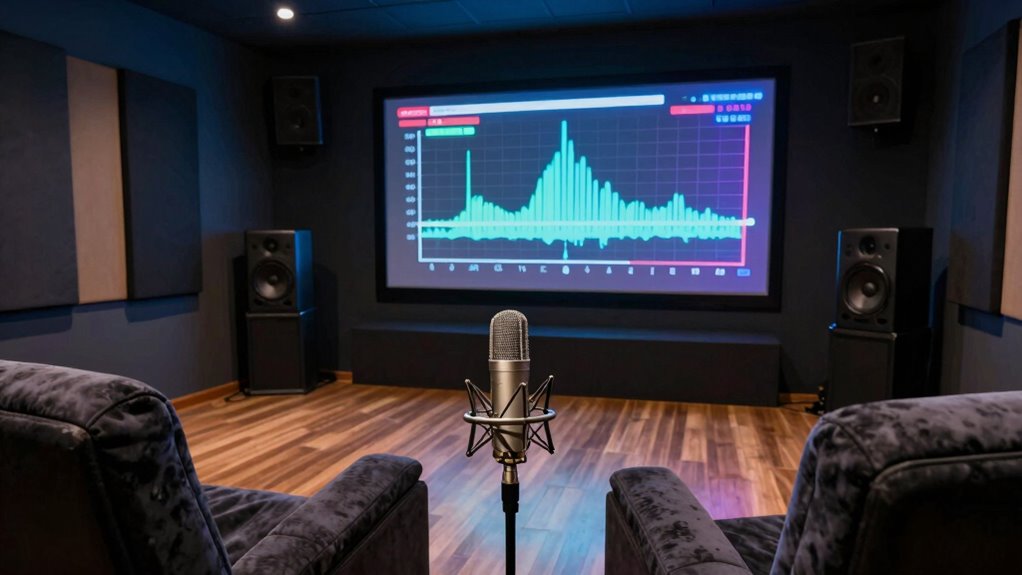
Have you ever wondered why your favorite music doesn’t sound as good at home as it does in the studio or concert hall? One major reason is the way your room interacts with your audio equipment. Room correction systems like Dirac or Audyssey aim to fix these issues, but understanding what they can and can’t do is key. The first step in achieving ideal sound involves correct speaker placement and acoustic treatments. Proper speaker placement ensures that sound waves reach your ears directly and evenly, minimizing reflections that can muddy the sound. Positioning your speakers correctly—away from walls, at ear level, and equidistant from your listening position—creates a more balanced soundstage. Acoustic treatments, such as bass traps, diffusers, and absorptive panels, further improve sound quality by controlling reflections, reducing echo, and managing low-frequency resonances. These physical adjustments set a solid foundation for your room’s acoustics, making room correction more effective.
Once you’ve refined speaker placement and added acoustic treatments, room correction technology steps in to fine-tune the sound. Dirac and Audyssey analyze how sound waves behave in your space, then apply equalization to correct frequency response issues—boosting or cutting certain ranges to achieve a flatter, more natural sound. They can markedly improve clarity, reduce muddiness, and make music sound more authentic. However, these systems have limitations. They cannot completely eliminate inherent room problems, such as severe standing waves or extreme asymmetries. If your room has large reflective surfaces or irregular shapes, room correction can only do so much. It’s not a substitute for good room design or physical adjustments; instead, it complements them. Additionally, room correction systems rely heavily on accurate measurements and calibration to perform optimally.
Furthermore, room correction doesn’t fix issues related to speaker quality or source material. If your speakers are inherently lacking in clarity or your recordings are poorly mastered, no amount of correction can fully compensate. It’s also worth noting that these systems work best when used with a calibrated setup, meaning your microphone measurements should be accurate, and the correction parameters properly configured. While Dirac and Audyssey can dramatically improve your listening experience, they shouldn’t replace proper speaker placement and acoustic treatments—they’re tools that enhance what you’ve already set up right. When used together, physical room modifications and intelligent correction technologies can bring you much closer to the sound quality you seek, but understanding their scope ensures you don’t overestimate their abilities.
room acoustic treatment panels
As an affiliate, we earn on qualifying purchases.
As an affiliate, we earn on qualifying purchases.
Frequently Asked Questions
Can Room Correction Improve Sound Quality for All Music Genres?
Yes, room correction can improve sound quality across all music genres by optimizing frequency response and tonal balance. It adjusts your system to reduce room-induced distortions, making music sound clearer and more natural. However, it can’t fix every issue, like speaker limitations or poor recordings. So, while it enhances overall sound, some genres or recordings may still benefit from additional tweaks or better equipment.
Does Room Correction Work Equally Well With All Speaker Types?
You might think room correction works equally well with all speaker types, but that’s not always true. Its effectiveness depends on speaker compatibility and room acoustics. For example, high-quality speakers often benefit more because they reveal subtle improvements. However, with less compatible or poorly matched speakers, the correction might not make a noticeable difference. So, your room and speaker setup play essential roles in how well room correction works.
How Does Room Correction Affect Bass Response in a Room?
Room correction can substantially improve your bass response by addressing room resonance and smoothing out bass frequencies. It reduces peaks and dips, making bass sound tighter and more even across your listening area. However, it can’t eliminate fundamental design issues or large room anomalies. For the best results, combine room correction with proper speaker placement and room treatment to achieve balanced, accurate bass throughout your space.
Is Room Correction Necessary for Small or Large Listening Spaces?
Did you know that over 80% of sound issues in a room can be improved with proper acoustic treatment? For small spaces, room correction might not be essential but can still enhance clarity. In larger rooms, it’s more beneficial, but acoustic treatment remains vital for ideal sound. So, consider your room size and prioritize acoustic treatment, as room correction alone can’t replace proper acoustic design for the best listening experience.
Can Room Correction Be Used With Headphones or Only Speakers?
You can use room correction with headphones through headphone calibration software, which adjusts for your headphones’ unique sound signature. Unlike speakers, headphones don’t rely on room acoustics, so corrections focus on headphone response. By calibrating your headphones, you improve sound clarity and consistency. Keep in mind, room correction tools are primarily designed for speakers, but headphone calibration offers similar benefits by compensating for individual headphone characteristics.
Dirac room correction system
As an affiliate, we earn on qualifying purchases.
As an affiliate, we earn on qualifying purchases.
Conclusion
Understanding room correction systems like Dirac and Audyssey helps you recognize their strengths and limits. They can considerably improve your sound by reducing echoes and balancing frequencies, but they can’t fix every acoustic issue. Did you know that over 60% of home theater setups see noticeable improvements with room correction? By knowing what it can and can’t do, you’re better equipped to optimize your listening experience and enjoy richer, more accurate audio in your space.
Audyssey calibration microphone
As an affiliate, we earn on qualifying purchases.
As an affiliate, we earn on qualifying purchases.
bass traps for home theater
As an affiliate, we earn on qualifying purchases.
As an affiliate, we earn on qualifying purchases.