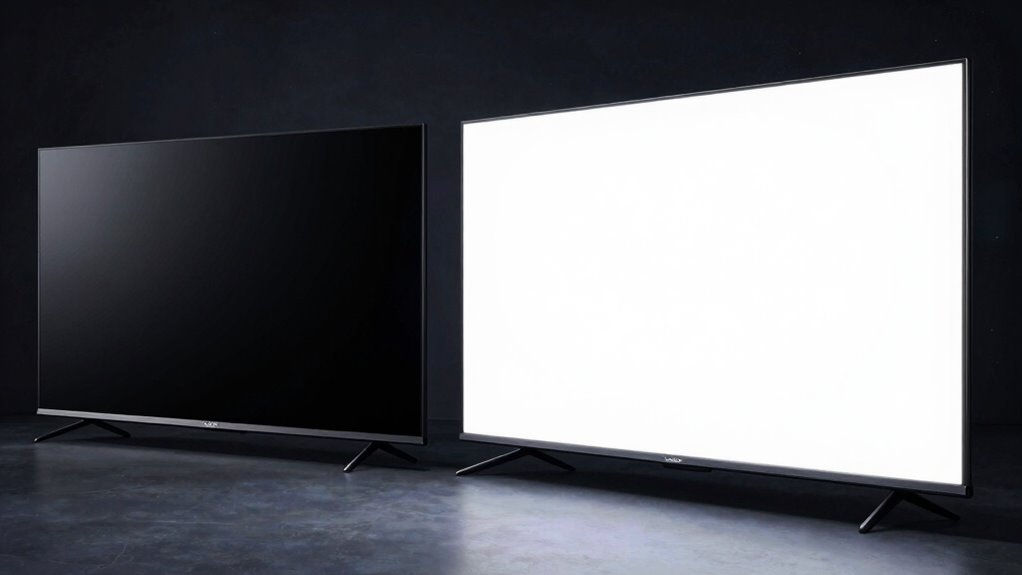

If you’re choosing between OLED and Mini-LED TVs, brightness and burn-in are key factors. OLEDs deliver stunning contrast and true blacks but struggle with lower peak brightness and have a slight risk of burn-in with static images. Mini-LEDs can reach higher brightness levels and don’t burn in, making them better for bright rooms and static content. Want to know how these differences impact your viewing? Keep exploring to find out more.
Key Takeaways
- Mini-LEDs achieve higher peak brightness, making them better for bright rooms and HDR content.
- OLEDs have lower maximum brightness but excel in deep blacks and contrast, especially in dark environments.
- Burn-in risk is a concern for OLEDs with static images, while Mini-LEDs are immune to burn-in issues.
- Modern OLEDs have minimized burn-in, but caution is advised for static UI elements and gaming.
- Overall, brightness favors Mini-LEDs, but OLEDs offer superior contrast and black levels in darker settings.
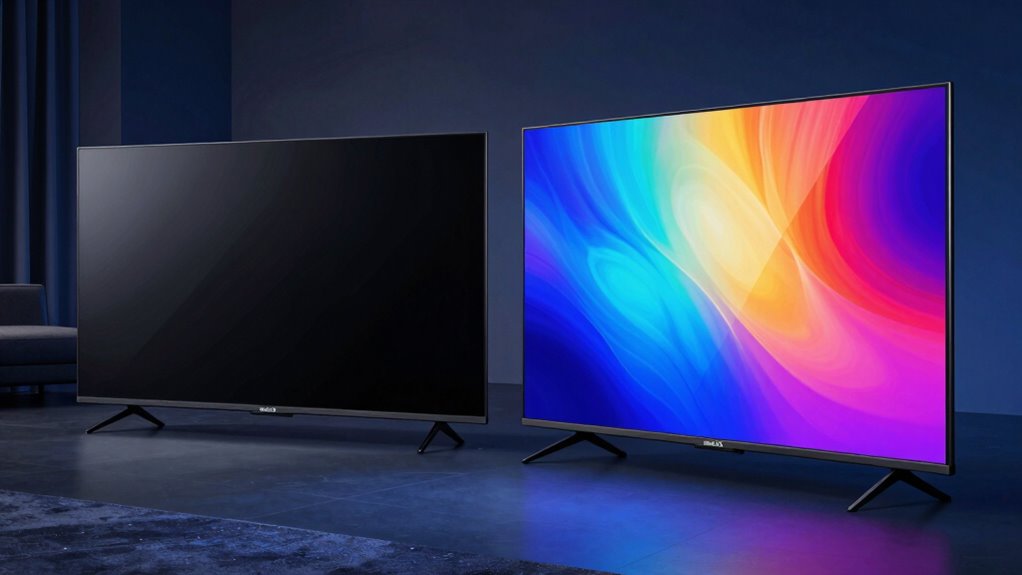
Are OLED and Mini-LED TVs the right choice for your viewing needs? If you’re someone who values vibrant visuals and sharp picture quality, understanding how these two technologies compare can help you decide. Both offer impressive features, but they differ markedly in areas like color accuracy and viewing angles, which are vital for an immersive experience. With OLEDs, each pixel emits its own light, allowing for incredibly precise control over brightness and color. This means you’ll enjoy rich, true-to-life colors that stay consistent no matter where you sit. When it comes to viewing angles, OLEDs excel because their self-emitting pixels produce uniform images from nearly any angle. You won’t have to worry about color shifts or dimming when you’re watching from the side, making OLEDs ideal for larger rooms or shared viewing. Additionally, OLED technology’s ability to produce true blacks enhances contrast and overall picture quality.
Mini-LED TVs, on the other hand, use thousands of tiny LEDs behind the LCD panel to produce brightness and contrast. While they can achieve impressive levels of brightness, especially useful in well-lit rooms, their color accuracy might not match OLEDs. Colors can sometimes appear slightly less vibrant or accurate, particularly in scenes with subtle gradations. That’s because Mini-LEDs rely on local dimming zones, which can cause blooming or halo effects around bright objects on dark backgrounds. Regarding viewing angles, Mini-LEDs generally perform well but not as perfectly as OLEDs. You might notice some color shifting or reduced contrast when viewing from sharp angles, which could impact your experience if you often watch with others or from different parts of the room.
The decision often boils down to your priorities. If you want the best possible color accuracy, deep blacks, and wide viewing angles, OLEDs are hard to surpass. They deliver a more consistent and true picture from various angles, making them perfect for movie nights or detailed gaming. However, if you mostly watch in bright environments and need high brightness levels with less concern about perfect angles, Mini-LEDs can offer excellent performance at a potentially lower cost. Keep in mind that burn-in is a concern with OLED TVs, especially if you leave static images onscreen for extended periods, but for typical use, modern OLEDs have mitigated that risk markedly. Understanding these display technologies helps guarantee you pick a TV that aligns with your viewing habits and environment, giving you a satisfying and visually stunning experience.
Frequently Asked Questions
How Do OLED and Mini-Led TVS Compare in Energy Efficiency?
You’ll find that OLED TVs generally use less power when displaying darker images because their pixels turn off completely, reducing energy consumption. Mini-LED TVs, however, tend to be more efficient with brighter scenes, as their backlighting can be more controlled. This difference impacts environmental impact, with OLEDs potentially being more eco-friendly during dark content viewing, but Mini-LEDs offering better overall power efficiency for varied content.
Can Mini-Led TVS Achieve True Black Levels Like OLEDS?
Imagine a painter aiming for perfect black; mini-LEDs paint shadows with depth, but can’t reach OLED’s pure darkness. While mini-LEDs excel in backlight uniformity and color accuracy, they struggle to produce true blacks like OLEDs. You’ll see richer contrast and deeper blacks on OLEDs, but mini-LEDs still deliver impressive brightness and detail, making them a solid choice if you value vibrant visuals without sacrificing overall picture quality.
What Is the Lifespan Difference Between OLED and Mini-Led Displays?
You’ll find that OLED durability typically ranges around 4 to 8 years, depending on usage, while mini‑LED longevity often exceeds 10 years due to its backlight design. OLED screens may experience burn-in over time, reducing lifespan, but proper care can extend it. Mini‑LED displays generally have a longer lifespan, making them a solid choice if you want a TV that lasts longer without burn-in concerns.
Are There Any Health Concerns Related to OLED Burn-In?
Yes, OLED burn-in can cause some health concerns, especially if you watch for long periods. You might experience more eye strain and exposure to blue light, which can impact your sleep and eye health. To minimize these risks, take breaks often, adjust brightness settings, and use blue light filters. Being mindful of burn-in and eye comfort helps you enjoy your TV without unnecessary health issues.
How Do Price Points Differ Between OLED and Mini-Led TVS?
You’ll notice that OLED TVs generally have higher pricing disparities compared to mini-LED models, mainly due to their advanced display technology. While OLEDs tend to be more expensive upfront, mini-LED TVs are becoming more competitively priced, thanks to wider market availability. If you’re budget-conscious, mini-LED offers a more affordable option, but if picture quality is your priority, OLEDs might justify the higher cost.
Conclusion
So, when choosing between OLED and Mini-LED, remember, you’re not just picking a TV—you’re deciding whether your living room will glow like a fiery sun or flicker with the faint glow of a dying candle. OLED’s stunning brightness and perfect blacks can make your movies feel like a cinematic universe, while Mini-LED offers incredible brightness with fewer burn-in worries. Pick your champion wisely—your TV’s brightness could light up your entire world or cast shadows that haunt every scene.