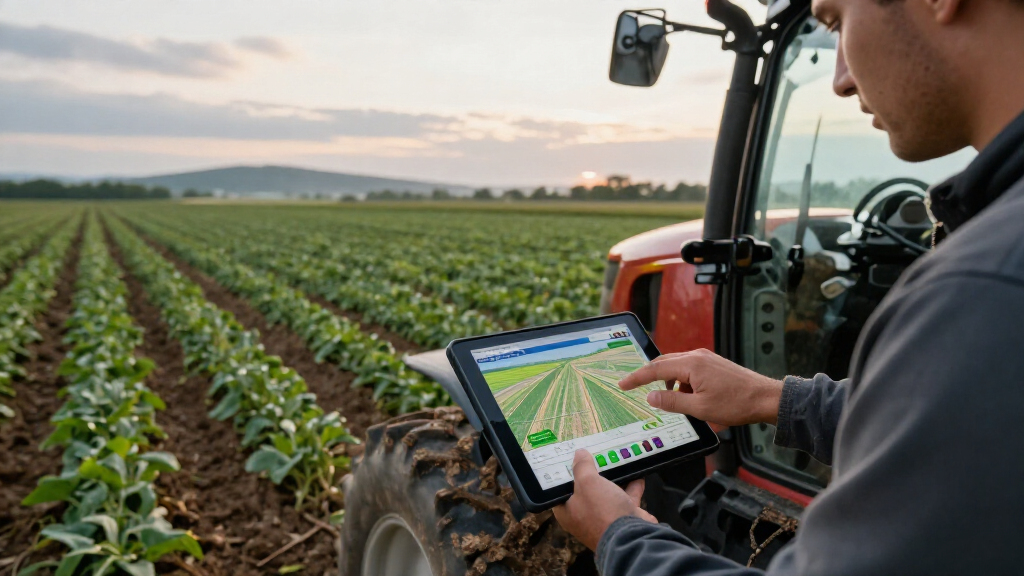

🔍 Read the full analysis: How AI Connects Data And Farm Decisions on ThorstenMeyerAI.com

Get the latest gadgets delivered free with Prime
- Fast, free delivery on millions of items
- Prime Video, Amazon Music and more included
- Member-only deals all year
TL;DR
A November 29, 2026, ThorstenMeyerAI.com report examines how digital tools connect farm data to decisions, from satellite-guided tractors to robotic milking. USDA figures show guidance systems cover more than half of some major crop acres, while only 22% of U.S. farms reported using any precision-farming practice in 2025; labor-intensive strawberry picking remains a difficult case for automation.
Digital farm tools are linking satellite positioning, field measurements and machine controls to decisions about where tractors drive and how much seed or fertilizer they apply, according to a November 29 report from ThorstenMeyerAI.com. The report finds that adoption is uneven: guidance systems cover more than half of the acres planted to several major U.S. crops, while 22% of U.S. farms reported using any precision-farming practice in 2025, and many soft-fruit harvests still depend on workers.
The report traces precision farming to yield monitors that appeared on the market in 1993, followed by soil and yield maps and variable-rate technology for adjusting inputs across a field. Satellite guidance expanded after the U.S. government ended its intentional degradation of civilian GPS on May 1, 2000. USDA Economic Research Service figures cited in the report show auto-steer was used on 5.3% of planted U.S. corn acres in 2001 and 58% in 2016.
Those acreage figures do not mean most farms use precision tools. USDA farm survey results cited by the report put use of at least one precision practice at 27% of farms in 2023 and 22% in 2025. Practices include GPS guidance, yield monitoring, soil mapping, variable-rate applications, drones, electronic livestock tagging, precision feeding and robotic milking. Scale is a factor: in 2016, 73% of the largest corn farms surveyed used guidance, compared with 10% of the smallest.
Automation has also reached some barns. Germany’s statistics office counted 8,800 dairy farms using automatic milking systems in 2023, or 19% of its dairy farms. The report contrasts these systems with strawberry harvesting, where it says picking accounted for about two-thirds of costs in a 2024 University of California study of organic production. A review of 50 harvesting robots published in 2014 found an average 66% success rate and 33 seconds per fruit; the report says commercial strawberry robots now operate on table-top systems rather than in soil.
Infographic 01 · Precision farming
Most acres, not most farms
Satellite steering took over most of America’s big crop fields, but only about one US farm in five uses any precision farming. The big farms adopt first.
US corn · share of planted acres with auto-steer (ERS, ARMS)
Guidance systems by 2019 · share of planted acres (ERS)
US farms using any precision agriculture practice · share of farms (NASS)
US corn farms using guidance, 2016 · by farm size (ERS)
Germany, 2023 · dairy farms with milking robots (Destatis)
Acre shares (ERS, by crop and survey year) and farm shares (NASS) are different measures and not directly comparable. Before 2018, ERS “guidance” means auto-steer without lightbars. NASS counts GPS guidance, yield monitoring, soil mapping, variable rate, drones, electronic tagging, precision feeding and robotic milking.
Sources: USDA ERS, EIB-248 (2023); USDA ERS, Amber Waves (April 2023); USDA NASS, Technology Use (August 2025); Destatis press release 204 (23 May 2024).
Powered by Thorsten Meyer AI
Why Farm Data Adoption Is Uneven
Farm data matters when it changes a practical decision: a tractor can follow a more precise route, and equipment can vary seed or fertilizer rates across a field. These tools can reduce the need for some driving and monitoring tasks, but the reported adoption gap shows that their reach is not uniform. A technology used on a majority of certain crop acres may still be absent from many farms, especially smaller operations.
The contrast also clarifies where automation has limits. Guidance and milking systems handle repeatable tasks with measurable routes or routines. Picking ripe strawberries requires identifying individual fruit and handling it without damage. The report’s examples suggest that agricultural automation is advancing task by task, rather than replacing farm labor as a whole. That distinction matters for workers, growers and policymakers assessing labor needs and technology investment.
Products Worth Considering

Sony WH-1000XM6 Wireless Noise Cancelling Headphones – Midnight Blue

DJI Osmo Mobile 8 Tracking and Fill Light Combo

Bose QuietComfort Wireless Noise-Cancelling Headphones, Sandstone
As an affiliate, we earn on qualifying purchases.
From GPS Maps to Robotic Milking
The report places today’s systems within a longer shift from manual observation to digital measurement. Yield monitors, mapping tools and variable-rate machinery allowed growers to connect field conditions with machine settings. The U.S. GPS change in 2000 improved civilian positioning and helped create conditions for broader guidance-system use, though access to data and equipment has not translated into equal adoption across farms.
Labor remains part of the picture. The report cites 398,258 temporary agricultural jobs certified through the U.S. H-2A guest-worker program in fiscal 2025, compared with just over 48,000 in fiscal 2005. Those figures count certified jobs, not a direct measure of all farm employment or of jobs displaced by automation. The report also draws on International Labour Organization estimates for 2025 to show that farming’s share of employment differs widely by country, but the supplied source excerpt cuts off before giving all its country figures.
“Most acres, not most farms.”
— Thorsten Meyer, ThorstenMeyerAI.com
Where the Evidence Stops
The figures describe adoption and task performance, not the overall effect of AI on farm productivity, costs or employment. The source does not provide a direct estimate of how much precision tools change yields or profits, nor does it establish that changes in H-2A certifications were caused by automation. The reported decline in farm use of any precision practice from 27% in 2023 to 22% in 2025 is not explained in the supplied material.
The strawberry robot figures also need careful interpretation: the 66% success rate and 33 seconds per fruit come from a 2014 review, not a test of current commercial machines. The report says table-top strawberry robots are working commercially, but gives no performance, scale or cost figures for them. The source excerpt ends during its country employment comparison, so the full comparison cannot be confirmed from the supplied material.
The Next Test for Farm Automation
The next developments to watch are whether precision tools spread beyond large farms and whether strawberry-harvesting systems move from table-top production to commercial use in soil. The report gives no timetable for either shift and does not identify a specific new deployment or policy decision.
For readers tracking the sector, future USDA farm surveys can show whether reported use of precision practices changes after 2025. More detailed commercial data on robot performance, operating costs and crop conditions would help establish whether harvest automation can match the reliability required in working fields. Until then, the available evidence points to continued machine support for guidance and some livestock tasks, alongside substantial human labor in harvesting.
Key Questions
What is the main development in the report?
The report describes how farm technologies connect data such as GPS position and field yields to machinery decisions, while showing that adoption differs by farm size and task. It is a sector report, not an announcement of a new product or deployment.
How many U.S. farms used precision-farming practices in 2025?
The USDA figure cited by the report is 22% of U.S. farms. The survey includes a range of practices, from GPS guidance and yield mapping to drones and robotic milking.
Why can guidance cover many crop acres if relatively few farms use precision tools?
Larger farms tend to adopt guidance more often and manage a greater share of the land. The report cites 2016 figures of 73% use among the largest corn farms and 10% among the smallest.
Are strawberry-picking robots replacing workers?
The report says some strawberry robots work commercially on table-top systems, but it does not provide evidence that they have replaced field pickers at scale. It describes soft-fruit harvesting as a difficult automation task.
What remains unknown about AI’s impact on farm jobs?
The source does not quantify jobs gained or displaced by these systems, or establish that automation caused changes in guest-worker certifications. Its figures describe technology adoption and certified H-2A jobs, not a complete employment-impact study.
Source: ThorstenMeyerAI.com