
📊 Full opportunity report: Change-order risk detector for landscaping contractors on IdeaNavigator AI — validation score, market gap, and execution plan.

Get the latest gadgets delivered free — and shop member deals
- Fast, free delivery on millions of items
- Access to Prime Big Deal Days deals on October 6–7
- Prime Video, Amazon Music and more included
TL;DR
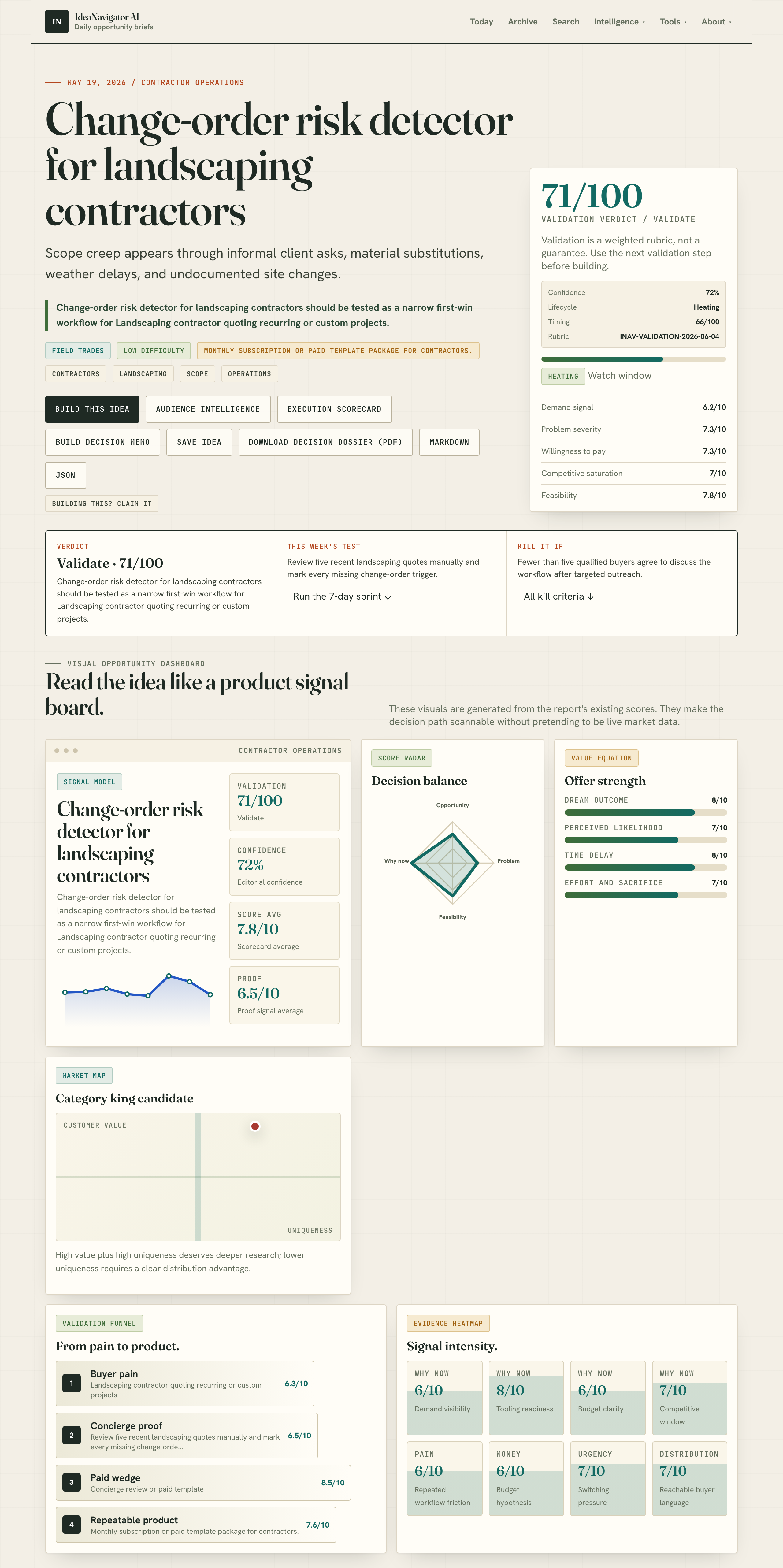
A proposed change-order risk detector for landscaping contractors is in early testing. It aims to identify scope creep and undocumented changes, helping small contractors control margins amid high uncertainty.
A new change-order risk detector tailored for landscaping contractors is in the early testing phase, focusing on recurring and custom project quotes to identify scope creep risks. This development responds to ongoing margin pressures faced by small contractors amid high labor, material, and scheduling uncertainties.
The risk detector aims to analyze quotes and job notes for missing exclusions, change-order triggers, and approval language, acting as a proactive tool to flag potential scope creep. It is designed as a workflow enhancement for contractors to review five recent quotes manually and identify missing elements that could lead to cost overruns.
According to IdeaNavigator AI, the tool will be offered as a monthly subscription or as part of a paid template package, targeting contractor operations that need better margin control. The initial focus is on testing the effectiveness of the quote and note checker in real-world scenarios before broader deployment.
Why Change-Order Risk Detection Matters for Small Contractors
This development is significant because it offers small landscaping contractors a potential solution to manage scope creep proactively, which is a common cause of project cost overruns. By identifying missing exclusions and change-order triggers early, contractors can avoid unexpected expenses and improve profit margins. As labor and material costs remain volatile, such tools could become essential for maintaining financial stability in a competitive market.
landscaping project quote analysis software
As an affiliate, we earn on qualifying purchases.
As an affiliate, we earn on qualifying purchases.
Market Need for Better Scope Management Tools in Landscaping
Small landscaping contractors often face high uncertainty due to informal client asks, material substitutions, weather delays, and undocumented site changes. Currently, many rely on manual review processes to identify scope creep, which can be inconsistent and time-consuming. The proposed risk detector aims to automate part of this process, providing a more reliable way to flag potential issues before they escalate into costly overruns.
The concept emerged as a response to ongoing margin pressures in the industry, with a focus on creating a minimal viable product that can be tested in real-world settings before wider adoption.
“The risk detector is designed to help contractors spot missing exclusions and change triggers early, reducing the likelihood of scope creep causing profit loss.”
— an anonymous researcher
Unclear Aspects of the Risk Detector’s Effectiveness
It is not yet clear how accurately the tool will identify all relevant change-order triggers or how well it will perform across diverse project types. The effectiveness of the manual review process used for validation is also still being assessed, and broader deployment will depend on successful testing outcomes.
Next Steps in Testing and Deployment Planning
The initial testing phase involves reviewing five recent landscaping quotes to evaluate the detector’s ability to flag missing exclusions and change triggers. Based on these results, developers plan to refine the tool and potentially expand testing to more contractors. A broader rollout could occur within the next six to twelve months if validation proves successful.
Key Questions
How will the change-order risk detector improve project management?
It will help contractors identify potential scope creep early by flagging missing exclusions and change triggers, enabling proactive adjustments and reducing cost overruns.
Is this tool available for all types of landscaping projects?
Initially, the focus is on recurring and custom projects, with testing underway to determine its applicability across different project types.
How will contractors access this risk detector?
It will be offered as a monthly subscription or as part of a paid template package aimed at contractor operations.
When can contractors expect wider availability?
If initial testing is successful, a broader rollout could happen within six to twelve months.
What are the limitations of the current development?
Its accuracy in diverse project scenarios is still being evaluated, and it remains uncertain how well it will perform outside initial testing conditions.
Source: IdeaNavigator AI
Fall Picks
fall essentials
As an affiliate, we earn on qualifying purchases.