AR displays like waveguides, micro‑OLED, and microLED are transforming how you see virtual content. Waveguides direct light seamlessly into your eyes, making visuals sharp and stable from different angles. Micro‑OLED offers vibrant colors and fast response times, while microLED boosts brightness and energy efficiency for outdoor use. Understanding how these technologies work together helps improve clarity and immersion. Keep exploring to discover how these innovations shape your AR experience.
Key Takeaways
- Waveguides direct light efficiently from projectors to the eyes, enabling thin and lightweight AR headsets.
- Micro-OLED displays offer high contrast and vibrant colors with fast response times for realistic AR visuals.
- MicroLED technology provides brighter images, higher energy efficiency, and longer lifespan, ideal for outdoor AR applications.
- Precise calibration of waveguides, Micro-OLED, and MicroLED ensures accurate alignment, minimal distortion, and seamless integration of virtual content.
- Advances in these technologies enhance AR display clarity, stability, and user comfort, making virtual and real-world blending more natural.
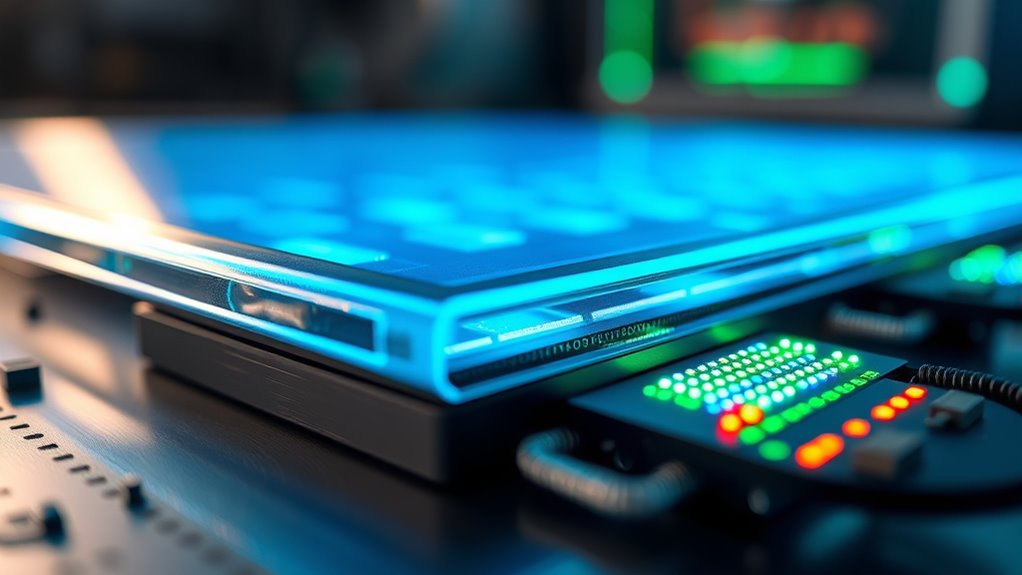
Have you ever wondered how augmented reality (AR) displays are transforming the way we interact with digital content? The magic lies in the sophisticated technology behind these displays, especially in the domain of AR design and display calibration. When you’re using an AR device, the clarity, responsiveness, and realism you experience depend heavily on how well the display is calibrated and designed to blend virtual elements seamlessly into your real-world view. Display calibration involves fine-tuning various parameters, such as color accuracy, brightness, and contrast, to ensure virtual images appear natural and consistent across different lighting conditions. Good calibration minimizes eye strain and enhances immersion, making your AR experience more comfortable and convincing.
Effective AR display calibration ensures visual clarity, comfort, and seamless integration of virtual content into real-world environments.
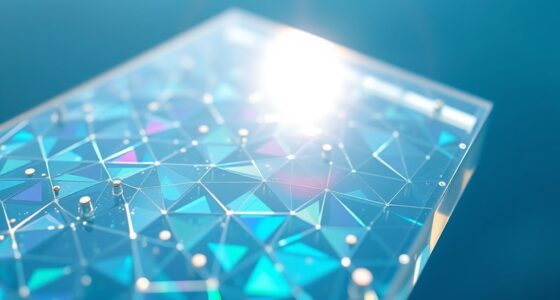
The core of many AR displays revolves around innovative technologies like waveguides, micro-OLED, and microLEDs. Waveguides, for example, act as transparent channels that direct light from tiny projectors into your eyes. They’re designed to be thin and lightweight, allowing for sleek, compact headsets or glasses. When you wear AR glasses with waveguide displays, you’ll notice how they project images directly onto your eyes without bulky hardware. Achieving ideal AR design means carefully calibrating these waveguides so the projected virtual images are sharp, correctly aligned, and free of distortions. Proper display calibration is vital here, ensuring the light pathways produce consistent visuals regardless of your head movements or environmental lighting.
Micro-OLED and microLED technologies push the boundaries of AR display quality. Micro-OLED displays feature tiny organic LEDs, offering superb contrast ratios, vibrant colors, and fast response times. When integrated into AR headsets, these displays deliver highly detailed images that appear incredibly realistic. Proper AR design involves aligning these displays precisely with the optical system, and calibration ensures the virtual content matches real-world cues perfectly, avoiding issues like misalignment or color inconsistencies. MicroLEDs, on the other hand, are inorganic LEDs that provide even brighter images, better energy efficiency, and longer lifespan. They’re especially promising for outdoor AR applications where high brightness is essential. The challenge in display calibration here is ensuring uniform brightness and color fidelity across the entire display, so virtual objects appear consistent from different angles and distances.
In essence, the development of AR displays hinges on meticulous AR design and precise display calibration. Both factors influence how natural and immersive your experience feels. Whether through waveguides, micro-OLED, or microLED, the goal remains the same: to make virtual content seamlessly integrate into your world, providing clarity, stability, and comfort. As these technologies evolve, your interactions with digital content will become more intuitive, engaging, and lifelike, revolutionizing everything from gaming to professional applications.
Frequently Asked Questions
How Do Waveguides Impact AR Display Brightness?
Waveguides considerably boost AR display brightness by improving waveguide efficiency, allowing more light to reach your eyes. This brightness enhancement results from optimized light management within the waveguide, reducing losses and maximizing illumination. By increasing the amount of light transmitted, waveguides help create clearer, brighter images, making your AR experience more vivid and immersive without demanding more power. This balance of efficiency and brightness is key to better AR display performance.
What Are the Power Consumption Differences Among Micro‑Oled and Microled?
You’ll find that micro-LED displays are more power-efficient than micro-OLED ones, primarily because micro-LEDs emit light directly without needing a backlight, reducing energy consumption. Micro-OLEDs tend to consume more power due to their reliance on organic materials that require additional circuitry and backlighting. This difference means micro-LEDs can provide longer battery life in AR devices, making them ideal for applications demanding higher power efficiency and lower energy consumption.
How Durable ARe AR Waveguide Displays in Daily Use?
Think of your AR waveguide display as a sturdy bridge, built for daily journeys. It’s designed through durability testing and crafted with high material resilience, making it capable of handling everyday wear and tear. While no technology is invincible, these displays generally endure well with proper care. You can confidently rely on them for daily use, knowing they’re engineered to withstand the rigors of your active lifestyle.
Can Microled AR Displays Be Made Flexible or Foldable?
MicroLED AR displays can be made flexible or foldable, thanks to advancements in flexible display technology. You can expect these displays to incorporate foldable technology, allowing them to bend without damaging the microLEDs. This flexibility enhances portability and durability, making your AR experience more versatile. Researchers are actively developing materials and designs to improve the foldability of microLEDs, so future AR devices will likely become more flexible and resilient for everyday use.
What Are the Current Challenges in Scaling Micro‑Oled Production?
Scaling micro-LED production feels like trying to build a skyscraper with tiny bricks that keep slipping away. You face enormous manufacturing scalability hurdles, struggling to produce millions of uniform, high-quality micro-LEDs quickly. Material stability is another beast, as tiny LEDs are prone to degradation or defects under stress. Overcoming these challenges demands groundbreaking advances in fabrication processes and durable materials, or you’ll be stuck with limited, expensive displays that can’t meet demand.
Conclusion
As you explore the future of AR displays, remember they’re more than just technology—they’re windows into new worlds. Waveguides, micro-OLED, and microLEDs are like the lanterns lighting your path through endless possibilities. Embrace these innovations, for they symbolize hope, connection, and discovery. With each advancement, you step closer to a reality where imagination and reality intertwine, opening dreams once confined to the domain of imagination. The horizon is bright, and your journey has just begun.