

📊 Full opportunity report: Apple Silicon’s Quiet Memory Advantage on ThorstenMeyerAI.com — validation score, market gap, and execution plan.
TL;DR
Apple Silicon’s unified memory architecture provides a significant capacity advantage for running large AI models. While slower than NVIDIA GPUs, it offers cost-effective, silent, and energy-efficient operation for models over 32 billion parameters.
Apple Silicon chips now offer a significant advantage in running large AI models due to their shared memory architecture, allowing models larger than 100GB to operate without multi-GPU setups. This development matters because it challenges the dominance of discrete GPUs like NVIDIA’s, especially for individual users and small-scale AI deployment.
In 2026, Apple Silicon chips, such as the M5 Max and M4 Max, leverage a unified memory system that combines CPU and GPU memory pools, allowing models to use the entire RAM available on the device. This architecture enables Mac users with 64GB or more RAM to run large models, including 70-billion-parameter models, that would typically require multi-GPU rigs costing thousands of dollars.
While this design offers a capacity advantage, it comes with a trade-off: lower memory bandwidth compared to high-end NVIDIA GPUs. For example, the RTX 4090 moves data at about 1,008 GB/s, whereas the M5 Max manages approximately 614 GB/s. As a result, Apple Silicon is slower per token during AI inference, typically providing 12–18 tokens/sec for large models, compared to 40–50 tokens/sec on a high-end NVIDIA GPU.
Despite slower inference speeds, the Apple approach is ideal for users needing to run large models locally without multi-GPU setups, especially when power consumption and silence are priorities. Apple’s chips also operate at a fraction of the power cost, making them more suitable for continuous operation and energy-conscious environments.
However, Apple faced its own memory shortage in 2026, leading to the discontinuation of certain configurations like the 512GB Mac Studio and price increases across its lineup. This reflects industry-wide supply constraints rather than a fundamental architectural flaw.
Apple Silicon’s quiet memory advantage
While the discrete-GPU world fought over 24GB of brutally expensive VRAM, a Mac quietly offered to run the big model on one silent, low-watt box. Not magic — but the rare place an architecture beats the squeeze.
Mac Studio 256GB holds a 70B at near-lossless Q8, or 200B+ at Q4 — no single GPU reaches that at any price. Win zone: 32–200B models at 10–30 tok/s for personal/dev use.
M5 Max ~614 GB/s vs RTX 4090’s 1,008. A 70B runs ~12–18 tok/s on M5 Max vs 40–50 on a 5090. You buy capacity, not raw throughput. Bandwidth & capacity matter — not FLOPs.
Apple turned a laptop-efficiency design — one shared memory pool — into the most elegant answer to the part of the squeeze that hurts most: capacity. Bonus: 25–90W vs a GPU rig’s 600–1,200, ~$35–55/yr to run 24/7 vs $300–400, and silent. Right for large models, privacy, low-power always-on; wrong for max speed on small models or heavy training. Next: Build, Rent, or Quantize.
Implications of Apple Silicon’s Memory Architecture for AI Users
Apple Silicon’s shared memory design offers a practical solution for running large AI models on consumer hardware, bypassing the need for costly multi-GPU rigs. This shifts the landscape for individual researchers, developers, and AI enthusiasts, providing a more accessible, energy-efficient, and silent alternative for large-model inference. However, the trade-offs in inference speed and current supply constraints mean it’s not a universal replacement for high-end discrete GPUs, especially where maximum throughput is essential.
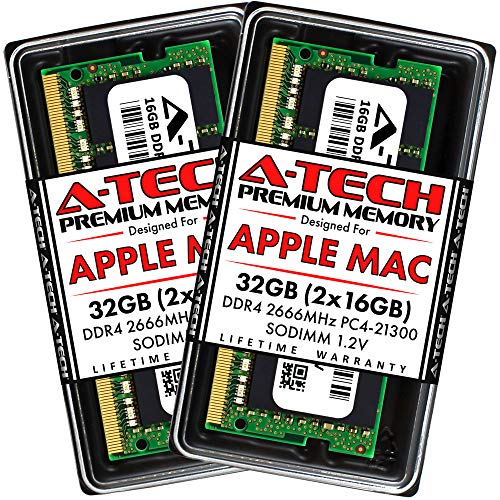
A-Tech 32GB Kit (2x16GB) RAM for Apple iMac & Mac mini (2018, 2019 & 2020) | DDR4 2666 MHz SODIMM PC4-21300 / PC4-21333 260-Pin SO-DIMM Memory Upgrade
- Total Capacity: 32GB (2x16GB) kit
- Memory Speed: DDR4 2666/2667 MHz
- Form Factor: 260-Pin SO-DIMM
As an affiliate, we earn on qualifying purchases.
As an affiliate, we earn on qualifying purchases.
2026 Industry-Wide Memory Shortage and Its Impact
Prior to 2026, discrete GPUs like NVIDIA’s RTX 4090 dominated large-model AI inference with high bandwidth and dedicated VRAM. The industry faced a severe memory supply squeeze, making high-capacity GPUs expensive and scarce. Apple’s architecture, originally designed for efficiency in laptops, unexpectedly became advantageous in this context by allowing large models to run within a single system’s RAM. The company’s withdrawal of certain configurations and price hikes reflect ongoing supply challenges, but the architectural advantage remains intact for those who can access sufficient memory.
“Our chips are optimized for efficiency and capacity, enabling users to run large models without the need for multi-GPU systems.”
— Apple representative
Remaining Questions About Apple Silicon’s Large-Model Performance
It is still unclear how Apple Silicon’s slower inference speed will affect practical applications beyond research and development. The extent of supply constraints and whether Apple will expand its high-capacity configurations in the near future also remains uncertain. Additionally, the long-term impact of the current bandwidth limitations on large-model deployment is yet to be fully understood.
Future Developments in Apple Silicon and Large-Model AI
Expect ongoing updates from Apple as they potentially improve bandwidth and expand high-capacity configurations. Industry analysts anticipate further integration of large-memory architectures in consumer hardware, possibly influencing other chipmakers to adopt similar designs. Monitoring supply chain resolutions and software optimizations will be key to assessing the long-term viability of Apple Silicon for large AI models.
Key Questions
Can Apple Silicon replace high-end NVIDIA GPUs for AI inference?
Not for maximum throughput; Apple Silicon offers capacity and energy efficiency but slower inference speeds compared to NVIDIA’s high-bandwidth GPUs. It’s ideal for large models where capacity is more critical than speed.
Will Apple expand its high-capacity Mac configurations?
It is uncertain. Supply constraints have led to the discontinuation of some configurations, but future updates may reintroduce or expand high-memory options depending on supply chain conditions.
Is Apple Silicon suitable for real-time AI applications?
Due to its slower inference speed, it may not be ideal for latency-sensitive applications requiring maximum tokens per second, but it is suitable for offline, large-model inference tasks.
What are the main trade-offs of using Apple Silicon for large AI models?
The main trade-offs are slower inference speeds and current supply limitations versus higher capacity, lower power consumption, and silent operation.
Source: ThorstenMeyerAI.com