
📊 Full opportunity report: 2026 AI Mini PCs That Combine Performance And Size on ThorstenMeyerAI.com — validation score, market gap, and execution plan.

Get the latest gadgets delivered free — and shop member deals
- Fast, free delivery on millions of items
- Access to Prime Big Deal Days deals on October 6–7
- Prime Video, Amazon Music and more included
TL;DR
In 2026, mini PCs equipped with advanced processors like AMD Ryzen AI 9 HX370 are delivering high AI performance while maintaining small sizes. These models balance power, expandability, and connectivity, appealing to AI professionals and enthusiasts. The development signals a shift toward more capable, space-efficient AI computing solutions.
In 2026, several manufacturers have introduced AI mini PCs that pack high-performance processors like AMD Ryzen AI 9 HX370 into compact enclosures, marking a significant step forward in space-efficient AI computing. These devices are designed to meet the needs of AI developers, researchers, and enthusiasts seeking powerful hardware without the bulk of traditional desktops.
The MINISFORUM AI X1 Pro stands out as a top performer, featuring the AMD Ryzen AI 9 HX370 processor and Radeon 890M GPU, offering robust AI processing capabilities in a small form factor. GEEKOM’s A9 Max emphasizes expandability with DDR5 memory and multiple upgrade options, catering to users requiring future-proofing. Meanwhile, the GEEKOM IT15 balances performance and connectivity, with support for multiple displays and fast networking features like WiFi 7.
These models exemplify a trend toward integrating high-end CPUs and GPUs into mini PCs, with a focus on expandability, connectivity, and power efficiency. Price points vary, with premium models emphasizing raw performance and future-proofing, while more budget-friendly options target lighter AI tasks. The key trade-offs involve size, thermal management, and upgrade potential, which are critical for demanding AI workloads.
The 10 picks
- 1
 GMKtec AI Mini PC Ryzen AI Max+ 395View on Amazon →
 - 2GMKtec EVO-X2 AI Mini PC AMD Ryzen AI Max+ 395, Up to 5.1GHz, 16C/32TView on Amazon →
- 3
 GEEKOM A9 Max Top AI Mini PC, AMD Ryzen AI9 HX470, 32GB DDR5, 2TB SSDView on Amazon →
 - 4
 GEEKOM IT15 Mini PC with Intel Ultra 9 285H, 32GB DDR5, 1TB SSD, Arc 140T GPU…View on Amazon →
 - 5
 MINISFORUM AI X1 Pro-370 Mini PC with AMD Ryzen 9 HX370, 32GB DDR5, 1TB PCIe…View on Amazon →
 - 6
 GEEKOM IT13 MAX AI Mini PC with Intel Ultra 9 185H, 24GB LPDDR5, 500GB SSDView on Amazon →
 - 7
 MINISFORUM AI X1 Pro-470 Mini PC with AMD Ryzen AI 9 HX470View on Amazon →
 - 8
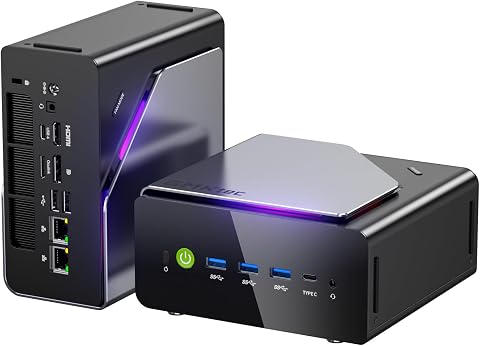 GMKtec K15 Mini PC AI Ultra 5 125U (up to 4.3GHz) 32GB DDR5 1TB PCIe 4.0 SSDView on Amazon →
 - 9
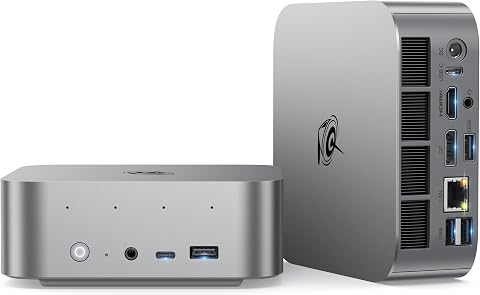 Beelink SER9 Pro AI Mini PC with AMD Ryzen 7 H255, 24GB RAM, 1TB SSD, Radeon…View on Amazon →
 - 10
 GMKtec K15 AI Mini PC with Intel Ultra 5 125U, 32GB DDR5, 512GB SSDView on Amazon →
Advancing AI Capabilities in Small Form Factors
The emergence of high-performance AI mini PCs in 2026 signifies a shift toward accessible, space-saving AI hardware solutions. These devices enable AI development and deployment in environments where traditional desktops are impractical, broadening the reach of AI applications across industries. Their compact size coupled with powerful processing opens new possibilities for edge computing, research labs, and small offices, reducing space and energy costs while maintaining high throughput.
2026 Mini PC Developments in AI Hardware
The trend toward miniaturized AI hardware has been accelerating over the past few years, with previous models gradually increasing in processing power and connectivity. Notable milestones include the integration of AMD Ryzen AI processors and support for advanced memory and networking standards. The 2026 lineup builds on this foundation, emphasizing not only raw power but also expandability and thermal management, addressing earlier limitations of small form factors.
Unconfirmed Details on Long-term Durability and Scalability
While these models show promising specs, it remains unclear how they will perform over extended periods under continuous AI workloads, especially regarding thermal management and upgradability. Long-term reliability data for these compact systems is still emerging, and user experiences in real-world AI tasks are yet to be fully documented.
Upcoming Model Releases and Performance Benchmarks
Manufacturers are expected to continue refining AI mini PC designs, with upcoming models potentially offering even higher processing capabilities and better thermal solutions. Benchmark tests and real-world performance reviews scheduled for late 2026 will clarify how these devices handle intensive AI workloads over time. Consumers and professionals should watch for these developments to inform future purchasing decisions.
Key Questions
Can these mini PCs handle large AI models?
Yes, models like the AMD Ryzen AI 9 HX370-equipped devices are designed to handle demanding AI tasks, including training and inference of large models, especially when paired with sufficient RAM and GPU support.
Are these mini PCs suitable for edge AI deployment?
Many of these devices are optimized for edge computing, offering a compact form factor with high processing power, making them suitable for deployment in environments with space or power constraints.
What are the main trade-offs of these mini PCs?
The key trade-offs involve size versus expandability, thermal management, and sometimes cost. Smaller devices may have limited upgrade options or cooling capacity, which can impact long-term performance under heavy workloads.
Will these models support future AI software updates?
Most high-end models are built with future-proofing in mind, supporting hardware upgrades and software updates. However, compatibility with future AI frameworks depends on hardware specifications and manufacturer support policies.
Source: ThorstenMeyerAI.com
Evergreen bestsellers Picks
bestsellers
As an affiliate, we earn on qualifying purchases.