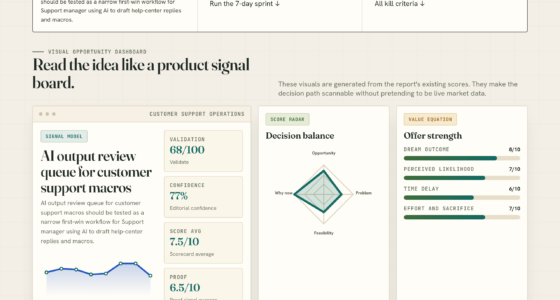

📊 Full opportunity report: 10 AI-Driven Innovations That Will Lead In 2026 on ThorstenMeyerAI.com — validation score, market gap, and execution plan.
TL;DR
This article outlines 10 confirmed AI innovations expected to lead in 2026, including advancements in healthcare, autonomous systems, and natural language processing. The developments are based on industry forecasts and expert analyses, with some innovations still in early stages.
Several AI innovations are projected to dominate the technological landscape in 2026, according to industry analysts and tech leaders. These developments are expected to significantly influence sectors such as healthcare, autonomous transportation, and natural language processing, underscoring the rapid pace of AI advancement and its growing role in everyday life. These developments are expected to significantly influence sectors such as healthcare, autonomous transportation, and natural language processing, underscoring the rapid pace of AI advancement and its growing role in everyday life.
Experts predict that by 2026, AI-driven healthcare diagnostics, autonomous vehicles, advanced language models, and AI-powered cybersecurity will be among the most influential innovations. These predictions are based on current research milestones, investments, and pilot programs that are already showing promising results.
For instance, several companies have announced breakthroughs in AI-enabled medical imaging and personalized treatment plans, which are expected to become standard practice within the next three years. You can explore the latest in AI-powered healthcare solutions in the 2026 AI Innovations: 10 Trends Transforming Society article. Similarly, autonomous vehicle technology continues to improve, with pilot programs expanding globally, signaling wider adoption by 2026.
Natural language processing (NLP) models are also anticipated to reach new levels of sophistication, enabling more intuitive human-AI interactions and expanding AI’s role in customer service, content creation, and education. For a broader look at AI trends, see the original analysis. Cybersecurity solutions powered by AI are expected to become more proactive and adaptive, addressing increasingly complex threats.
Impacts of 2026’s Leading AI Innovations
The anticipated AI advancements for 2026 will reshape industries, improve efficiency, and enhance quality of life. Healthcare breakthroughs could lead to earlier diagnoses and personalized treatments, reducing costs and saving lives. Autonomous systems may revolutionize transportation and logistics, reducing accidents and congestion.
Furthermore, more sophisticated NLP models will improve communication interfaces, making AI more accessible and useful across various domains. Cybersecurity enhancements will better protect data and infrastructure amid rising digital threats.
Understanding these trends helps consumers, businesses, and policymakers prepare for the transformative effects of AI and plan investments accordingly.
AI-powered medical imaging devices
As an affiliate, we earn on qualifying purchases.
As an affiliate, we earn on qualifying purchases.
Current AI Trends and Development Milestones
Over the past few years, AI has rapidly evolved from narrow applications to broader, more integrated systems. Major tech companies and startups alike have invested heavily in AI research, leading to notable milestones such as GPT-4’s release, which demonstrated significant advances in language understanding and generation.
In healthcare, AI-powered diagnostics and predictive models have shown promising results in early trials, with several pilot programs underway. Autonomous vehicle testing has expanded across multiple regions, with companies like Tesla, Waymo, and others conducting large-scale trials.
Despite these advancements, many innovations remain in development or early deployment stages, with regulatory, ethical, and technical challenges still to address before widespread adoption.
“By 2026, we expect AI to be seamlessly integrated into daily life, from personalized healthcare to autonomous transportation, driven by continuous breakthroughs and increased investment.”
— Dr. Emily Chen, AI Research Lead at TechFuture
Unconfirmed Aspects of the 2026 AI Landscape
While forecasts are optimistic, several uncertainties remain. The pace of regulatory developments, ethical considerations, and technological hurdles could influence the actual timeline and scope of these innovations. Some predictions are based on current pilot projects and investment trends, which may face unforeseen delays or setbacks.
Specifically, the widespread adoption of autonomous vehicles and AI-driven healthcare diagnostics depends on regulatory approval, public acceptance, and technological refinement, which are still evolving.
Next Steps for AI Development and Adoption
Researchers and companies will continue refining AI models, with pilot programs expanding and regulatory frameworks evolving. Key milestones include the deployment of AI-enabled healthcare tools in clinical settings, larger-scale autonomous vehicle trials, and the release of next-generation NLP systems.
Stakeholders should monitor policy developments, technological breakthroughs, and pilot results over the coming months to better understand the trajectory toward 2026’s predicted innovations.
Key Questions
Which AI innovations are most likely to impact daily life by 2026?
Healthcare diagnostics, autonomous transportation, advanced language models, and AI-powered cybersecurity are expected to have the most significant impact on daily life by 2026.
Are these AI innovations already in development or just theoretical?
Many of these innovations are in active development, with pilot programs and early deployments demonstrating their feasibility. However, full-scale adoption depends on overcoming regulatory, technical, and ethical challenges.
What are the main challenges facing AI development toward 2026?
Key challenges include regulatory approval, ethical considerations, technological limitations, and ensuring AI safety and fairness during widespread deployment.
How should consumers and businesses prepare for these AI changes?
They should stay informed about AI advancements, invest in adaptable infrastructure, and participate in discussions about AI ethics and regulation to ensure responsible adoption.
Source: ThorstenMeyerAI.com