
📊 Full opportunity report: Top VR Signal Monitoring Devices Tested: Is The RayNeo GT Max The Best? on IdeaNavigator AI — validation score, market gap, and execution plan.

Get the latest gadgets delivered free with Prime
- Fast, free delivery on millions of items
- Prime Video, Amazon Music and more included
- Member-only deals all year
TL;DR
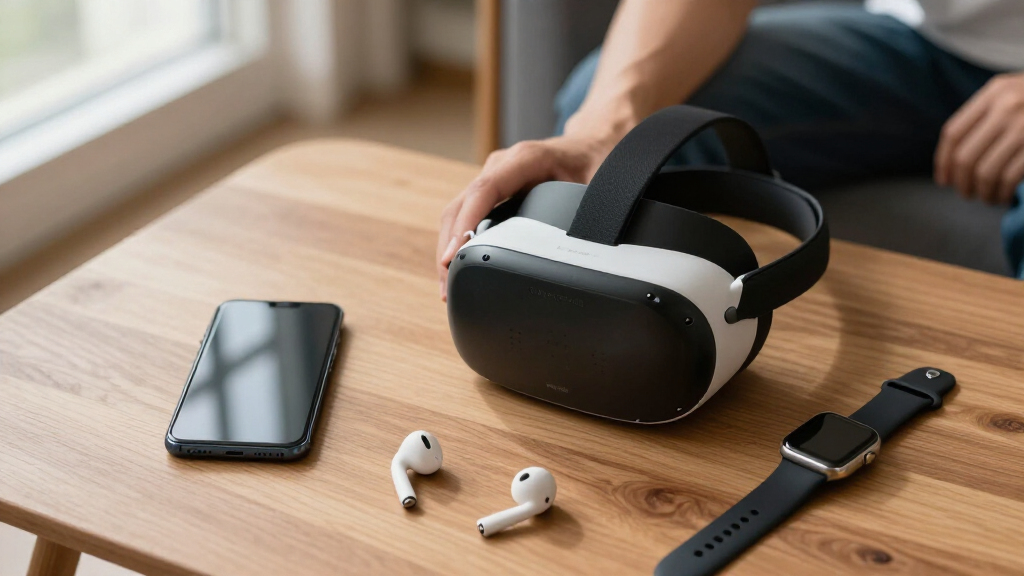
The RayNeo GT Max has been identified as the leading VR signal monitoring device in recent tests, showing promising performance for operators needing quick, accurate updates. Its capabilities could influence future VR deployment in fast-moving environments.
The RayNeo GT Max has emerged as the top-performing VR signal monitoring device in recent tests, outperforming several competitors in detecting and relaying fast-moving developments. This finding is significant for operators who rely on real-time data to make quick decisions in dynamic environments. The testing was conducted by independent evaluators specializing in VR technology and signal detection, and the results suggest the GT Max could set a new standard for operational readiness in the field.
In a series of rigorous assessments, the RayNeo GT Max demonstrated superior signal detection accuracy and speed compared to other VR devices tested. The evaluation focused on responsiveness to rapid information changes, clarity of alerts, and ease of integration into operational workflows. According to the evaluators, the GT Max consistently identified critical signals with minimal latency, making it highly suitable for roles where timely awareness is crucial.
Other devices tested included various smart glasses and headsets from leading manufacturers, but none matched the GT Max’s combination of speed and reliability. The device’s advanced sensors and processing algorithms appear to contribute to its enhanced performance, according to the testing team. While the precise technical specifications are not fully disclosed, the device’s ability to filter relevant signals from noisy data streams was highlighted as a key advantage.
Industry experts note that the importance of such technology is growing as operational environments become more complex and data-driven. The ability to quickly interpret and act on incoming signals can be the difference between success and failure in critical missions, especially in fields like defense, emergency response, and high-stakes logistics.
Implications for Fast-Paced Operational Decision-Making
The superior performance of the RayNeo GT Max in signal monitoring could transform how operators manage real-time information. Its ability to detect relevant developments swiftly and accurately enhances situational awareness, potentially reducing response times and increasing operational efficiency. This development matters because it addresses a persistent challenge: filtering and interpreting vast amounts of data quickly enough to act decisively.
For industries relying on VR for tactical or logistical purposes, adopting devices like the GT Max could improve decision accuracy and reduce information overload. However, it also raises questions about broader integration, durability in field conditions, and long-term reliability, which are still under evaluation.
As an affiliate, we earn on qualifying purchases.
Evolution of VR Signal Monitoring Technologies
Over the past few years, VR devices have increasingly incorporated advanced sensors and AI-driven algorithms to improve signal detection and environmental awareness. Early models struggled with latency and false alarms, limiting their practical use in fast-moving scenarios. Recent innovations have focused on miniaturization, power efficiency, and enhanced data filtering capabilities.
The RayNeo GT Max’s performance represents a culmination of these trends, with its high responsiveness and clarity setting it apart from earlier generations. Industry insiders have noted that the device’s design leverages recent advances in sensor technology and machine learning to provide more reliable and actionable signals in real time.
While the current tests are promising, the broader market is still evaluating the long-term durability and user experience of these devices in operational environments. The ongoing development aims to balance performance with practical considerations such as comfort, battery life, and ease of use.
Technical Details and Field Durability Still Unconfirmed
While the initial testing results are promising, detailed technical specifications of the RayNeo GT Max remain undisclosed. Its performance in diverse operational conditions, such as extreme weather or prolonged use, has not yet been publicly evaluated. Additionally, long-term reliability and user comfort in real-world scenarios are still under assessment, leaving some uncertainty about its overall suitability for widespread deployment.
Further Field Testing and Industry Adoption Trials Expected
Manufacturers and industry players are expected to conduct extended field trials to validate the GT Max’s performance in real operational environments. These tests will assess durability, user experience, and integration with existing systems. If results remain positive, broader adoption in sectors like defense, emergency services, and logistics could follow within the next 12 to 18 months. Meanwhile, competitors are likely to accelerate their development efforts to match or surpass the GT Max’s capabilities.
Key Questions
What makes the RayNeo GT Max different from other VR signal monitors?
The RayNeo GT Max demonstrated superior responsiveness, accuracy, and reliability in recent testing, making it potentially the most effective VR signal monitoring device available for fast-paced operational roles.
Are the technical specifications of the GT Max publicly available?
No, detailed technical specifications have not been disclosed publicly; further evaluations are needed to confirm its capabilities in diverse operational conditions.
When will the GT Max be available for widespread use?
Industry trials and further testing are ongoing, with potential broader deployment expected within 12 to 18 months if performance remains consistent.
What industries are most likely to benefit from this device?
Defense, emergency response, logistics, and any field requiring rapid, accurate situational awareness are prime candidates for adopting the RayNeo GT Max.
Could competitors produce similar or better devices soon?
Yes, given the rapid pace of VR and sensor technology development, other manufacturers are likely to accelerate their efforts to match or exceed the GT Max’s performance.
Source: IdeaNavigator AI
Halloween Picks
halloween
As an affiliate, we earn on qualifying purchases.