
TL;DR

Get the latest gadgets delivered free with Prime
- Fast, free delivery on millions of items
- Prime Video, Amazon Music and more included
- Member-only deals all year
Neufangled Robotics presents Stringman, a cable-driven robot designed to move a gripper throughout a room, with a listed price of $795 and published plans and software. The company reports an average payload of 1.9 kg in a specified room configuration, but independent performance and safety evaluations are not provided in the source material.
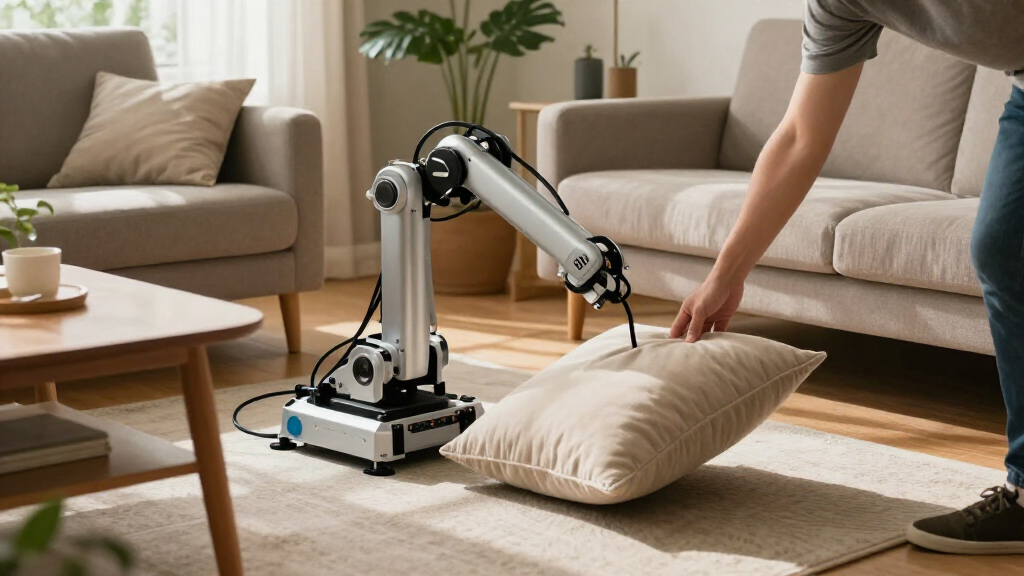
Neufangled Robotics has introduced Stringman, a cable-driven robot listed at $795 that suspends a gripper from lines attached near a room’s ceiling corners. The company says the system can move objects across a room while carrying up to 2.2 kilograms near the floor, offering a different approach to household and home-lab automation than a fixed-base robotic arm.
Stringman uses four motors and overhead lines to position its gripper within a bounded work area. The manufacturer’s specifications describe supported room sizes with an XY diagonal of 3 to 10 meters and heights of 2.3 to 4 meters. For a stated 7-by-7-by-3-meter room, the company reports an average payload of 1.9 kilograms and a maximum of 2.2 kilograms near the floor. Those figures are stated at a 28-newton line-tension limit and account for the 638-gram gripper and marker in the company’s comparison.
The listed system includes two anchor cameras, a camera on the gripper, Raspberry Pi computers at the anchors and gripper, and a controller running on an external computer. Neufangled gives a traverse speed of about 0.4 meters per second. Structural parts are 3D-printed, and the company says the anchors can be attached to wall studs or structural columns. It describes installation as a process of mounting the anchors, connecting the lines and running an automated calibration.
The project is presented as open source and OSHWA-certified. The company says its mechanical CAD, circuit-board designs, software, build guide and bill of materials are published. It also says Stringman can operate locally on a Wi-Fi network, with the interface and AI models hosted on user-controlled hardware. An optional remote-control service is described separately; the source says remote access requires binding the robot to an account.
A Different Route to Room-Scale Reach
Stringman’s main proposition is that cables can cover a large work area without a mobile base or long articulated arm. The design could be useful in home labs where parts need to move between workstations, or in spaces where floor clutter limits wheeled robots. Its overhead layout also shifts the trade-off: users gain access to much of the room, but must accept lines crossing the space and hardware mounted near the ceiling.
The company compares Stringman’s 147-cubic-meter work volume in a 7-by-7-by-3-meter room with a 0.75-meter research arm, and says the room-scale system provides roughly 500 times more work-area volume per dollar at comparable payload. That is a manufacturer-provided comparison, not an independent benchmark; it depends on the selected room, arm and assumptions. For prospective buyers, the practical questions are whether their room can support the mounts, whether the work area is useful for their tasks and how the system performs outside the company’s reported tests.
Products Worth Considering

Sony WH-1000XM4C (M4 2nd Gen) Wireless Noise-Cancelling Headphones, Black

Amazon Kindle Paperwhite (2024), 16 GB, 7-inch Display, Black

Bose QuietComfort Ultra Earbuds (2nd Gen), Wireless Noise-Cancelling Earbuds, Black
As an affiliate, we earn on qualifying purchases.
How the Cable System Works
Unlike a conventional serial arm, which moves a tool through the reach of linked joints, Stringman positions its gripper by changing the lengths of lines running from ceiling-corner anchors. The company says the load is shared among the motors, with payload capacity greatest near the room’s center, where the lines share the load more evenly. Its advertised comparison with a seven-actuator arm assumes the same direct-drive motors at rated torque and excludes the arm’s link weight.
Neufangled says the robot has accumulated about 1,000 hours of testing in real homes. It also describes built-in workflows for collecting training data and says some learned behaviors may be trained with as few as 50 episodes. These are company statements; the supplied material does not identify an external test program or provide detailed evaluation results for particular tasks.
““Tension is all you need.””
— Neufangled Robotics
Performance and Installation Questions
The source material does not provide independent verification of the payload, speed, reliability or safety figures, nor does it identify a retail shipping date or give a complete account of what is included in the $795 price. It is also unclear how performance changes across the stated range of room dimensions, under repeated use or with objects of different shapes.
Installation depends on having suitable studs or structural columns near the ceiling, and the lines remain present while the robot is installed, though the company says they sit near the ceiling when parked. Neufangled states that the motors relax when tension reaches 28 newtons, allowing the lines to be pulled loose. The supplied information does not include a third-party safety assessment, so the tension limit should be treated as a product specification rather than proof of safety in every situation.
Availability and Independent Testing
The next practical milestones for readers are confirmation of availability, full kit contents and support arrangements, along with hands-on testing by users or independent reviewers. Buyers will also need to check whether their room’s mounting points and ceiling layout fit the installation requirements before relying on the advertised work volume.
Neufangled’s published files allow technically capable users to inspect or build the system, while its software and training tools may support further experiments. The source does not state a release schedule for future versions or provide a timetable for external evaluations.
Key Questions
What is Stringman?
Stringman is a cable-driven robot that suspends a gripper from lines attached near the ceiling corners and moves it within a room.
How much does it cost?
Neufangled lists the system at $795. The source material does not clarify every item included in that price.
How much can it lift?
The company reports up to 2.2 kilograms near the floor and an average payload of 1.9 kilograms for a specified 7-by-7-by-3-meter room configuration. These are manufacturer figures, not independently verified results in the supplied material.
Does Stringman require cloud access?
Neufangled says the robot can run locally on the user’s Wi-Fi network, with its interface and AI models on local hardware. Remote operation is described as an optional account-based service.
What does installation require?
The company says users need mounting points on suitable wall studs or structural columns, access to the ceiling and a computer to run the controller. The lines remain in the room while the robot is installed, though they can be parked near the ceiling.
Source: neufangled.com