
🔍 Read the full analysis: Is The Mac Mini A Good Fit For Running AI Locally? on ThorstenMeyerAI.com

Get the latest gadgets delivered free with Prime
- Fast, free delivery on millions of items
- Prime Video, Amazon Music and more included
- Member-only deals all year
TL;DR
Apple has positioned the Mac mini as a desktop for always-on AI, and its unified memory lets some open models run locally. The 64GB M5 Pro can accommodate larger models than base configurations, but model fit is not the same as fast performance, and the largest models exceed the mini’s memory.
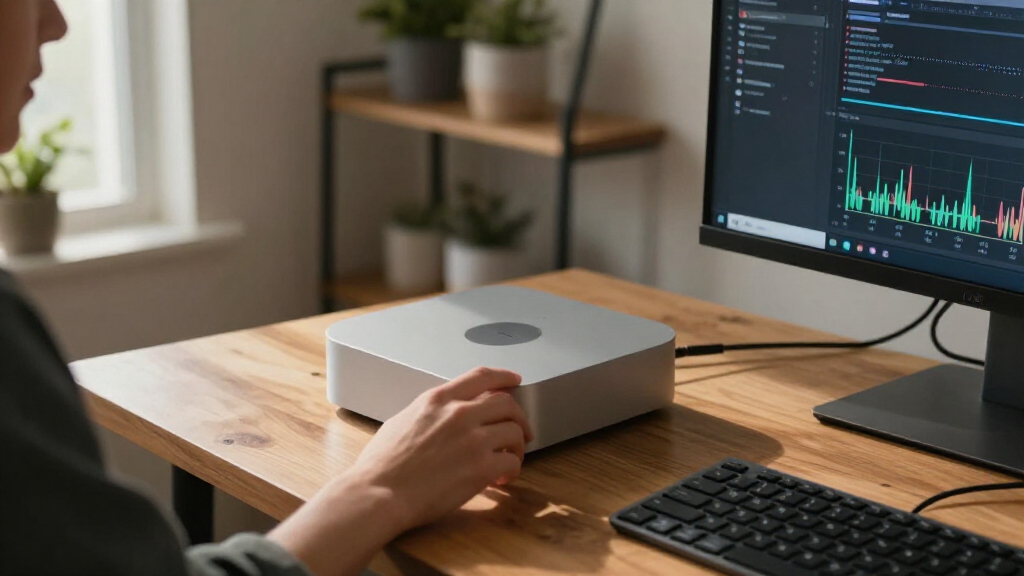
Apple is marketing its Mac mini as a desktop for always-on agentic computing, but whether it is a good local-AI machine depends chiefly on memory capacity and the model being run. As of November 16, the listed configurations range from 16GB to 64GB of unified memory: enough for some smaller and mid-sized open models, but not the largest systems, and with substantially less memory bandwidth than a data-center GPU.
Apple’s August 25 announcement called the Mac mini “the leading desktop for always-on agentic computing.” Earlier, on an April 30 earnings call, CEO Tim Cook said customer recognition of the Mac mini and Mac Studio as platforms for AI and agentic tools was growing faster than Apple had predicted, according to MacRumors. Those statements establish Apple’s positioning; they do not by themselves show how quickly specific models perform in everyday use.
The main hardware advantage is unified memory. Apple’s MLX documentation says the CPU and GPU have direct access to the same memory pool, so a local model can use more of the computer’s memory than a graphics card with a smaller, separate memory allocation might offer. Apple lists M6 Mac mini options with 16GB, 24GB or 32GB, and M5 Pro options with 24GB, 48GB or 64GB. U.S. list prices cited from Apple on November 16 start at $899; the 64GB M5 Pro configuration with 1TB storage is listed at $3,199.
Published model requirements give a rough guide. Google lists its Gemma 4 31B model at about 17.5GB at 4-bit precision and 34.9GB at 8-bit. OpenAI says gpt-oss-20b runs “within 16GB of memory.” These figures indicate that some models can fit on a mini, but they do not include all operating-system, application and conversation-context memory. Google says its weight estimates cover static model weights and that larger context windows require more memory.
Memory Sets the Model Ceiling
The Mac mini makes local AI more accessible to people who want to run a model on a small desktop rather than send every request to a cloud service. Running locally can reduce dependence on per-use cloud charges, keep prompts and outputs on the computer, and allow use when internet access is unavailable. Those are practical advantages, not guarantees that a particular setup will be cheaper overall or suitable for every workload.
Capacity is not speed. Apple lists memory bandwidth of 153 to 170GB/s for M6 configurations and 307GB/s for M5 Pro. Nvidia lists 3.35TB/s for its H100 SXM accelerator, about 11 times the M5 Pro figure. The comparison concerns bandwidth, one factor in how quickly a model can produce output; it is not a direct benchmark of complete systems. For demanding or high-volume work, cloud and data-center hardware may remain more suitable.
Power use is another part of the appeal in the source material: it reports the mini idling at about 4 watts while an agent waits. That figure is an idle-state claim, not a measurement of power consumption while running a model. Buyers weighing an always-on system should distinguish standby draw from the energy used during active inference.
Products Worth Considering

Sonos Era 300 Wireless Smart Speaker with Dolby Atmos, Black

Kindle Paperwhite Signature Edition Bundle, 32GB, Jade, with Plant-Based Leather Cover and Wireless Charging Dock

LG UltraGear 32-inch 4K UHD OLED Gaming Monitor, 165Hz
As an affiliate, we earn on qualifying purchases.
How Model Fit Is Estimated
Local models store learned numerical values, or weights, in memory while generating responses. Lower-precision versions use fewer bits per weight, reducing memory needs, though this can affect quality. The source’s Gemma examples show why configuration matters: a 12B model at 4-bit is listed at 6.7GB, while Gemma 4 31B at 4-bit is listed at 17.5GB. A 64GB machine can hold more of the model weights than a 16GB model, while leaving additional space for the system and context.
Some model names can obscure the memory requirement. Google describes Gemma 4 26B A4B as activating four billion parameters per token, but says all 26 billion parameters must be loaded into memory. The source gives its 4-bit weight requirement as 14.4GB. For the 31B model, the 16-bit version is listed at 69.9GB, beyond the Mac mini’s maximum 64GB before accounting for macOS or other software.
The upper end is further away: OpenAI sizes gpt-oss-120b for a single 80GB GPU, according to the source. Apple says Thunderbolt 5 lets users cluster multiple Mac mini systems to run large models on-device, but the cited material does not provide performance measurements for such a cluster.
““The leading desktop for always-on agentic computing.””
— Apple, in its August 25, 2026 Mac mini announcement
Real-World Speed Still Varies
Published memory requirements do not establish how fast a model will respond on a given Mac mini. The source material provides chip bandwidth specifications and model-size estimates, but no standardized Mac mini inference benchmarks, token-generation rates or comparisons across model settings. Results can differ with quantization, software, prompt length and how much memory remains available to other applications.
It is also unclear from the cited information how much memory a particular long conversation or workload will require in practice. Google cautions that larger context windows need memory beyond the model weights. The reported 4-watt idle figure likewise does not describe power draw during active AI use, and Apple’s cluster statement is not accompanied here by measured speed or cost data.
Check Your Model and Workload
Anyone considering a Mac mini for local AI should compare the intended model’s published memory needs with the chosen configuration, then leave room for macOS, applications and context. A 16GB model is a more constrained entry point; 32GB or 64GB can accommodate larger quantized weights, though the higher-capacity configurations cost more and still do not fit every model.
The next useful evidence will be independent, repeatable testing of model speed, sustained power use and multi-mini clustering across specific configurations. Until those measurements are available, Apple’s AI positioning and published model memory figures show what may fit on paper, not a guarantee of performance for a particular user.
Key Questions
Can a Mac mini run AI models locally?
Yes. The source lists models such as Gemma 4 12B at 4-bit precision with a 6.7GB weight requirement and says OpenAI’s gpt-oss-20b runs within 16GB. Actual use also needs memory for the operating system, applications and context.
Which Mac mini configuration is best suited to larger models?
The 64GB M5 Pro offers the most memory among the configurations described. Google lists Gemma 4 31B at about 34.9GB at 8-bit precision, but the full system needs additional memory beyond the model weights.
Does a model that fits run as fast as it would in the cloud?
Not necessarily. The cited specifications show the M5 Pro has 307GB/s of memory bandwidth, compared with Nvidia’s listed 3.35TB/s for the H100 SXM. Those figures are not a direct performance benchmark, and the source gives no standardized response-speed comparison.
Can the Mac mini run the largest models?
Not within a single 64GB configuration when a model requires more memory. The source says OpenAI sizes gpt-oss-120b for an 80GB GPU. Apple says multiple Mac mini systems can be clustered over Thunderbolt 5, but the cited material does not report cluster performance.
Source: ThorstenMeyerAI.com