
🔍 Read the full analysis: From Open Weights To On-Prem: IBM’s AI Outlook on ThorstenMeyerAI.com

Get the latest gadgets delivered free with Prime
- Fast, free delivery on millions of items
- Prime Video, Amazon Music and more included
- Member-only deals all year
TL;DR
IBM CEO Arvind Krishna argued on the company’s October 21 earnings call that open-weight models can deliver about 90% of frontier performance at 10% to 25% of the token cost, and that enterprises can start on-prem with two or three racks. Artificial Analysis data read October 26 puts the strongest downloadable model at 80% of its proprietary leader, while actual on-prem savings depend on utilization, staffing and infrastructure.
IBM CEO Arvind Krishna told investors on October 21 that open-weight AI models can be 90% as effective as frontier systems at a fraction of their token cost, making them a candidate for on-premise deployment. An independent model index read October 26 puts the best downloadable model at 80% of the top proprietary score, while the economics of running models in company data centers depend on hardware use and operating costs.
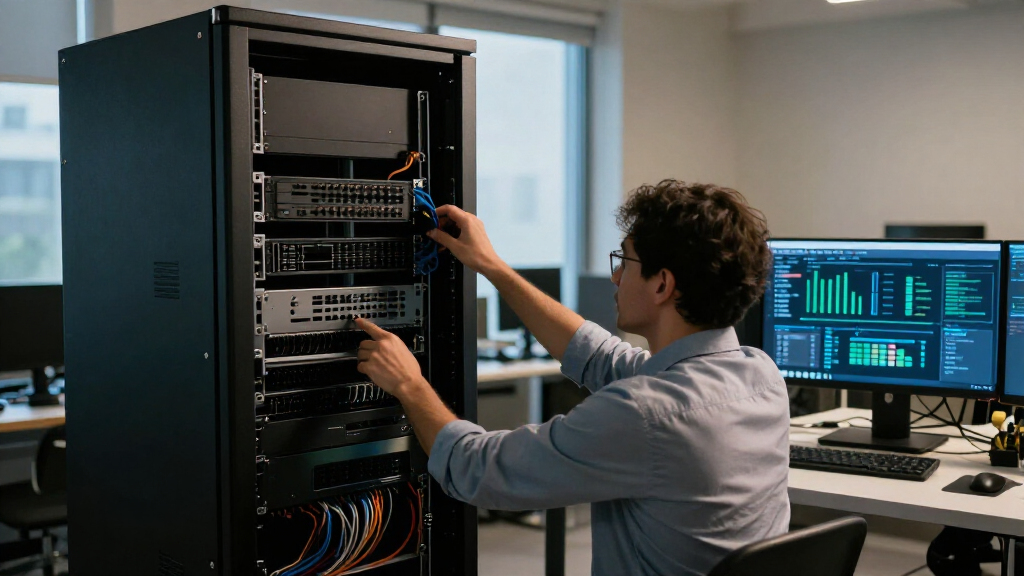
In the question-and-answer session of IBM’s third-quarter earnings call, Krishna said open-weight models cost “25% to 10% of the token cost” of frontier models while being “90% as effective.” He said a large enterprise could begin with two or three racks. The examples he gave for work that may not require the best available model included summarizing email, reviewing contracts and answering customer calls.
Krishna also linked on-prem deployment to data sovereignty, saying banks and trading firms may want to keep underlying data and logs within their control. Open weights, he said, give customers permission and intellectual-property rights to run models on their own infrastructure or private clouds. These are arguments from IBM’s CEO, a vendor that sells enterprise hardware; they are not independent findings about the cost or performance every customer will achieve.
Artificial Analysis’s Intelligence Index, read October 26, scored MiMo-V2.6-Pro at 46.3 and proprietary leader Claude Opus 5.5 at 57.6. That makes the downloadable model’s score about 80% of the leader’s on the index. Kimi K3.1 Pro scored 55.1, but its weights had not shipped: Moonshot had promised them “by Nov 4,” so it was not yet an available open-weight model at the time of the index check.
IBM's 90% claim, checked
Open weights reach 80% of the leader
Krishna says open-weight models are "90% as effective". On an independent index the best model you can download today reaches 80% of the best closed one, up from about half two years ago.
Best open model as a share of the best closed
Artificial Analysis Intelligence Index, current version, best downloadable vs. best proprietary model at each date.
What Krishna said
Illustrations from the earnings call, not a named benchmark.
- Late 2024"70" vs. "20 or 30"Krishna, Q3 call, 21 Oct · no named benchmark
- Late 2025"70 to 50"Krishna, Q3 call, 21 Oct · no named benchmark
- Now"90% as effective"Krishna, Q3 call, 21 Oct · no named benchmark
Top downloadable models today
Intelligence Index score and licence type. Read the licence before the leaderboard.
| Model | Index | Licence |
|---|---|---|
| MiMo-V2.6-Pro Xiaomi | 46.3 | MIT |
| DeepSeek V4.1 Flash 1017 DeepSeek | 45.1 | MIT |
| GLM-5.3 Z AI | 44.8 | own commercial licence |
| Step 5 Preview StepFun | 43.7 | own commercial licence |
| Muse Spark Open Meta | 38.9 | licence with conditions |
In points the gap did not shrink: 7.5 points at the end of 2024, 11.3 today. Closed models moved too.
Sources: Artificial Analysis, Intelligence Index v4.3.2 (read 26 Oct 2026), IBM Q3 2026 earnings call transcript (21 Oct 2026), Artificial Analysis on Kimi K3.1 Pro (23 Oct 2026).
Powered by Thorsten Meyer AI
The Cost of Running AI In-House
The dispute is not only about which model performs best. It is also about whether a company can run a sufficiently capable model more cheaply and with greater control than a hosted service. Open weights can give organizations more choice over where data is processed, but they also shift responsibility for computing capacity, deployment and technical support to the customer.
The source’s hardware comparison shows why utilization matters. An eight-GPU H200 server was listed from $172,643, while renting the same GPU class on AWS was listed at $63.30 an hour. At continuous full use, the purchase cost would equal roughly 114 days of rental; at 25% use, the estimate rises to about 15 months. Those figures exclude staff, cooling and networking, so they are not a complete cost comparison. A purchased system that spends much of its time idle may not deliver the expected savings.
Krishna acknowledged a related constraint: enterprises need engineers who can work on model kernels and networks. He said that capability gap remains for all but the most sophisticated enterprises. That caveat matters because lower token prices do not by themselves make an on-prem deployment straightforward or cheaper overall.
Products Worth Considering

Jackery Explorer 300 Portable Power Station, 292Wh

Jackery HomePower 3600 Plus Portable Power Station, 3584Wh, 3600W

Sonos Era 100 SL Compact Microphone-Free Speaker, Black
As an affiliate, we earn on qualifying purchases.
Scores, Licences and Availability
Krishna described model progress with illustrative comparisons: in late 2024, he said, a top model might score 70 against an open model’s 20 or 30; by late 2025, he put the comparison at 70 against 50. These were his examples, not scores from a named benchmark. Artificial Analysis offers a separate comparison, using the same ten evaluations for the models it covers. Its reported share of the proprietary leader’s score rose from 51% at the end of 2024 to 74% at the end of 2025, 68% at the end of June 2026 and 80% on October 26, 2026.
The current gap in index points is not smaller than the end-of-2024 gap in the supplied figures: it is 11.3 points, versus 7.5 then. The proportional gap narrowed because the scores rose, but the proprietary leader also moved. Scores describe results on that index; they do not establish that models perform equally across all business tasks.
Availability and licence terms also affect what “open” means in practice. The source identifies MiMo-V2.6-Pro and DeepSeek V4.1 Flash 1017 as MIT-licensed, while other models have their own commercial, custom or conditional licences. A model’s score alone does not say whether an organization can use it for a particular purpose. IBM also said its llm-d project can run large models at five to ten times lower cost; the source does not provide an independent measurement supporting that company claim.
The Open-Model Gap Is Not Settled
The index comparison does not settle whether open-weight models are “90% as effective” for a given company. It measures performance across its own evaluations, while business results depend on the task, model version and deployment conditions. Kimi K3.1 Pro’s promised weights could change the comparison if released, but they were not available on October 26. The source says no licence had been published and notes that its 2.8-trillion-parameter size would itself require data-center-scale resources.
The cost estimates also leave out important variables, including staff, cooling and networking, and rely on listed prices and assumed utilization. It is not clear what workload or utilization a specific enterprise would sustain, or whether IBM’s claims about on-prem cost and llm-d performance apply to its systems. IBM has a commercial interest in on-prem demand, and the source notes the company expects that demand to support sales of its Spyre cards.
Watch for Weights and Deployment Costs
The immediate model milestone is whether Moonshot releases Kimi K3.1 Pro’s weights by its stated November 4 target, and under what licence. Until then, its index score cannot be treated as evidence of an available open-weight option. New index results may also shift as models and evaluation versions change.
For enterprises weighing on-prem systems against rented compute, the next useful evidence will be deployment-specific: workload volume, sustained utilization, staffing and the full infrastructure bill. IBM’s earnings-call remarks set out the company’s case, but the supplied material does not establish how much customers will save in practice. The gap between model scores and total operating costs remains open.
Key Questions
What did IBM’s Arvind Krishna say about open-weight models?
On IBM’s October 21 earnings call, Krishna said open-weight models could cost 10% to 25% of frontier-model token costs while being “90% as effective.” That is his claim, not an independent measure of performance or savings.
How close is the best available open-weight model to the leading proprietary model?
In the Artificial Analysis Intelligence Index read October 26, MiMo-V2.6-Pro scored 46.3 against Claude Opus 5.5’s 57.6, or about 80% of the proprietary leader’s score on that index.
Is Kimi K3.1 Pro an open-weight model now?
Not according to the source’s October 26 status. Moonshot had promised the weights “by Nov 4,” but they had not shipped. Until release, it should not be counted as an available open-weight model.
Does buying an AI server guarantee lower costs than renting?
No. The supplied comparison estimates that an eight-GPU H200 server’s purchase price equals about 114 days of AWS rental at full utilization, or about 15 months at 25% utilization. It excludes staff, cooling and networking, and actual costs depend on a company’s workload.
Source: ThorstenMeyerAI.com