
Cognitive Load Theory shows you how managing your mental effort can boost productivity and learning in daily tasks. By breaking complex work into smaller steps, removing distractions, and using visual tools, you prevent overload that hampers focus and retention. Understanding your brain’s limits helps you prioritize and structure tasks better. If you continue exploring, you’ll discover simple ways to apply these principles and improve your efficiency even further.
Key Takeaways
- Managing mental effort prevents cognitive overload, enabling more efficient task completion in daily activities.
- Breaking complex tasks into smaller steps reduces working memory strain, improving productivity.
- Eliminating distractions and externalizing information helps maintain focus and reduces cognitive load.
- Prioritizing essential tasks and using visual aids support better understanding and task management.
- Regular breaks and structured routines help reset mental effort, enhancing focus and knowledge retention.
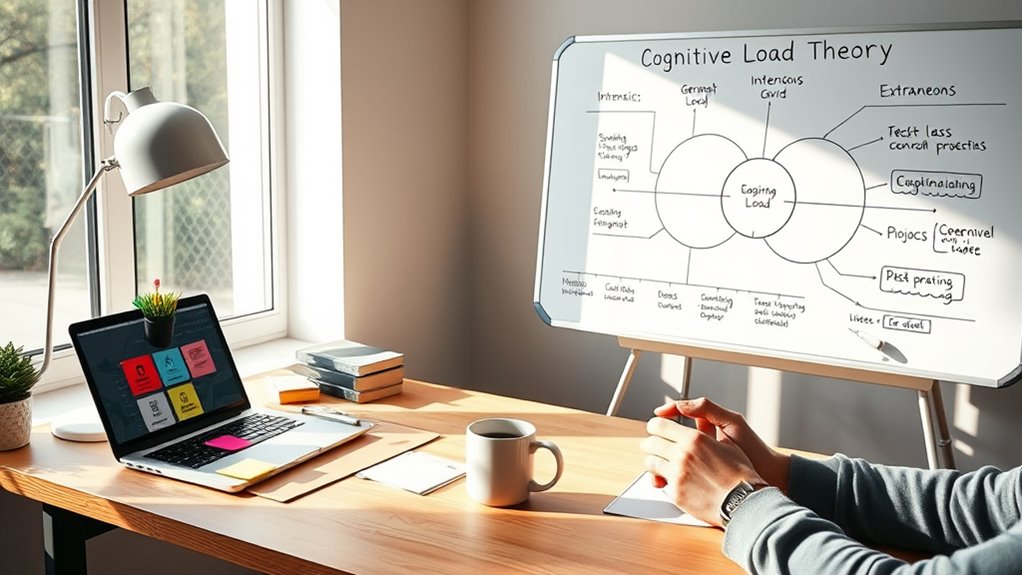
Cognitive Load Theory explains how the brain processes information during learning and why managing mental effort is essential for effective education. When you’re trying to learn new skills or absorb complex information, your working memory plays a vital role. It temporarily holds and manipulates data needed for understanding, problem-solving, or decision-making. However, working memory has limited capacity, which means if you overload it with too much information at once, your ability to process and retain that information diminishes considerably. That’s where managing mental effort comes into play. If you push your mental resources too hard or present information in a cluttered, overwhelming way, you’ll struggle to grasp key concepts or complete tasks efficiently.
Effective learning depends on managing your mental effort and respecting working memory limits.
In everyday productivity, understanding how to optimize your mental effort can make a big difference. When you approach tasks, be aware of how much information you’re trying to juggle simultaneously. For example, if you’re working on a complex report, breaking it into smaller, manageable parts reduces the load on your working memory. This approach prevents you from feeling overwhelmed and helps you maintain focus. Additionally, eliminating unnecessary distractions during important tasks minimizes extraneous mental effort, allowing you to dedicate more cognitive resources to the core activity. Recognizing how cognitive overload impacts your ability to focus is crucial for maintaining efficiency.
You can also use strategies that align with Cognitive Load Theory to boost your efficiency. Prioritize tasks to avoid multitasking, which fragments your mental effort and can lead to errors or fatigue. When learning new skills, focus on understanding fundamental concepts first before moving to advanced details. This sequencing reduces the cognitive load, making it easier to build on existing knowledge without straining your working memory. Visual aids, such as charts or diagrams, can also help by externalizing some of the cognitive effort, freeing up your working memory for higher-level thinking.
Furthermore, adopting a mindful approach to mental effort helps you recognize when you’re reaching cognitive overload. Take regular breaks to give your brain a chance to reset, which prevents mental fatigue and enhances overall productivity. Being intentional about how much information you take in at once and structuring tasks in a way that minimizes unnecessary cognitive strain allows you to work smarter, not harder. Ultimately, understanding and applying the principles of Cognitive Load Theory in your daily routines enables you to manage your mental effort more effectively, leading to better learning, sharper focus, and increased productivity.

3-in-1 Visual Timer & ADHD Tool for Kids – ADHD Task Timer for Adults with Visual Schedule, Chore Chart & Planning Board for Home, School, Classroom, Work (White)
- 3-in-1 Visual Timer: Countdown, digital clock, planning board
- Visual Schedule & Chore Chart: Helps manage daily tasks and routines
- Easy Time Management: Rainbow display, simple controls, adjustable alarms
As an affiliate, we earn on qualifying purchases.
As an affiliate, we earn on qualifying purchases.
Frequently Asked Questions
How Can I Reduce Cognitive Load During Multitasking?
To reduce cognitive load during multitasking, you should focus on task prioritization by tackling the most important tasks first. Avoid distractions by managing your environment—turn off notifications and create a dedicated workspace. Break larger tasks into smaller steps to make them manageable. Staying organized and limiting interruptions helps keep your mental effort focused, making multitasking more efficient and less overwhelming.
What Are Common Signs of Cognitive Overload?
Your mind is like a sponge nearing saturation—signs of cognitive overload become clear. You may experience mental fatigue, feeling drained after tasks that once seemed simple. Information overload causes distractions, making it hard to focus or remember details. You might also feel overwhelmed, anxious, or struggle to prioritize. Recognizing these signs helps you step back, recharge, and manage your cognitive load before burnout takes hold.
How Does Sleep Affect Cognitive Load and Productivity?
Sleep plays a crucial role in managing your cognitive load and boosting productivity. When you get quality sleep, your dream recall improves, helping process emotions and memories. Good sleep hygiene ensures you rest well, reducing mental fatigue. If you neglect sleep, your ability to focus and handle tasks diminishes, increasing cognitive overload. Prioritizing sleep supports mental clarity, making it easier to stay productive and retain information throughout the day.
Can Cognitive Load Theory Improve Time Management Skills?
They say “less is more,” and that’s true for time management. By reducing mental clutter and decision fatigue, you can prioritize tasks better and avoid burnout. Cognitive Load Theory helps you understand how too much information overload hampers your efficiency. Applying its principles, you streamline your workload, make smarter decisions, and manage your time more effectively — turning chaos into clarity and productivity.
Are There Specific Exercises to Enhance Cognitive Load Capacity?
You wonder if there are specific exercises to boost your cognitive load capacity. To enhance your mental agility, try focus techniques like mindfulness meditation and attention control drills. Mental exercises such as memory games, puzzles, or task-switching activities also challenge your brain, strengthening its capacity. Regular practice helps you manage cognitive load better, improving your focus and productivity in everyday tasks. Incorporate these exercises consistently for noticeable improvements.
Conclusion
By understanding cognitive load, you reveal a secret akin to Da Vinci’s mastery—simplifying complexity to boost your productivity. When you manage your mental space wisely, you clear the path like a river freed from debris, allowing ideas to flow effortlessly. Remember, just as the sun rises to illuminate shadows, reducing unnecessary mental clutter brightens your focus. Embrace these principles, and watch your everyday tasks transform into opportunities for mastery, one mindful step at a time.