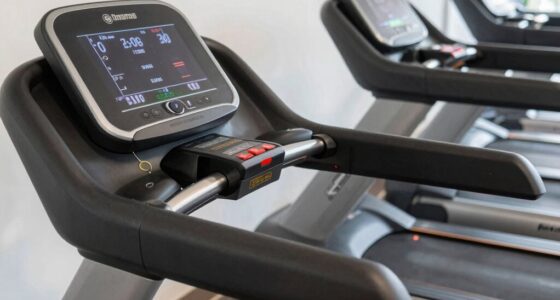
VO2 max measures how efficiently your body delivers and uses oxygen during intense exercise, making it the most quoted fitness metric for aerobic capacity. It reflects your cardiovascular health and endurance level, helping track progress and performance. You can measure it through lab tests or estimate with simple field tests. Improving your VO2 max involves interval training, steady cardio, and maintaining overall health. Keep going to discover how to boost this key indicator of fitness.

Get the latest gadgets delivered free with Prime
- Fast, free delivery on millions of items
- Prime Video, Amazon Music and more included
- Member-only deals all year
Key Takeaways
- VO2 max measures the maximum oxygen your body can utilize during intense exercise.
- It reflects aerobic capacity and overall cardiovascular fitness.
- Higher VO2 max indicates better endurance and athletic performance.
- It can be measured through lab tests or estimated with field tests.
- Regular training and healthy habits can improve VO2 max over time.

Have you ever wondered what your body’s maximum ability is to take in and use oxygen during intense exercise? That’s where VO2 max comes into play. It’s a key fitness metric that measures your aerobic capacity — how effectively your body can deliver oxygen to your muscles during strenuous activity. Understanding your VO2 max can help you gauge your cardiovascular fitness level and track your progress as you train. To improve it, you need to focus on specific training techniques that push your limits, like interval training, long-distance cardio, or high-intensity workouts. These methods challenge your heart and lungs to work more efficiently, gradually increasing your VO2 max over time.
Measuring your VO2 max isn’t as complicated as it sounds, but it does require specific measurement methods. The most accurate way involves a laboratory test, where you wear a mask connected to a machine that measures the volume of oxygen you breathe in and the amount of carbon dioxide you exhale while you exercise on a treadmill or cycle ergometer. This test progressively increases in intensity until you reach exhaustion, providing precise data about your maximum oxygen uptake. However, for most people, field tests like the Cooper Test or the Rockport Fitness Walking Test offer practical alternatives. These involve running or walking a set distance or time, then estimating your VO2 max based on your performance and heart rate data. Incorporating standardized assessment methods can give more reliable insights into your fitness level. Additionally, measurement methods are evolving as technology advances, making it easier to track progress outside of lab settings.
Your training techniques can significantly influence your VO2 max. Incorporating interval workouts, where you alternate between high and low intensities, forces your cardiovascular system to adapt and grow stronger. Steady-state cardio, like running or cycling at a consistent pace, also helps build endurance and increases oxygen efficiency. Strength training can complement these efforts by improving muscle efficiency, allowing your body to utilize oxygen more effectively during activity. Consistency is essential — making these training techniques a regular part of your routine will lead to measurable improvements over weeks and months. Additionally, oxygen consumption is a fundamental aspect of this metric that reflects your body’s ability to utilize oxygen during exercise. Maintaining a balanced diet and proper hydration can also support optimal oxygen transport and utilization, enhancing your overall training results.
Products Worth Considering

LG UltraGear 32GX850A-B 32-inch 4K UHD Glossy OLED Gaming Monitor

LG UltraGear 34GX90SA-W 34-inch WQHD Curved OLED Gaming Monitor

LG UltraGear 32GS60QC-B 32-inch Curved QHD Gaming Monitor (180Hz, 1ms, 1000R, AMD FreeSync, HDR10)
As an affiliate, we earn on qualifying purchases.
Frequently Asked Questions
How Often Should I Test My VO2 Max?
You should test your VO2 max every 8 to 12 weeks to track progress, especially if you’re training consistently. This frequency allows you to see improvements without overtaxing your body. Remember, recovery strategies like proper rest and nutrition are essential between tests, ensuring accurate results and preventing burnout. Regular testing helps you adjust your workouts effectively, keeping your training aligned with your fitness goals.
Can VO2 Max Improve With Age?
Yes, VO2 max can improve with age if you engage in consistent training. Although there’s an age-related decline, regular aerobic exercise promotes training adaptations that help maintain or even boost your VO2 max. By staying active and challenging yourself with endurance workouts, you counteract the natural decline caused by aging, ensuring you maximize your fitness potential and keep your cardiovascular health in check.
Is VO2 Max the Only Indicator of Endurance?
While VO2 max is a valuable measure of endurance, it’s not the only indicator. Your overall stamina also depends on training techniques, mental resilience, and muscular efficiency. To get a fuller picture, consider combining VO2 max assessments with other performance metrics, ensuring measurement accuracy. This balanced approach helps you understand your fitness landscape better, guiding you toward personalized training strategies that boost your endurance beyond just cardiovascular capacity.
How Does Altitude Affect VO2 Max Readings?
Altitude decreases your VO2 max readings because your body struggles with lower oxygen saturation levels. As you ascend, your body initiates altitude adaptation to improve oxygen delivery, but initially, your VO2 max drops. This reduction reflects the challenge your cardiovascular system faces in supplying enough oxygen. Over time, with acclimatization, your body adapts, and VO2 max improves, though it may still remain below sea level levels during the adjustment period.
Are VO2 Max Results Different for Men and Women?
Yes, VO2 max results differ between men and women due to gender differences and physiological factors. Men generally have higher VO2 max values because of larger heart sizes, greater muscle mass, and higher hemoglobin levels, which improve oxygen transport. Women typically have lower VO2 max scores, but both genders can improve their fitness through training. Understanding these differences helps tailor workouts and set realistic goals for each individual.
Conclusion
Understanding your VO2 max isn’t just about numbers—it’s about revealing your potential, much like a key opens a door. While it might seem like a complex fitness metric, it’s simply a reflection of your body’s ability to use oxygen during exercise. Think of it as your personal fuel gauge; the higher it is, the farther you can go. So, keep pushing, stay consistent, and let your VO2 max tell the story of your progress.