
📊 Full opportunity report: TRT Lab Tracking: Connect Results With How You Feel on IdeaNavigator AI — validation score, market gap, and execution plan.

Get the latest gadgets delivered free — and shop member deals
- Fast, free delivery on millions of items
- Access to Prime Big Deal Days deals on October 6–7
- Prime Video, Amazon Music and more included
TL;DR
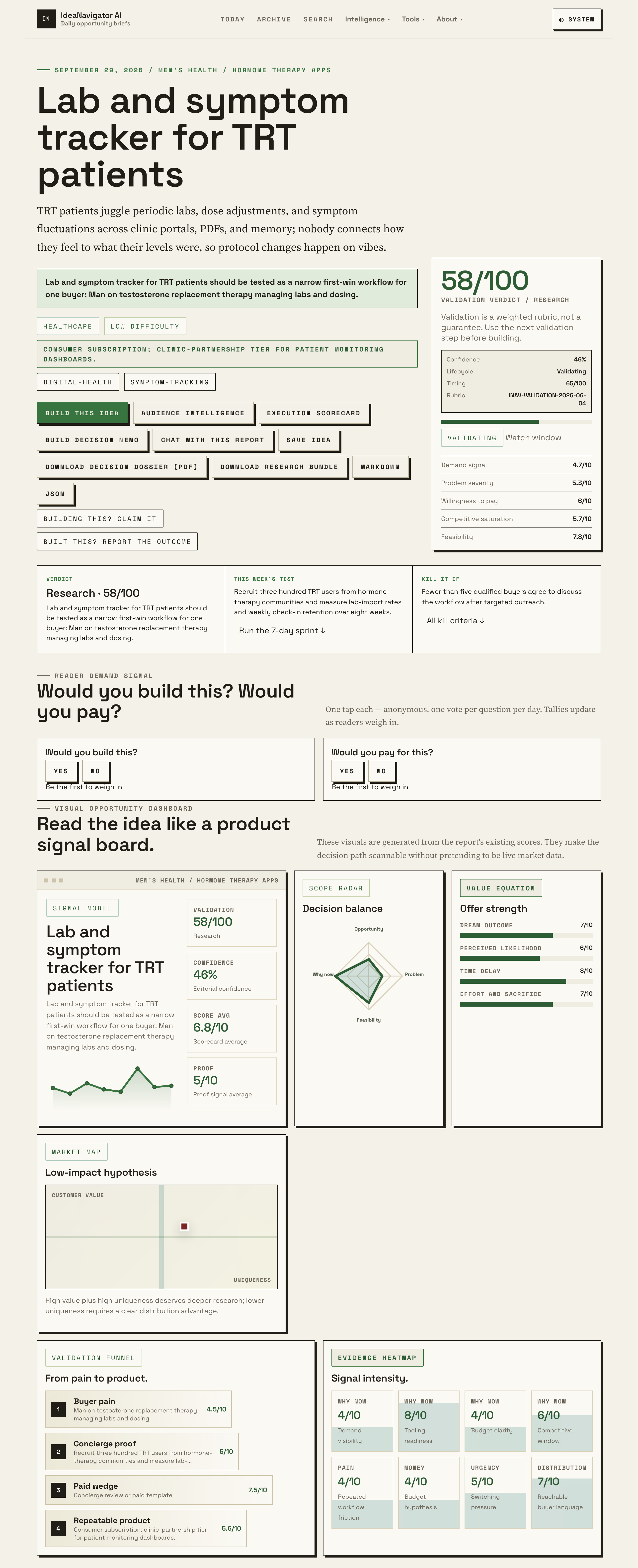
IdeaNavigator AI has outlined a proposed tracker for men managing testosterone replacement therapy, combining imported lab results, dose changes and daily symptom check-ins. The concept includes clinic summaries and alerts, but no finished app, clinical evaluation or user-validation results are reported.
IdeaNavigator AI has outlined a proposed lab and symptom tracker for men receiving testosterone replacement therapy (TRT), with a planned app workflow that would connect hormone test results to dose changes and daily reports of how patients feel. The listing describes a product opportunity and a way to test demand; it does not report that an app has launched or that the proposed approach has been evaluated.
The IdeaNavigator AI listing says the concept targets men who manage TRT labs and dosing across clinic portals, PDF reports and personal recollection. Its premise is that test results, treatment changes and symptoms can be difficult to review together when stored in separate places. The listing says patients may make protocol changes without a clear record linking how they felt to measured hormone levels. That is the proposal’s account of the problem, not a finding from a published patient study.
According to the listing, the proposed minimum viable product would let users import lab PDFs, chart hormone panels over time, mark dose changes and record symptoms each day. It would also generate summaries for clinic visits and flag results outside target ranges. The listing does not specify which lab markers or target ranges the app would use, how clinicians would set those ranges, or how alerts would be reviewed.
IdeaNavigator AI describes two possible revenue streams: a consumer subscription and a clinic partnership tier with patient-monitoring dashboards. The listing’s suggested validation plan is to recruit 300 TRT users through hormone-therapy communities and track lab-import rates and weekly check-in retention for eight weeks. Those figures describe a proposed test, not participants already recruited or results already collected.
Linking Symptoms to TRT Records
If built and adopted, a shared timeline could help patients and clinicians review lab results, doses and symptoms in one place during treatment discussions. A record that includes dates and dose changes may make it easier to spot patterns worth raising at an appointment, rather than relying on memory or scattered documents. The concept could also make routine tracking more consistent for people whose care involves multiple providers.
That potential depends on how the information is interpreted. A symptom entry alongside a lab result does not establish that one caused the other, and an alert outside a selected range is not a diagnosis or treatment instruction. For readers, the immediate development is a product proposal, not evidence that a tracker improves care, changes prescribing decisions or prevents adverse outcomes.
A Proposed Workflow for TRT Care
The IdeaNavigator AI listing places the concept in the men’s health and hormone-therapy app market. It says TRT prescriptions and telehealth clinics have grown, leaving more patients to manage records across services. The listing offers that as the reason the concept may be timely, but provides no prescription counts, clinic figures or market-size data to quantify the trend.
The proposal focuses on a narrow user group and a defined sequence: import a lab report, record treatment dosing, check in about symptoms and prepare a summary for a clinic visit. This makes the idea more specific than a general wellness tracker. Still, the listing reports no product, development team, clinic partner or release schedule, and includes no named clinician or patient quotes.
Product and Clinical Details Missing
The IdeaNavigator AI listing does not say whether development has started, who would build or operate the app, or whether any clinics have agreed to use it. It also provides no privacy or data-security design, despite the proposed collection of health records and symptom reports. Those details would affect whether patients and providers could use the product in practice.
Clinical handling is also unspecified in the listing. It does not explain how target ranges would be chosen, whether they would vary by patient or clinic, how abnormal results would be checked, or whether alerts would be reviewed by a medical professional. The listing provides no evidence that the suggested charts or summaries lead to better decisions. Its proposed 300-person, eight-week test has no reported start date, recruitment status or results.
Testing User Interest and Retention
IdeaNavigator AI’s listing describes a next step of recruiting 300 TRT users and measuring two engagement signals over eight weeks: how often users import lab results and whether they keep up weekly symptom check-ins. If carried out, those measures could show whether the core workflow attracts repeat use. They would not, on their own, establish clinical benefit or confirm that patients’ treatment is safer or more effective.
The listing includes no launch, trial or follow-up announcement, so it remains unclear whether the proposed validation will proceed. Further reporting would depend on an update about recruitment, a working product, clinic involvement and how health data and medical alerts would be handled.
Source: IdeaNavigator AI listing
Key Questions
Has a TRT lab and symptom tracker launched?
The IdeaNavigator AI listing describes a proposed app concept. It does not report a launch or identify a product available to patients.
What would the proposed app track?
The planned workflow would combine imported lab PDFs, dose changes and daily symptom check-ins, then chart trends and prepare summaries for clinic visits.
Has the proposed 300-person test begun?
The IdeaNavigator AI listing gives no start date or recruitment update. Recruiting 300 TRT users for eight weeks is presented as a validation plan, with lab-import rates and weekly check-in retention as measures.
Would the app recommend TRT dose changes?
The listing proposes charts, clinic summaries and alerts for values outside target ranges. It does not say that the app would recommend dose changes or specify how a clinician would review alerts.
Source: IdeaNavigator AI
Fall Picks
fall essentials
As an affiliate, we earn on qualifying purchases.