
🔍 Read the full analysis: The Five-Dollar Day And Ford’s Assembly Line Era on ThorstenMeyerAI.com

Get the latest gadgets delivered free with Prime
- Fast, free delivery on millions of items
- Prime Video, Amazon Music and more included
- Member-only deals all year
TL;DR
Ford cut its workday from nine hours to eight and raised minimum daily pay to $5 on Jan. 5, 1914, amid severe workforce turnover at its Detroit plant. The change followed sharp productivity gains from the moving assembly line, but Ford tied the higher pay to eligibility rules; the evidence presented here does not support the popular claim that the main aim was to help workers buy cars.
Ford Motor Co. raised its minimum daily pay to $5 and cut the workday from nine hours to eight on Jan. 5, 1914, as workers left its Detroit factory at exceptionally high rates after the introduction of the moving assembly line. The policy, described as profit sharing and subject to strict conditions, was a response to a staffing problem at a plant whose new production methods had made car assembly much faster.
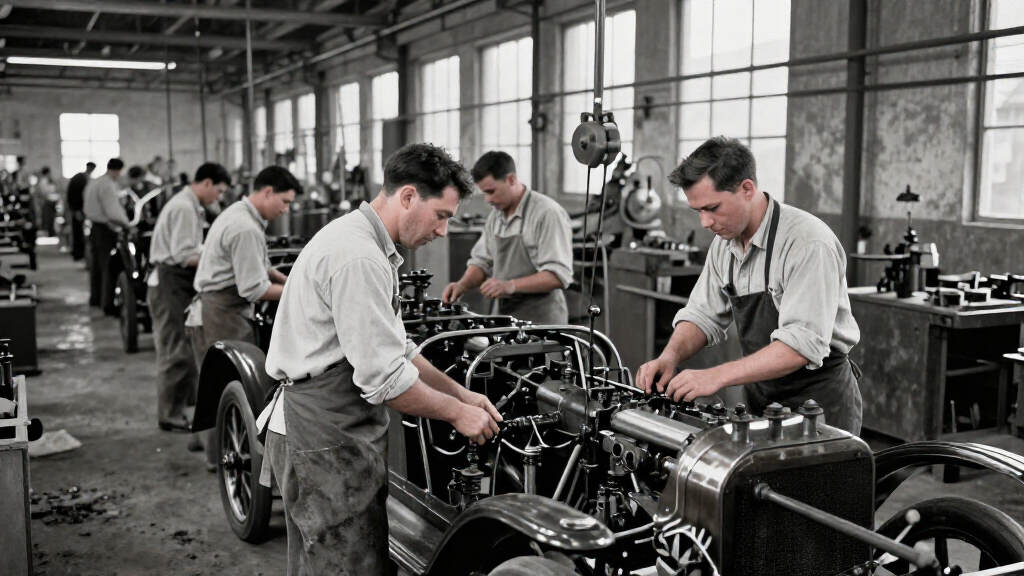
The assembly line changed how work was organized at Ford’s Highland Park plant. Instead of workers building a car around a stationary chassis, parts moved past workers assigned narrower, repeated tasks. In his 1922 book My Life and Work, Henry Ford said the company’s best average for assembling a chassis while it stood still was 12 hours and 28 minutes of labor. By early 1914, the moving line had cut that figure to 1 hour and 33 minutes, a reduction of about 88% in labor time per chassis, based on Ford’s account.
Higher production efficiency did not mean a stable workforce. A 1987 study by economists Daniel Raff and Lawrence Summers reported that Ford made 50,448 hires in 1913 to maintain an average workforce of 13,623. That amounts to turnover of about 370% under the study’s measure. The source account also reports that about one in ten workers was absent on an average day. Ford later wrote that the company had to hire at a rate of roughly 53,000 workers a year in 1914 to keep a force of 14,000.
The five-dollar day was not an unconditional wage increase for every employee. Ford’s announcement combined the higher minimum daily pay with an eight-hour schedule, while the additional money was paid under a profit-sharing plan with eligibility requirements. The source account says turnover fell to 54% in 1914. That outcome is consistent with the policy addressing retention, though the figures alone do not isolate the effect of higher pay from other changes at the company.
How Higher Pay Addressed Turnover
The policy matters because it shows how Ford’s production system depended on more than machinery and speed. The moving line reduced the labor time needed per chassis, but its repetitive pace and tightly divided tasks coincided with a workforce that was difficult to retain. Ford’s pay and hours change was a management response to the costs of recruiting and replacing workers, not simply a reward for rising output.
The distinction also complicates the familiar story that Ford raised wages primarily so his employees could afford his cars. The source account notes that the company’s immediate problem was workers leaving, rather than an inability to sell vehicles. It gives production of about 250,000 cars and a workforce of about 14,000 around 1914. Those figures provide context, but do not by themselves establish every motive behind the decision. The documented turnover problem offers a more direct explanation for why the company changed its pay policy.
For readers looking at the history of work, the episode illustrates a recurring tension: productivity gains can make production more efficient while also making jobs harder to sustain. The source account says U.S. factory employment grew by about a third between 1910 and 1920, even as assembly-line methods spread. That broad figure suggests the line did not immediately eliminate factory work, though it changed how that work was organized. The account also notes that assembly lines remain in use, with more tasks now performed by robots.
Products Worth Considering

Kindle Paperwhite 16GB (2024) – 7 Glare-Free Display, Weeks Battery Life – Black

Kindle Paperwhite Signature Edition 32GB (2024) – Auto-adjusting front light, wireless charging, weeks of battery life – Metallic Black

Amazon Kindle Scribe (64GB) with Premium Pen, Metallic Jade
As an affiliate, we earn on qualifying purchases.
From Stationary Chassis to Moving Line
Ford began experimenting with an assembly line in 1913, first applying it to the flywheel magneto, a small generator used in the ignition system. Ford wrote that the company divided magneto assembly into 29 operations and moved the part past workers. In his account, the time to assemble one fell from about 20 minutes to 13 minutes and 10 seconds; subsequent adjustments brought it lower. These are figures reported by Ford, rather than independent measurements in the source material.
The company then adapted the method for the Model T chassis. In an early trial, workers moved alongside a chassis pulled down a 250-foot line, reducing labor time to 5 hours and 50 minutes. Further changes to the line and division of tasks brought the figure to 1 hour and 33 minutes by early 1914. Ford described the method as reducing the worker’s need to think through a job and minimizing movements. The account’s figures show what the company’s production system sought: standardized, divided tasks carried out as parts moved through the plant.
The source identifies Ford’s 1922 autobiography, written with journalist Samuel Crowther, as the basis for many production details. It also cites Raff and Summers’ 1987 paper, which drew on earlier labor research and company surveys for turnover figures. Those sources have different roles: Ford’s book presents the company’s account of its methods, while the later study examines the wage policy and turnover using historical data.
Limits of the Historical Record
The figures rely on sources with different methods and perspectives. Ford’s production times come from his own account, and should be read as company-reported figures. The 1987 study provides a later analysis of turnover, but the material summarized here does not include enough detail to assess every underlying record or how the turnover rate was calculated against alternative measures. The Henry Ford museum’s estimate, cited in the source account, is slightly higher at about 380%.
It is also not clear from the supplied material how many workers actually received the full five dollars on a given day, how the eligibility conditions operated in practice, or how much of the fall in turnover resulted from pay rather than the shorter workday or other workplace changes. The account gives no detailed breakdown of the plan’s conditions or a comparison with a similar factory that did not adopt it. Ford’s claim that the policy cut costs is a retrospective characterization, not a complete accounting of its effects.
The Evidence Behind the Pay Change
The historical account’s next step is to trace how the assembly line and workforce changes fit together: the sequence of production experiments, the scale of employee departures, and Ford’s decision to change pay and hours. For a fuller assessment, readers would need the original company surveys and a close reading of the labor studies cited, including their definitions of turnover and their treatment of workers who stopped attending without formally quitting.
No new corporate announcement or continuing policy change is described here; the event is historical, not developing. The main open task is to distinguish what Ford reported about its production system from what later researchers established about worker turnover, and to assess how far the five-dollar day itself explains the decline in departures.
Key Questions
What did Ford change on Jan. 5, 1914?
Ford cut the scheduled workday from nine hours to eight and raised minimum daily pay to $5. The higher pay was described as profit sharing and carried conditions.
Why did Ford introduce the five-dollar day?
The source account presents severe turnover as the immediate problem. Ford had to hire tens of thousands of people in 1913 to maintain an average workforce of about 13,600. The account does not establish that retention was the only consideration.
How much faster did the moving line make chassis assembly?
According to Henry Ford’s 1922 account, labor time per chassis fell from 12 hours and 28 minutes when the chassis stood still to 1 hour and 33 minutes by early 1914 on the moving line.
Did Ford raise wages so workers could buy cars?
The source account calls that explanation a legend and says the company’s immediate challenge was workers leaving, not a lack of customers. The material supports turnover as a key reason for the policy, but does not settle every motive behind Ford’s decision.
Did the higher pay end turnover?
No. The account reports turnover falling to 54% in 1914, down from about 370% in 1913, but still records substantial worker replacement. It does not show that turnover disappeared or isolate the pay increase’s effect from other changes.
Source: ThorstenMeyerAI.com