

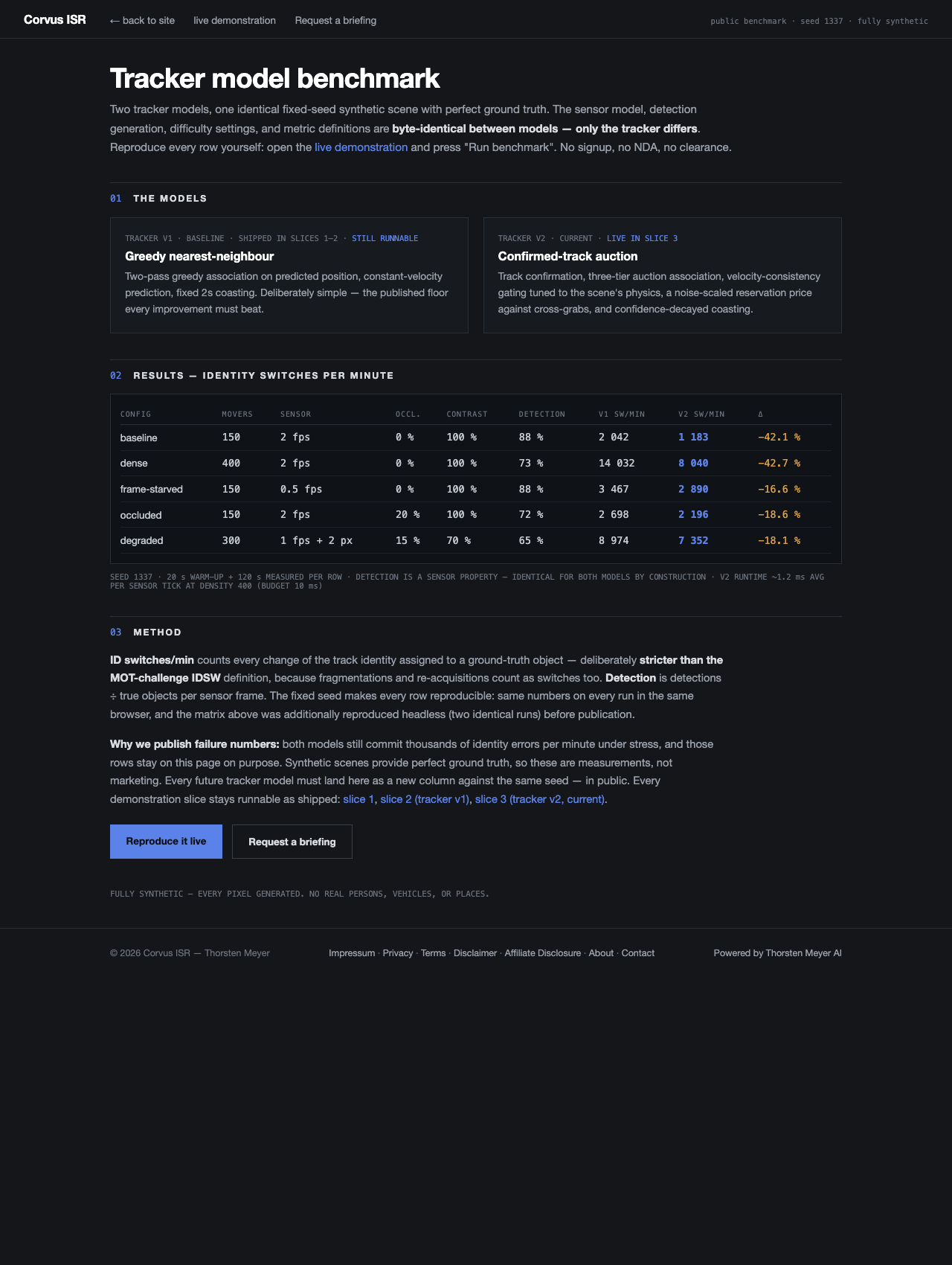
In the realm of wide-area motion imagery (WAMI), the challenge of consistently tracking multiple moving objects is critical. CORVUS ISR has published its latest public tracker benchmark, comparing two different models on a synthetic scene with perfect ground truth. This synthetic environment allows for precise measurement of tracking performance, including the often-elusive metric of identity switches.

Get the latest gadgets delivered free with Prime
- Fast, free delivery on millions of items
- Prime Video, Amazon Music and more included
- Member-only deals all year
The baseline model, v1, employs a simple greedy nearest-neighbour approach with two-pass association and fixed velocity prediction. While functional, it tends to produce a high rate of identity errors, especially under stress. The newer model, v2, introduces an auction-based tracker with three-tier association, velocity consistency, and noise-scaled reservation pricing, significantly reducing identity switches. It’s a clear example of how advanced algorithms can improve tracking robustness in complex scenes.
Results from the benchmark reveal that for scenes with 150 movers at 2 frames per second, the v1 model registers around 2,042 ID switches per minute. In contrast, v2 drops this number to approximately 1,183 switches, marking a 42% improvement. Similar gains are observed in denser scenes with 400 movers: ID switches drop from 14,032 to 8,040, again a reduction of over 42%. These improvements are vital for applications demanding high accuracy and reliability in object identity preservation.
Understanding the importance of honest measurement, the benchmark counts every change in track identity, including fragmentations and re-acquisitions, making it a stricter metric than traditional MOT challenges. Despite the improvements, both models still commit thousands of errors per minute under challenging conditions. The data, published openly, underscores that even advanced models are far from perfect, especially in synthetic scenes designed for rigorous testing.
Beyond accuracy, the engineering performance of v2 is notable. It averages around 1.2 milliseconds per sensor tick at a density of 400 objects, comfortably fitting within real-time constraints. The entire process is transparent and accessible—anyone can reproduce the results by visiting the live demo and clicking “Run benchmark” — no signup or NDA required.
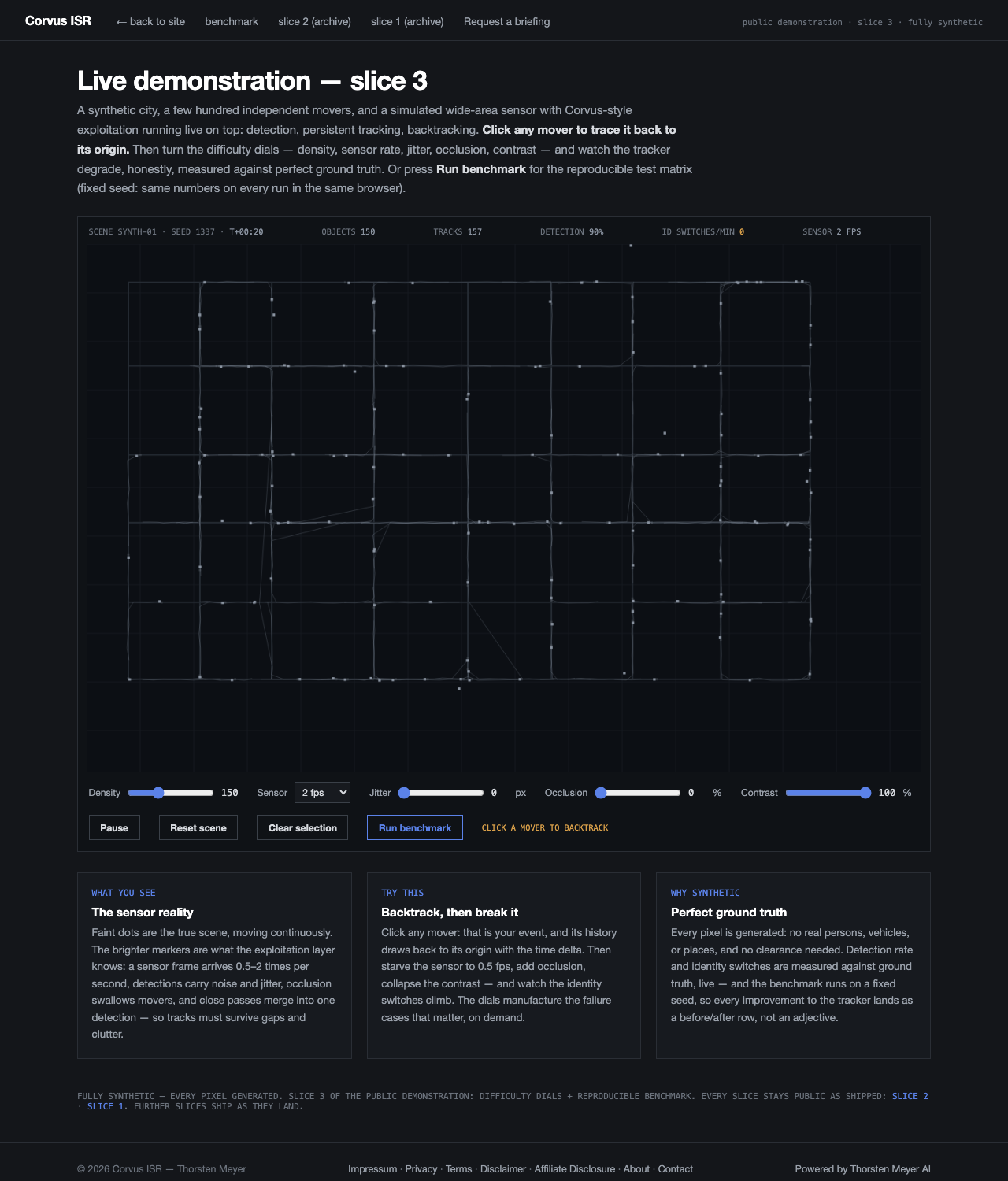
Built with an AI executor guided by a formal contract and an independent review, v2 demonstrates how machine learning and sophisticated algorithms can advance the state of multi-object tracking. Since every pixel is synthetically generated, these results focus purely on measurement, not marketing. For tech enthusiasts and developers, this benchmark offers a clear view of current capabilities and a challenge to improve further. Feel free to try it yourself and see how your tracker stacks up against the published numbers.
As an affiliate, we earn on qualifying purchases.
Halloween Picks
halloween
As an affiliate, we earn on qualifying purchases.