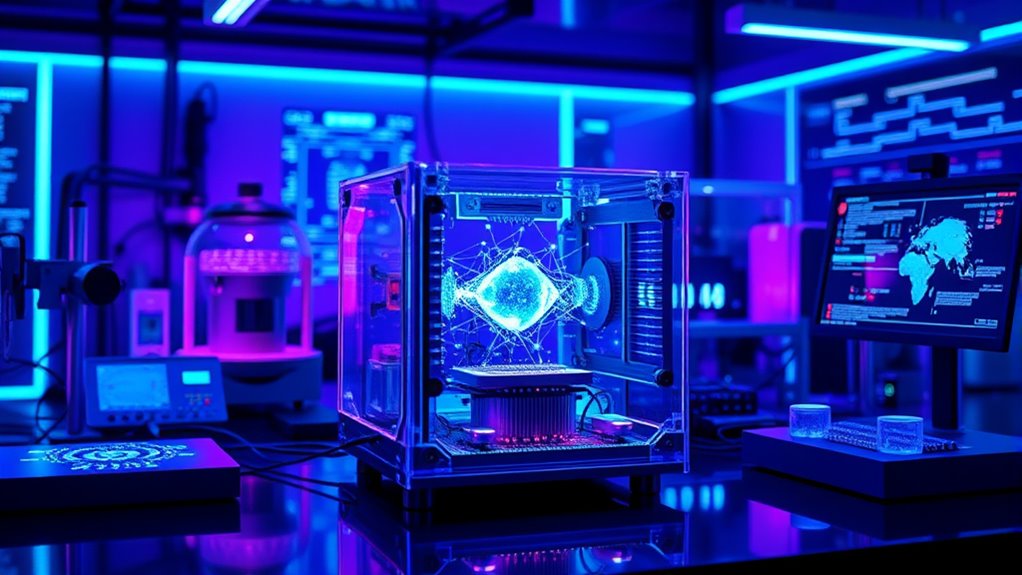

Quantum random number generators use the unpredictable nature of quantum physics, like entanglement and measurement uncertainty, to produce truly random numbers. When you measure a quantum system, outcomes become inherently uncertain and can’t be predetermined, ensuring high security for cryptography and secure communications. This method guarantees true randomness based on fundamental physics, not algorithms. Want to understand the science behind how they work and why they’re so reliable? Keep exploring to discover more.
Key Takeaways
- QRNGs utilize quantum phenomena like entanglement and measurement uncertainty to produce truly unpredictable random numbers.
- They rely on the inherent non-deterministic nature of quantum mechanics, unlike classical pseudo-random algorithms.
- Measurement of quantum states introduces fundamental unpredictability, ensuring high-quality randomness.
- Quantum entanglement links particles so that measurement outcomes are inherently unpredictable and cannot be predetermined.
- These generators are vital for secure cryptography and advanced quantum technologies due to their guaranteed true randomness.
Quantum random number generators (QRNGs) harness the unpredictable nature of quantum phenomena to produce truly random numbers. Unlike traditional algorithms that generate pseudo-random sequences based on deterministic processes, QRNGs rely on the fundamental principles of quantum mechanics. This means the randomness they produce isn’t just complicated or difficult to predict—it’s inherently unpredictable. This intrinsic unpredictability stems from two key quantum concepts: quantum entanglement and measurement uncertainty.
When you use a QRNG, you’re tapping into the strange world of quantum entanglement, where particles become linked in such a way that the state of one instantly influences the state of another, regardless of distance. In some QRNG designs, entangled particles are prepared in a way that measuring one instantly determines the outcome of measuring the other. This correlation contributes to the generation of random numbers because the measurement results are fundamentally unpredictable until performed. The entanglement ensures that no hidden variables can determine the outcome beforehand, guaranteeing true randomness rooted in quantum physics.
Measurement uncertainty, another cornerstone, plays a pivotal role in the unpredictability of QRNGs. According to quantum mechanics, certain properties of particles—like spin or polarization—are inherently uncertain until measured. When you perform a measurement on a quantum system, you inevitably introduce uncertainty into the outcome. This isn’t due to technical flaws but a fundamental feature of the quantum world. As a result, the measurement outcomes you obtain from a QRNG are genuinely unpredictable, making the generated numbers truly random. This measurement uncertainty guarantees that no pattern or bias can be discerned, which is essential for applications requiring high levels of security, such as cryptography.
Frequently Asked Questions
How Secure Are Quantum Random Numbers Against Future Hacking Methods?
You’re wondering how secure quantum random numbers are against future hacking. Quantum hacking is a concern, but quantum random number generators (QRNGs) produce true randomness, making predictability nearly impossible. This unpredictability strengthens security, even as hacking methods evolve. While no system is entirely invulnerable, QRNGs profoundly reduce risks associated with randomness predictability, offering a robust defense against future cyber threats and ensuring your data remains protected.
Can Quantum Random Number Generators Be Integrated Into Existing Cryptographic Systems?
You can integrate quantum random number generators into existing cryptographic systems, but you’ll face compatibility challenges with classical systems. These generators produce superior randomness, enhancing security, but integrating them may require upgrades to hardware and software. Careful planning and testing are essential to guarantee seamless classical integration, so your cryptographic systems remain robust without disrupting current operations. Overcoming these challenges can substantially boost your security posture.
What Are the Main Limitations of Current Quantum Random Number Generators?
Did you know that current quantum random number generators (QRNGs) often produce fewer than a million bits per second? Their main limitations include scalability challenges and hardware complexity, making widespread adoption difficult. You might find that developing more efficient, miniaturized devices is essential, but the intricate hardware and need for precise quantum control hinder progress. Overcoming these issues is vital for integrating QRNGs into everyday cryptography.
How Does Environmental Noise Affect the Output of Quantum Generators?
Environmental noise can critically impact the output of quantum generators by causing environmental interference, which distorts the quantum signals. This interference introduces errors and reduces randomness quality. To combat this, noise mitigation strategies are essential, such as isolating the system from external disturbances and using advanced shielding. By effectively managing environmental interference, you can guarantee more reliable and pure quantum-generated randomness, enhancing the generator’s overall performance.
Are Quantum Random Number Generators Cost-Effective for Widespread Use?
Think of quantum random number generators as rare gems in a vast market. While they offer unmatched security and true randomness, their cost comparison to classical methods can seem steep. You might face scalability challenges as integrating them into widespread use requires overcoming production and infrastructure hurdles. However, their unique benefits make them worth considering for high-stakes applications, even if they’re not yet the most budget-friendly option on the block.
Conclusion
Now that you understand how quantum random number generators work, you see their potential for secure communication and cryptography. They harness the unpredictable nature of quantum mechanics to produce truly random numbers, making hacking nearly impossible. Isn’t it fascinating how science reveal such powerful tools from the tiniest particles? As technology advances, these generators will become even more essential in safeguarding your digital world. Isn’t it exciting to imagine what the future holds with quantum randomness?