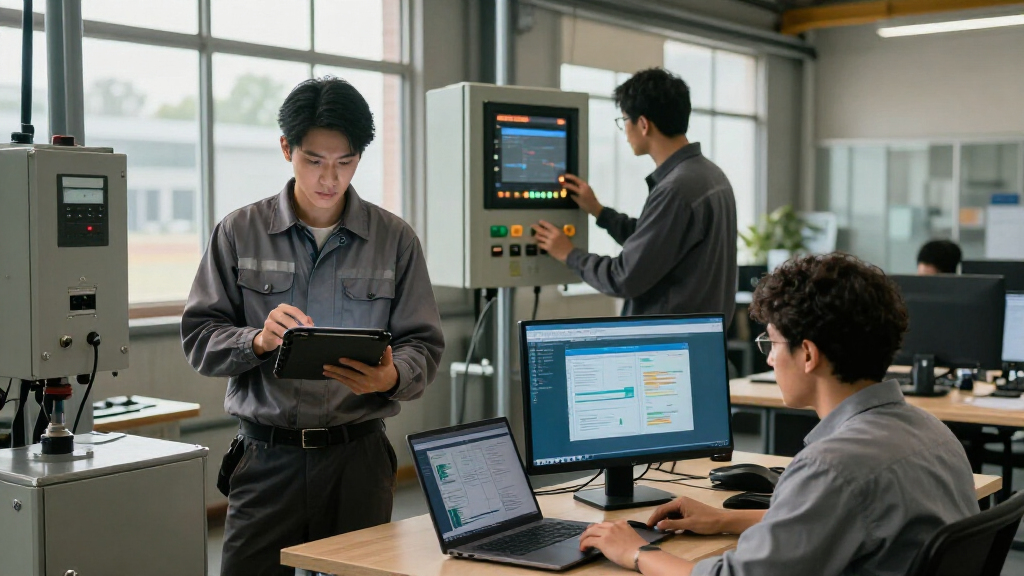

🔍 Read the full analysis: Where Does Your Work Fit: Field, Factory, Or Office? on ThorstenMeyerAI.com

Get the latest gadgets delivered free with Prime
- Fast, free delivery on millions of items
- Prime Video, Amazon Music and more included
- Member-only deals all year
TL;DR
ThorstenMeyerAI.com has launched “Work After Work,” a 60-episode series about how work has changed and how automation may affect it. Its first episode introduces the three-sector model—primary, secondary and tertiary—and uses historical employment estimates to trace the shift from farming toward manufacturing and services. The article’s forecast that automation could become a separate sector is explicitly presented as a thesis, not an established finding.
ThorstenMeyerAI.com published the first episode of “Work After Work,” a planned 60-part series examining how employment has shifted across farming, manufacturing and services—and how machines may shape future work. The installment introduces the three-sector model and presents historical estimates showing agriculture’s declining share of employment; its suggestion that automation could become a separate sector is identified by the author as a thesis, not a confirmed forecast.
The episode’s three categories are the primary sector, which takes resources from nature, such as farming, fishing and forestry; the secondary sector, which makes or builds things, including manufacturing, construction and energy; and the tertiary sector, which covers services such as transport, trade, health, education and government. The article uses a loaf of bread to illustrate how all three can contribute to one product: growing wheat, processing it, then transporting and selling the bread.
For the United States, the source cites estimates by economic historian Stanley Lebergott that farming accounted for 73.7% of the labor force in 1800, 40.2% in 1900 and 12.0% in 1950. It also gives an International Labour Organization modelled estimate of 1.5% in 2025. These figures describe farming’s share of employment, not the number of workers or the volume of food produced.
The episode also reports that the primary sector’s share of employment in China fell from 83.5% in 1952 to 22.2% in 2024, and that Japan’s census recorded a decline from 53.8% in 1920 to 3.2% in 2020. It says that, in ILO modelled estimates, services have employed more people worldwide than farming since 2001. The source further argues that the United States still manufactures substantial output: it says factory employment is about 35% below its June 1979 peak while real manufacturing output in 2025 was about 1.9 times its 1979 level.
How Workers Moved Beyond Farming
The figures put today’s work force in historical perspective: agriculture can employ a much smaller share of workers without food production disappearing. The source’s central point is that employment has shifted among sectors as technology and economic activity changed, rather than simply vanishing when a particular kind of work became more productive.
That framing matters as people debate automation and job security. It distinguishes changes in the kinds of jobs available from claims that machines will eliminate work altogether. But the sector model is a broad map, not a precise account of every occupation. How a software engineer at a car company is classified, for example, can vary by statistical system, the article says.
The series’ forward-looking premise is less settled than its historical examples. The author proposes that automation might eventually become a sector in its own right and could perform up to 90% of work with no human hand. That is an author’s forecast, not a measured outcome; the episode says a later installment will examine it.
Products Worth Considering

Jackery Explorer 300 Portable Power Station, 292Wh

LG UltraGear 32GX850A-B 32-inch 4K UHD Glossy OLED Gaming Monitor

Bose QuietComfort Wireless Noise-Cancelling Headphones, Petal Pink
As an affiliate, we earn on qualifying purchases.
The Model Behind the Three Sectors
The three-sector framework took shape in the early 20th century, according to the source. New Zealand economist Allan G. B. Fisher used “tertiary” for the services category in work written in 1934 and published in 1935. Colin Clark later compared employment patterns across countries in The Conditions of Economic Progress, published in 1940, and documented movement from agriculture toward manufacturing and services.
French economist Jean Fourastié added an argument about technology in a 1949 book: productivity gains in industry could release workers, while services might absorb them because some service work is harder to mechanize. That is an economic argument from the period, not proof that every displaced worker will find a replacement job. The episode places that question at the center of its wider series on work and machines.
“My thesis, not a fact: within a decade or a few decades, automation could become a sector of its own, doing up to 90% of the work with no human hand.”
— Thorsten Meyer, author of the episode
Limits of the Work Estimates
The sector categories do not classify every job consistently. The source notes that a software engineer employed by a car manufacturer may count as manufacturing in one statistical system and services in another; mining’s classification also differs across frameworks. Comparisons across countries and periods therefore depend on definitions, datasets and methods.
The material supplied for this article does not provide the full underlying tables or methodological notes for every cited figure. In particular, the US farming estimates span historical series and an ILO modelled estimate for 2025, so readers should not assume that every point was produced using an identical method. The episode’s automation forecast is also speculative: it does not establish a timeline or explain how the proposed 90% figure was calculated. Its basis and meaning remain unclear.
The Series Turns to Machines
“Work After Work” is planned as a daily series of 60 episodes on how the economy is built, how work has moved and which tasks may remain human as machines take on more. The first installment says the automation thesis will be examined in episode 48. The source gives no publication calendar for that episode beyond describing the series as daily, and does not provide a separate schedule or supporting analysis for the forecast.
For now, the first episode establishes the historical framework rather than resolving what automation will do to employment. Later installments are intended to trace work across the three sectors and test the author’s argument against those developments. The forecast remains open until that analysis is presented; no outcome is confirmed by the first installment.
Key Questions
What are the three economic sectors?
The primary sector takes resources from nature, the secondary sector makes or builds goods, and the tertiary sector provides services. The categories are useful for tracking broad employment patterns but do not classify every job consistently.
What is “Work After Work”?
It is a planned 60-episode daily series published by ThorstenMeyerAI.com about how the economy is built, how work has shifted and how machines may affect jobs. The first episode was published November 2, 2026.
Does the article establish that automation will do 90% of work?
No. The author labels the idea that automation could become a sector and perform up to 90% of work as a thesis, not a fact. The first episode does not establish the estimate’s method or confirm that it will happen.
Does a fall in farm employment mean less food is produced?
No. The figures cited describe farming’s share of employment, not food output. The episode uses the long decline in that share to illustrate how workers can move into other sectors as economies change.
Source: ThorstenMeyerAI.com