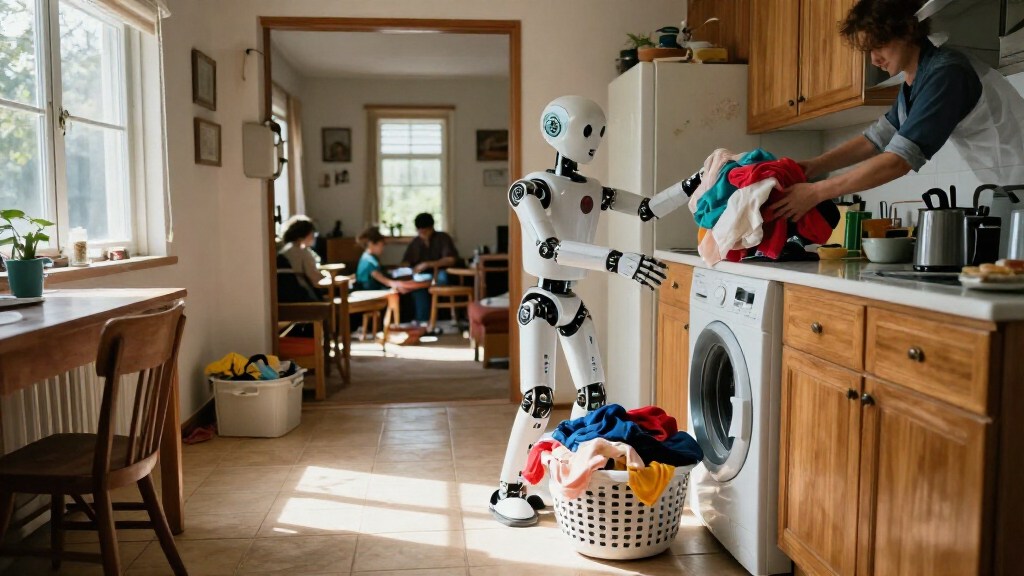

🔍 Read the full analysis: Meta Reportedly Built A Humanoid Robot Called Max. Could Chores Be Its Next Job? on ThorstenMeyerAI.com

Get the latest gadgets delivered free with Prime
- Fast, free delivery on millions of items
- Prime Video, Amazon Music and more included
- Member-only deals all year
TL;DR
The Information reported on Oct. 31 that Meta and Shanghai-based robotics company Fourier built a humanoid prototype called Max in about three months. Meta has not announced the robot, and the reported details have not been independently verified by Reuters; Meta reportedly described the work as internal research, with no plans to sell the units. The report points to home assistance as a long-term aim, not a confirmed ability to perform household chores.
Meta and Shanghai-based robot maker Fourier reportedly built a humanoid prototype called Max in about three months, according to a report published by The Information on Oct. 31. Meta has not announced the robot; the report says the work is for internal research and experimentation, not a product launch. Although headlines have linked Max to household chores, the available reporting describes that as a possible long-term goal, not a demonstrated capability.
The reported prototype is about five feet (1.5 metres) tall and weighs roughly 106 pounds (48 kilograms). It has a screen that can display facial expressions, speakers, and five-fingered hands designed for handling small objects. The Information’s details have been repeated by outlets including Engadget, The Next Web and Investing.com. Reuters said it could not immediately verify the report.
Max reportedly uses Nvidia’s Jetson Thor robotics computer. Meta employees are said to have seen it at an internal robotics summit in late August. The Information also reported that work on a second version, Max 2, began in September; that version is expected to have a redesigned torso, improved hands, a projector and additional sensors intended to help it navigate stairs. These specifications and development details have not been confirmed in a public Meta announcement.
According to The Information, Meta said its work with Fourier is limited to internal research and experimentation and that it has no plans to sell the units. The report links the project to the prospect of humanoid robots helping with household tasks in the future. It does not establish that Max can currently complete chores, nor does it give a launch date, consumer price or public testing schedule.
Infographic 01 · Meta’s humanoid, on paper
Max: a humanoid built in about three months
What multiple outlets reported from The Information’s story, and what is not confirmed.
What the report says Max is
From The Information (31 Oct 2026), as carried by Engadget, The Next Web and Investing.com
- Built by Meta with Fourier, a Shanghai robot maker
- Runs on Nvidia Jetson Thor, a computer for robots
- A screen that shows facial expressions, built-in speakers
- Five-fingered hands designed for small objects
- Shown to some Meta staff at an internal summit in late August
- Max 2: new torso, better hands, a projector, sensors for stairs
What you should not take from the headlines
- No Meta announcement. Reuters “could not immediately verify the report.”
- Not for sale. Meta told The Information the work is internal research, with no plans to sell units.
- No chores shown. “Can do household chores” is a goal, not a reported demonstration.
- Dropped: “lifts bottles and toys” and a Muse quote, found only on aggregator sites.
Jetson Thor, per Nvidia: up to 2,070 FP4 teraflops of AI compute, 128 GB memory, 130-watt power envelope; developer kit from $3,499 at launch in August 2025. Meta was named an early adopter.
Sources: The Information (paywalled), reported by Engadget, The Next Web, Investing.com and Reuters, all 31 Oct 2026 · Nvidia, 25 Aug 2025.
Powered by Thorsten Meyer AI
From Prototype to Home Assistance
The report matters because it places Meta among companies exploring general-purpose humanoid robots, a field where hardware, AI systems and practical home use are developing at different speeds. A prototype assembled with an established robotics manufacturer and an off-the-shelf computing platform may show how companies can combine existing components rather than build every part from scratch. But a short development timeline is not proof that a robot can work safely or reliably in a home.
Household labor is a large part of the possible market and social impact. The International Labour Organization estimates that people perform 16.4 billion hours of unpaid care work each day, around three-quarters by women. It also estimates that paid domestic work employs 80 million people worldwide, with 83% of those jobs informal. Those figures describe work that could be affected if robots eventually take on domestic tasks; they do not show that machines are ready to replace it.
For now, the gap between a humanoid prototype and a dependable household assistant is substantial. A home robot would need to recognize varied objects and rooms, handle unpredictable situations, operate safely around people and complete tasks consistently. The report offers no test results showing Max can meet those demands. The near-term significance is therefore the research direction and partnership, rather than a robot ready to do chores.
Products Worth Considering

Apple Watch SE (2nd Gen) GPS 40mm with Starlight Aluminum Case and Sport Band (S/M)

DJI Osmo Mobile 8 Gimbal with Mic Mini Transmitter, Infinity Black

Amazon Kindle Scribe (32GB) with Premium Pen, Tungsten
As an affiliate, we earn on qualifying purchases.
The Robotics Work Behind Max
Meta’s reported collaboration draws on Fourier’s existing robotics experience. The Shanghai-based company introduced its GR-3 humanoid in August 2025, describing it as a care robot aimed at settings such as nursing homes and rehabilitation centres. That background helps explain how the companies could reportedly produce a prototype quickly: Fourier brought robot-development experience, while Meta brought its interest in AI and possible household applications. The report does not say that Max is simply a modified GR-3.
The computing hardware is also part of the story. Nvidia made its Jetson Thor platform generally available in August 2025, positioning it for robotics and other physical AI applications. Nvidia said the platform can run AI workloads on the robot itself. Meta was listed among its early adopters, and reporting cited in the source material says 1X’s NEO home robot also uses Jetson Thor. The availability of such hardware can reduce the need for a robotics team to develop its own computing system.
Other companies are testing home robots, but their claims need to be read with care. 1X sells its NEO home robot for $20,000 and says human remote operators, called “experts,” can handle tasks it does not know how to perform. Figure has reported that its robot completed whole chores in 56% of trials across 30 homes it had not previously encountered. That is Figure’s own reported result, not an independent assessment, and it does not establish that Meta’s Max can do the same.
“The work with Fourier is for internal research and experimentation, and Meta has no plans to sell the units.”
— Meta, as quoted in The Information
What Max Can Actually Do
Meta has not publicly confirmed Max’s existence or specifications, and Reuters said it could not immediately verify The Information’s report. The original Information story is behind a paywall; the source material says the details included here were cross-checked against other outlets where possible. The prototype’s reported weight, height, hardware and development timeline should therefore be treated as reported details, not company-confirmed specifications.
Most important for readers wondering about chores, there is no cited demonstration or test data showing Max completing household tasks. The source material says Meta’s long-term interest is home assistance, but it does not establish that the robot can lift particular objects, handle a full set of chores or operate without human oversight. Nor is there a confirmed consumer release, price, timetable or plan to sell the units.
The status and performance of Max 2 are also unclear. The reported redesign and sensor additions describe work said to have started in September, not a completed version. It is not known whether the project will advance beyond internal research, how much of its software will run on the robot, or what safeguards and privacy controls a home version would require.
Evidence Needed Beyond the Prototype
The next clear milestone would be a public statement or demonstration from Meta confirming the project and explaining what Max can do. Until then, readers should treat the robot’s reported capabilities and development plans as information attributed to The Information and other outlets, rather than verified product features.
If Meta or Fourier releases test results, useful details would include the tasks attempted, the number and type of homes used, how often a human operator intervened, and how performance changed across unfamiliar rooms and objects. Those details would help distinguish a research prototype from a system dependable enough for everyday use.
No launch or sales date has been reported, and Meta’s reported position is that it does not plan to sell the units. The immediate story is the companies’ reported research partnership; whether Max becomes a home assistant, remains an internal experiment or leads to a later product is still unknown.
Key Questions
Has Meta officially announced the Max robot?
No. The Information reported the project, but Meta has not publicly announced Max. Reuters said it could not immediately verify the report.
Can Max do household chores now?
The available reporting does not show that it can. Home assistance is described as a possible long-term goal; no public test results or demonstration of Max completing chores have been provided.
Who reportedly built Max?
The Information reported that Meta worked with Fourier, a robotics company based in Shanghai. The report says the prototype took about three months to develop.
Will Meta sell the robot?
According to The Information, Meta said the work is for internal research and experimentation and that it has no plans to sell the units. No consumer release date or price has been reported.
What is known about the reported Max 2?
The Information reportedly said work began in September on a version with a redesigned torso, improved hands, a projector and more sensors intended to help with stairs. Those details have not been publicly confirmed, and the status of the project is unclear.
Source: ThorstenMeyerAI.com