
TL;DR

Get the latest gadgets delivered free with Prime
- Fast, free delivery on millions of items
- Prime Video, Amazon Music and more included
- Member-only deals all year
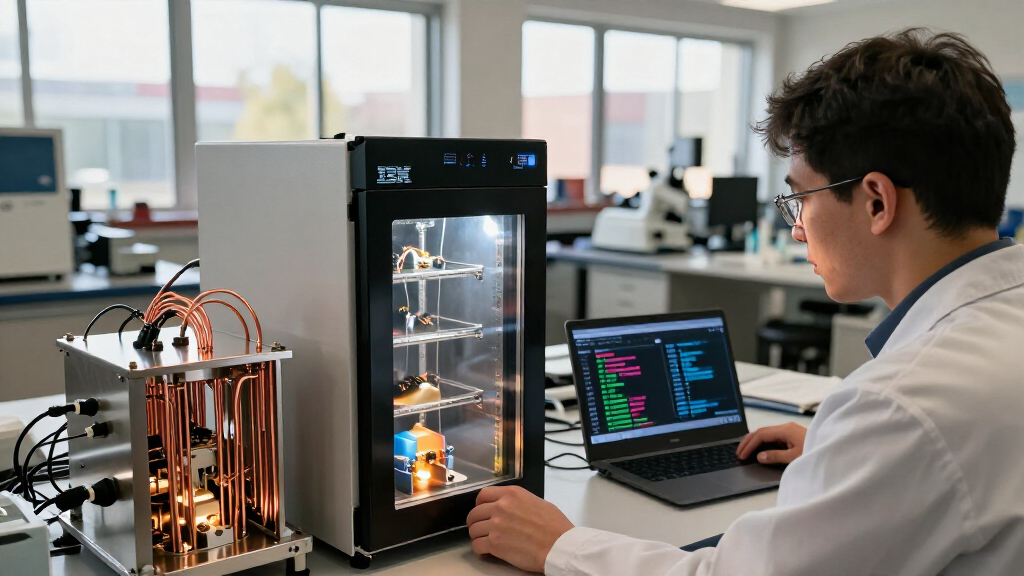
IBM says it has been selected for Stage C of DARPA’s Quantum Benchmarking Initiative, where independent experts will evaluate companies’ hardware and approaches to fault-tolerant quantum computing. The selection advances IBM to testing, but does not establish that its planned system will meet DARPA’s goal of delivering useful computation at a cost lower than its value by 2033.
IBM has been selected for Stage C of the U.S. Defense Advanced Research Projects Agency’s Quantum Benchmarking Initiative, moving its fault-tolerant quantum-computing plans into independent testing. The phase is intended to let DARPA’s verification team assess companies’ hardware and technical approaches; selection is a step in the review, not confirmation that IBM has built a fault-tolerant system.
IBM said the initiative’s independent verification and validation team will test and measure quantum hardware, technology, systems engineering and architectures. The company had previously passed the program’s first two stages, which assessed initial technical concepts and more detailed research and development plans, including risks and ways to mitigate them.
DARPA launched the initiative in 2024 to examine whether an industrially useful fault-tolerant quantum computer can be built by 2033. The program defines the target in economic terms: a machine whose computational value exceeds its cost. The stated objective is a program goal, not a finding that any participant has already met it.
IBM says it plans to deliver its Quantum Starling system in 2029. The company describes Starling as combining work on error correction, processor design and systems engineering. IBM also says it has demonstrated core hardware components for fault tolerance and made progress on error-correction decoding; these are company-reported developments, not results of the newly announced Stage C review.
Independent Tests Put IBM’s Plan to Work
Stage C matters because it moves the review beyond proposals and development plans toward examination of working hardware and engineering. Independent testing can give DARPA a basis for evaluating whether a company’s technical approach is plausible, while also helping distinguish a stated roadmap from progress demonstrated under review.
The broader issue is whether quantum computing can produce useful results at a cost that justifies building and operating the systems. DARPA’s 2033 target makes that question more specific than a general race to increase processor size or publish research. Still, passing into this phase does not settle the cost, performance or engineering challenges, and the source material does not report a Stage C result for IBM.
For organizations following quantum development, the announcement signals that IBM’s plan will face scrutiny within a government-led benchmarking process. IBM says its systems are used by a network of more than 340 organizations in areas including finance, health care, materials science, academia and government. That figure describes the company’s reported user network; it does not establish that those users have deployed fault-tolerant computers or achieved commercial value from them.
As an affiliate, we earn on qualifying purchases.
How DARPA’s Three Stages Work
The Quantum Benchmarking Initiative uses staged assessments to examine whether proposed systems have a credible path to the program’s target. In Stage A, organizations submitted initial technical concepts for a cost-effective, fault-tolerant computer with a plausible near-term path. DARPA announced several Stage A performers in April 2025, according to IBM’s announcement.
Stage B asked participants for comprehensive research and development plans, including risks and mitigation measures. Stage C adds evaluation by the initiative’s independent verification and validation team, which IBM says will test company hardware. The stages therefore move from concepts, to plans, to testing; selection at one stage is not itself proof of the final system’s capabilities.
IBM announced its Starling roadmap last year, saying it aims to deliver the system in 2029. Its progression through the first two QBI stages and selection for Stage C are separate from that delivery target: the former describes its status in DARPA’s process, while the latter remains a company forecast.
“Advancing to the third stage of DARPA’s Quantum Benchmarking Initiative validates the strength of IBM’s path to building a fault-tolerant quantum computer.”
— Jay Gambetta, director of IBM Research and an IBM Fellow
Testing Results and Delivery Remain Open
The announcement does not specify when Stage C testing will be completed, what exact benchmarks DARPA will apply to IBM, or when the initiative will publish findings. It also provides no independent test results, performance measurements or cost estimates for Starling.
IBM’s 2029 delivery date remains a company plan. Whether the system will meet DARPA’s definition of an industrially useful computer by the program’s 2033 goal is unresolved. The source material also does not give a full list of Stage C participants or describe how DARPA will compare their results.
DARPA’s Hardware Review Begins
The next stated step is evaluation by DARPA’s independent verification and validation team, including testing of participant hardware. IBM says it looks forward to working with the team as its review of fault-tolerant approaches moves into the testing phase.
Readers should look for details from DARPA or IBM about the review’s schedule, test methods and findings. Separately, IBM’s progress toward its 2029 Starling target and DARPA’s broader 2033 assessment will provide later milestones. No timetable for those public updates is included in the announcement.
Key Questions
What does IBM’s selection for Stage C mean?
It means IBM has advanced into the phase in which DARPA’s independent verification and validation team is expected to assess and test participant hardware and technical approaches. It is not a certification that IBM has already built a fault-tolerant quantum computer.
What is DARPA trying to determine?
DARPA’s initiative aims to determine whether an industrially useful fault-tolerant quantum computer can be built by 2033, with computational value greater than its cost.
When does IBM plan to deliver Quantum Starling?
IBM says it expects to deliver its planned Quantum Starling system in 2029. That date is the company’s target, not a confirmed delivery or a result of DARPA’s testing.
Have DARPA’s Stage C tests produced results?
The announcement reports IBM’s selection for Stage C, but provides no test results or independent performance measurements. The timing and publication of any findings are not specified.
Source: rss
Columbus Day / Indigenous Peoples' Day Picks
long weekend sales
As an affiliate, we earn on qualifying purchases.