
📊 Full opportunity report: What These 5 Gastrointestinal Symptoms May Signal For Your Wellbeing on IdeaNavigator AI — validation score, market gap, and execution plan.

Get the latest gadgets delivered free — and shop member deals
- Fast, free delivery on millions of items
- Access to Prime Big Deal Days deals on October 6–7
- Prime Video, Amazon Music and more included
TL;DR
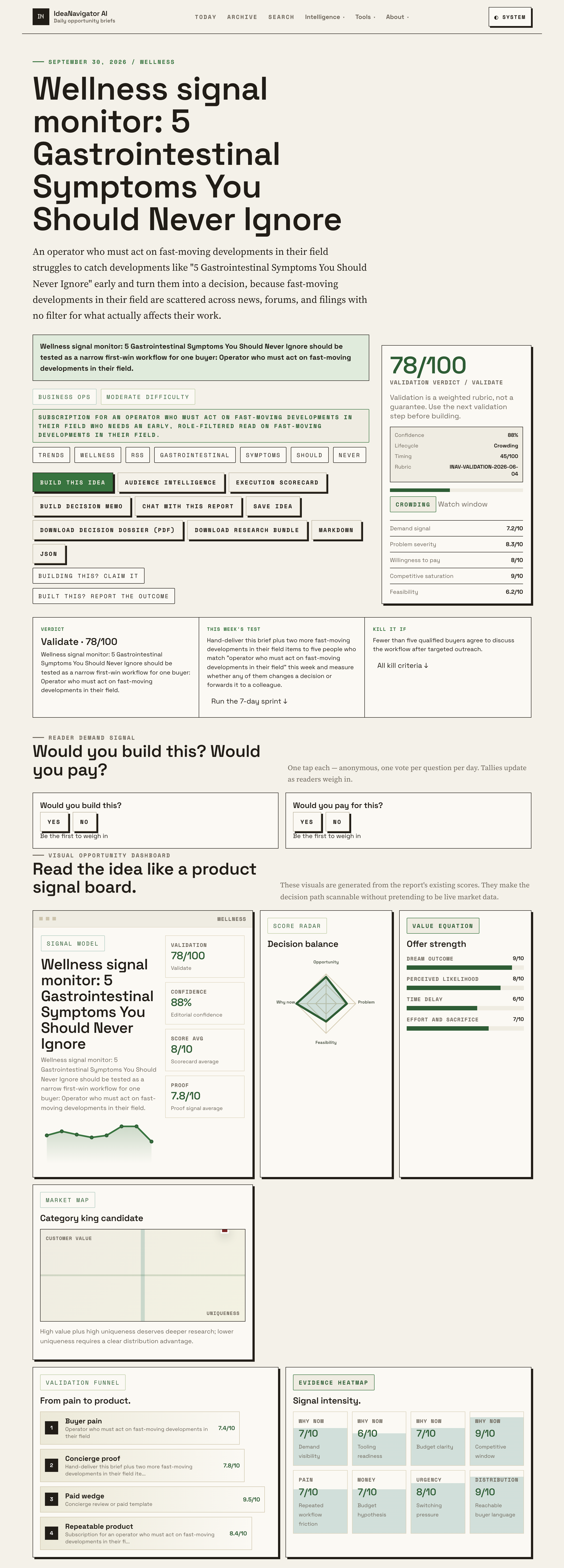
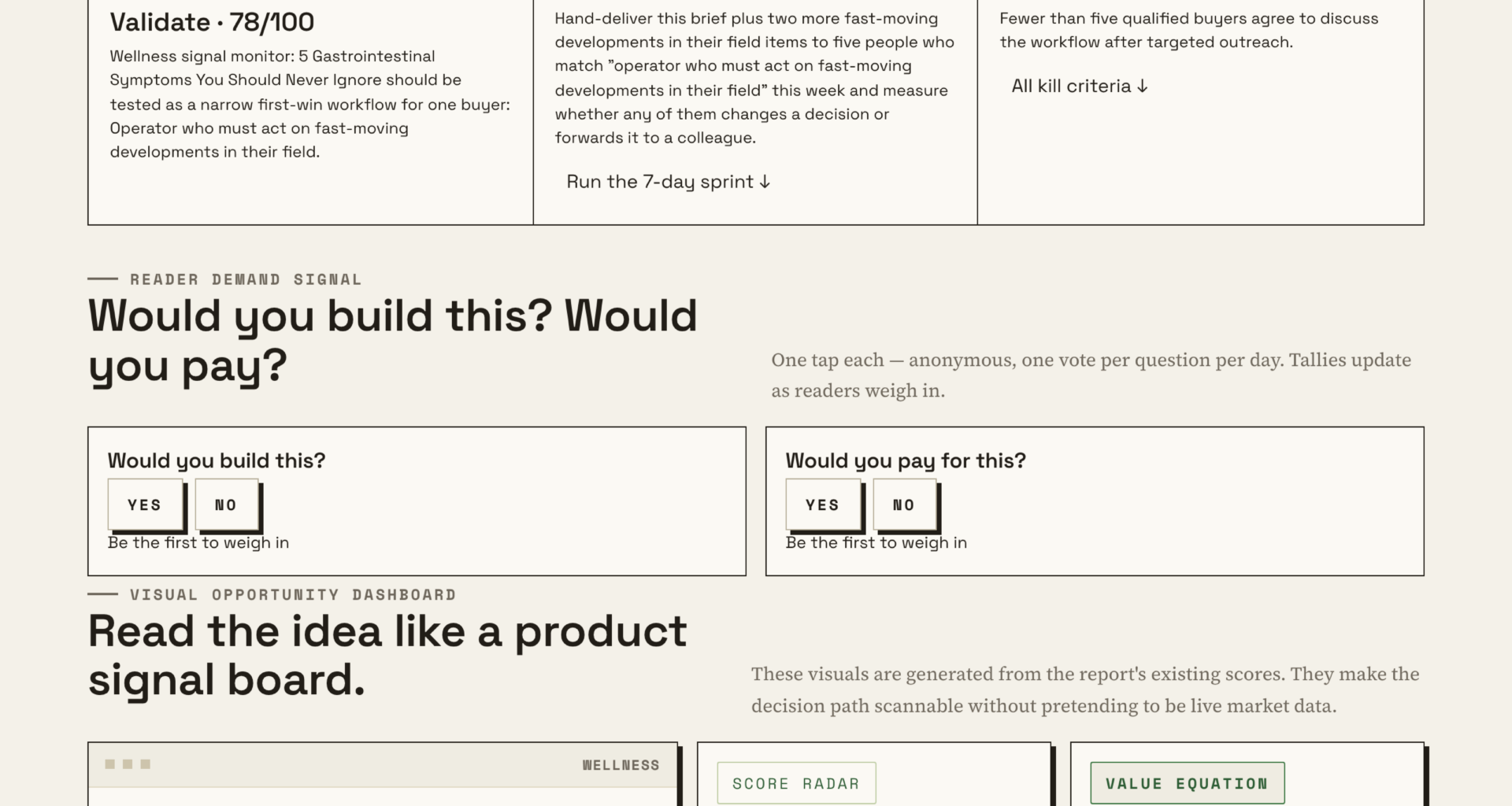
IdeaNavigator AI has proposed testing a wellness news-monitoring service with operators who need to act on fast-moving developments. Its example is an item about five gastrointestinal symptoms, but the material describes a product idea and validation plan, not medical findings or a launched service.
IdeaNavigator AI has proposed testing a wellness monitor that turns relevant developments into short decision briefs for operators who need to act quickly. The concept uses an item titled “5 Gastrointestinal Symptoms You Should Never Ignore” as an example, but the proposal does not report new medical evidence, identify the symptoms, or say the service has launched.
According to IdeaNavigator AI’s proposal, the service would watch RSS and similar feeds, then filter items for their relevance to a particular operator. Each selected item would be condensed into a brief explaining what changed, why it matters and what to do. The proposal describes the intended customer broadly as an operator who needs to follow fast-moving developments in their field; it identifies no specific job title, organization or purchasing team.
IdeaNavigator AI assigns the example a signal score of 88 out of 100 and says it surfaced through RSS. The proposal gives no scoring method, measurement period or comparison baseline, so the score cannot establish how widely the item was discussed or how much attention it received relative to other developments. The title is presented as an example for the monitor, rather than as evidence that the five symptoms or their health implications have been verified.
IdeaNavigator AI proposes handing the brief, alongside two other developments, to five people matching the intended user profile during the week. The test would track whether a brief changes a decision or is forwarded to a colleague. The proposal suggests a subscription as the business model but gives no price, revenue estimate or evidence of customer demand.
Testing Whether Briefs Change Decisions
IdeaNavigator AI frames the concept as a response to a practical problem: relevant information may be spread across news, forums and filings, leaving a busy operator to decide what deserves attention. A filtered brief could save time if it consistently identifies developments that affect the reader’s work and makes the next decision clearer. That value remains a hypothesis to test, rather than a result established by the proposal.
The company’s proposed test looks for two observable responses: a user changes a decision or shares the item with a colleague. Those signals could indicate that the brief is useful, but five participants would provide only an early indication. The plan does not specify how participants would be recruited, how a decision change would be checked, or what result would justify building a paid service. In the health topic used as an example, a concise format would also need to preserve the limits and attribution of medical claims so readers do not mistake a headline for individual medical advice.
Top picks for "gastrointestinal symptom signal"
As an affiliate, we earn on qualifying purchases.
From RSS Signal to User Test
In its proposal, IdeaNavigator AI describes a sequence: identify a development, assess its relevance to a defined role, then deliver a short brief. The company’s stated rationale is that developments move quickly enough for a same-day, role-filtered read to be more useful than a generic weekly roundup. The material describes no user interviews, existing product, feed list or operating results.
The example’s wording refers to five gastrointestinal symptoms, but IdeaNavigator AI does not name them or link them to diagnoses, prevalence figures or clinical guidance. The proposal also does not identify the publisher or publication date of the underlying item. As a result, the example illustrates the kind of headline the monitor might process; it cannot support conclusions about particular symptoms or how readers should respond to them.
Open Questions Before a Launch
IdeaNavigator AI’s proposal does not say whether any users have tested the proposed brief, whether the five participants have been recruited, or what counts as a meaningful change in a decision. The score of 88 out of 100 has no stated methodology or baseline, and the proposal supplies no readership, engagement or health-outcome data for the gastrointestinal item.
Other open questions include which feeds the service would monitor, how it would judge role relevance, how quickly it could deliver a brief, and how it would handle inaccurate or conflicting reports. The proposal reports no evidence that intended customers would pay for a subscription. It also does not establish that the named symptom article is a medical source or that its claims have been reviewed by clinicians.
Five User Interviews Are Proposed
IdeaNavigator AI says the next step is to deliver the example brief and two additional developments to five people who match the proposed user profile during the week, then record whether they change a decision or forward an item. The proposal does not report that this test has started or set out a date for results. Any decision to build the monitor or charge for it would depend on evidence from that test and further assessment of the service’s accuracy and usefulness.
Source: IdeaNavigator AI
Key Questions
Has a gastrointestinal health finding been announced?
No. IdeaNavigator AI uses the gastrointestinal headline as an example for a proposed monitoring service. Its proposal does not provide medical findings or identify the five symptoms.
What would the proposed monitor do?
According to IdeaNavigator AI’s proposal, it would scan RSS and similar feeds, select items relevant to an operator’s role, and turn them into short briefs on what changed, why it matters and what to do.
Has the service launched?
No launch is reported in IdeaNavigator AI’s proposal. The company describes a product concept and a plan to test it with five prospective users.
What does the 88 out of 100 score mean?
IdeaNavigator AI calls it a signal score for the example surfaced through RSS, but does not explain the scoring method, time window or comparison baseline.
Source: IdeaNavigator AI
Halloween Picks
halloween
As an affiliate, we earn on qualifying purchases.