
TL;DR

Get the latest gadgets delivered free with Prime
- Fast, free delivery on millions of items
- Prime Video, Amazon Music and more included
- Member-only deals all year
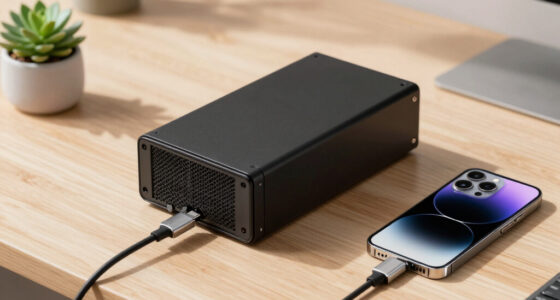
Apple’s new Mac Studio with up to 512GB of unified memory enables home users to load large frontier AI models locally. However, performance and software maturity vary, making it suitable mainly for experimentation and small-scale use.
Apple has introduced the Mac Studio Ultra, a desktop machine capable of holding up to 512GB of unified memory, enabling users to load and run frontier-scale AI models locally for the first time on a Mac Studio with 128GB+ unified memory. This development marks a significant shift in AI hardware accessibility, especially for individual researchers and small teams seeking to avoid reliance on cloud infrastructure. For more on powerful Mac options, see the top Mac Studio models for creative professionals.
The Mac Studio Ultra, announced on August 25, 2026, features a custom-built chip that connects two M5 Max processors via Apple’s UltraFusion interconnect, creating a single, powerful processor with a 36-core CPU and an 80-core GPU. The machine offers up to 512GB of unified memory with a bandwidth of 1.2 terabytes per second, a capacity that allows loading models with hundreds of billions of parameters directly into RAM. Preorders are now open, with general availability scheduled for late October, and the 512GB configuration expected to cost around $10,800 before storage upgrades. If you’re interested in high-performance options, check out the best Mac Studio models for video editing.
Apple claims the machine delivers up to 4.3x faster AI performance than previous models, based on benchmarks measured in July, though real-world performance will depend on specific workloads. The key advantage is the ability for local inference and experimentation with large models, which previously required access to expensive data center hardware. However, experts caution that loading a model does not equate to high throughput or low latency in inference tasks, which depend on bandwidth and compute power beyond mere memory capacity.
Impact of High Memory Capacity on Local AI Workloads
This development is significant because it makes frontier-scale AI models accessible to individual users and small teams without cloud dependence. The 512GB unified memory allows loading entire large models directly into RAM, enabling experimentation, development, and privacy-sensitive inference at home. While it does not replace data center hardware for high-volume deployment, it represents a step toward greater model sovereignty and local control over AI workflows, aligning with privacy and security priorities.
Mac Studio Ultra 512GB unified memory
As an affiliate, we earn on qualifying purchases.
As an affiliate, we earn on qualifying purchases.
Evolution of Desktop AI Hardware and Apple’s Role
Until now, running large AI models locally was limited to specialized, expensive GPU clusters used by data centers. Consumer desktops typically lacked sufficient memory and bandwidth to handle frontier-scale models. Apple’s move to integrate high-capacity unified memory and a multi-chip architecture in the Mac Studio Ultra signifies a notable shift, bringing large-model capabilities to a broader audience. Previous efforts, such as high-end workstations and server-grade hardware, were out of reach for most users, making this release a meaningful democratization of AI hardware.
Prior to this, most local inference was confined to smaller models or required complex partitioning and sharding across multiple systems. The new Mac Studio Ultra’s architecture simplifies this process, although real-world performance and software ecosystem maturity remain areas to watch.
“This machine is dramatically better at loading large models than it is at serving many users at scale. It’s a desktop with enormous capacity, but not a datacenter replacement.”
— Thorsten Meyer
Performance and Ecosystem Maturity Unclear
While the hardware specifications are confirmed, real-world performance for running large models at high throughput remains to be validated through independent benchmarks. Additionally, the maturity of Apple’s ML tooling ecosystem is still evolving, and some workflows may require porting or may not run optimally compared to established GPU platforms. The extent to which this hardware can replace cloud inference in production scenarios is still uncertain.
Expected Benchmarks and Ecosystem Development
In the coming months, independent researchers and early adopters will test the Mac Studio Ultra’s ability to load, run, and serve large models at practical speeds. Benchmark results will clarify its suitability for different AI tasks. Software ecosystem improvements, including better ML frameworks and tooling, are also anticipated, which will influence how effectively users can leverage this hardware for AI development and deployment.
Key Questions
Can I run any large AI model on the Mac Studio Ultra?
Not all models are equally suited. While the hardware supports loading models with hundreds of billions of parameters, actual inference speed and usability depend on software optimization, model architecture, and workload specifics.
Does this mean I can replace my cloud AI infrastructure?
For small-scale experimentation and privacy-sensitive inference, yes. However, for high-throughput, low-latency production serving, cloud or specialized hardware remains necessary due to bandwidth and compute limitations.
What software tools are available for running AI models on Apple Silicon?
Apple’s ML ecosystem has improved but is still less mature than GPU-focused platforms like CUDA. Frameworks such as TensorFlow, PyTorch, and Core ML are supported, but some workflows may require adaptation or alternative tools.
When will independent benchmarks be available?
Expect early results from AI researchers and industry testers in the next few months, which will provide clearer insights into real-world performance and usability.
Is this hardware suitable for small teams or individual researchers?
Yes, especially for those focused on local development, experimentation, and privacy-sensitive inference. It offers a significant capacity boost over previous desktops but is not designed for large-scale deployment.
Source: ThorstenMeyerAI.com
Halloween Picks
halloween
As an affiliate, we earn on qualifying purchases.