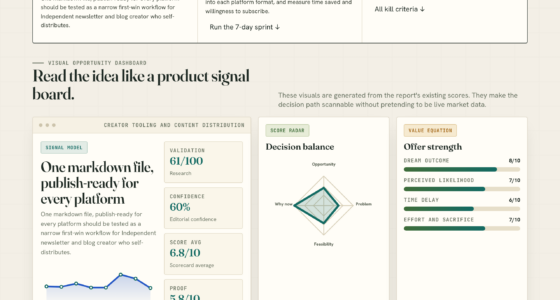

📊 Full opportunity report: The Door: Why the Interface Is Worth More Than the Model on ThorstenMeyerAI.com — validation score, market gap, and execution plan.
TL;DR
SpaceX bought a coding interface for $60 billion, emphasizing that controlling the user interface — the door — is now more valuable than owning the AI models themselves. This shift impacts distribution, data flow, and market power in AI.
SpaceX has acquired a leading coding interface platform for $60 billion, marking a significant shift in AI industry dynamics. This purchase underscores the growing importance of owning the user interface — the ‘door’ through which developers and users interact with AI — rather than just the underlying models. The move suggests that control of the interface layer is now a key strategic asset, influencing distribution, data flow, and market dominance.
The platform acquired by SpaceX, called Cursor, built a profitable business on top of existing AI models, reaching approximately $4 billion in annualized revenue. Despite rebuffing efforts from OpenAI and Microsoft, it was sold for $60 billion, primarily because SpaceX valued the interface as the critical choke point in AI distribution.
According to industry sources, owning the surface — the user interface — allows control over routing demand, the habit of user engagement, and the data feedback loop. This enables the owner to decide which models are called and which are sidelined, effectively making the interface the gatekeeper of AI interactions.
This development highlights a shift from the traditional focus on model sophistication to the strategic importance of interface control. The move is seen as a way to capture long-term value in AI, as the underlying models become commoditized and the interface becomes the primary point of leverage.
The Door: Worth More Than the Model
SpaceX paid $60B for a coding tool — not a model. As the model commoditizes, the surface the human touches captures the value: the default, the habit, the data, and the choice of which model gets called.
Perplexity
The most valuable chokepoint — and, strangely, the most winnable. You can’t bootstrap a gigawatt or a 555K-GPU cluster, but a small team can still build the door (Cursor was a few founders on rented models). Own the interface and the user relationship even if you rent everything underneath — and never let a platform’s default be your only door to your users.
Why Interface Ownership Is the New Strategic Focus
This development indicates that control of the user interface is becoming the most valuable asset in AI. By owning the door, companies can influence distribution, data collection, and model routing. This shifts power away from model providers toward interface owners, who can shape user habits and gather proprietary data, creating a durable moat.
For developers and users, this means the default experience and habit formation will increasingly determine which AI models are used, rather than the raw capabilities of the models themselves. The move could redefine competitive advantage in the AI industry, emphasizing interface control over raw model performance.

AI ESP32-P4-WIFI6-DEV-KIT Development Board, Based On ESP32-P4 and ESP32-C6, Supports Wi-Fi 6 and Bluetooth 5 / BLE 5, Rich Human-Machine Interfaces, Supports AI Speech Interaction, with Speaker
ESP32-P4-WIFI6-DEV-KIT Development Board, Based On ESP32-P4 and ESP32-C6. It features rich Human-Machine interfaces, including MIPI-CSI (with integrated Image…
As an affiliate, we earn on qualifying purchases.
As an affiliate, we earn on qualifying purchases.
The Evolving Role of Interfaces in AI Dominance
Over the past three years, the industry has shifted from valuing the smartest models to recognizing the importance of the interface layer. Companies like OpenAI, Perplexity, and others have built popular browsers and tools that serve as the entry point to AI, with some reaching millions of users.
The recent acquisition by SpaceX reflects a broader trend: the interface is now the chokepoint where demand is routed, habits are formed, and data is collected. Major tech giants like Google and Microsoft are also integrating AI interfaces into their OS and browser defaults, reinforcing the importance of control over the entry point.
This shift is driven by the commoditization of models, which makes the surface — the interface — the primary battleground for market share and influence.
“The acquisition of Cursor aligns with our vision to control the primary touchpoints for developers and users in AI.”
— SpaceX spokesperson

OCHIKI 7 Ft VOE OBD to Ethernet Adapter Fit for Volvo Vehicles Based on SPA CMA Platform 2016+ Replace 9513108 9513062, OBD Cable Compatible with VIDA PC Software or Third-Party Software
Compatible Model: The OBD cable fit for Volvo models based on the SPA platform, such as XC90 2016…
As an affiliate, we earn on qualifying purchases.
As an affiliate, we earn on qualifying purchases.
Unclear Impacts and Future Challenges of Interface Control
While the purchase underscores the importance of interfaces, it remains unclear how widespread this approach will become or how competitors will respond. Questions persist about whether owning the interface will translate into sustained market dominance or if regulatory and technical challenges might limit its effectiveness.
It is also uncertain how this shift will impact open-source models and whether new standards will emerge to regulate interface control and data sharing.

LLM Routing in Practice: Architecture, Gateways, and Production-Grade Model Orchestration
As an affiliate, we earn on qualifying purchases.
As an affiliate, we earn on qualifying purchases.
Next Steps in the Race for Interface Dominance
Expect increased investment in developing and acquiring key interfaces by major tech and AI companies. Regulatory scrutiny around data and competition may intensify, potentially shaping how interface ownership evolves. Meanwhile, developers and users will observe which platforms establish dominant default interfaces, influencing the future landscape of AI distribution and usage.
Further industry consolidations and innovations in interface design are likely as companies seek to secure their position at the chokepoint.

Caring About User Interface: Insights On More Humane Software
As an affiliate, we earn on qualifying purchases.
As an affiliate, we earn on qualifying purchases.
Key Questions
Why is owning the interface more valuable than owning the AI model?
Because the interface controls distribution, user habits, and demand routing, making it the primary point of influence over how AI is used, rather than just the raw model capabilities.
What does SpaceX’s $60 billion purchase of Cursor signify for the AI industry?
It signals a strategic shift toward valuing interface control as the key to market dominance, as models become commoditized and the interface becomes the gatekeeper of demand and data.
Could this focus on interfaces lead to new regulations?
Yes, as control over interfaces impacts competition and data privacy, regulators may intervene to ensure fair access and prevent monopolistic practices.
Will open-source models be affected by this trend?
Potentially, as dominant interfaces could limit access to open models or prioritize proprietary ones, influencing the open-source ecosystem.
What are the risks for companies that do not own their interface?
They risk losing influence over distribution, user engagement, and data flow, which could diminish their competitive position over time.
Source: ThorstenMeyerAI.com