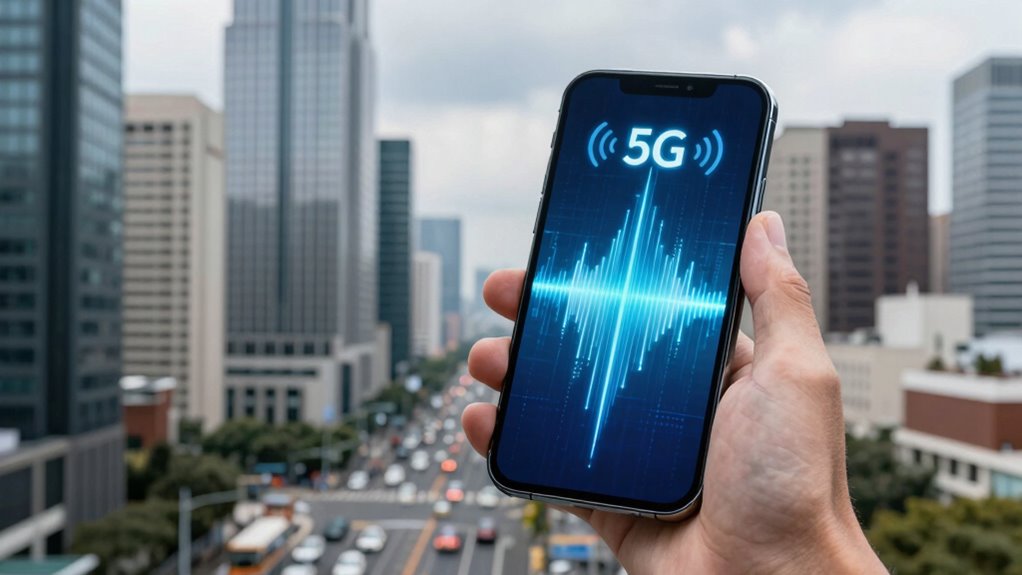

You’ll notice that 5G’s high speeds with mmWave tend to have limited coverage because these signals are easily blocked by obstacles and need dense small-cell deployments. Meanwhile, Sub-6 offers wider coverage but at slightly lower speeds, making it more reliable across larger areas like rural or suburban zones. This fundamental trade-off means you usually can’t get both top speed and broad coverage at the same time — but there’s more behind why this happens.
Key Takeaways
- mmWave offers higher speeds but has limited range and is easily blocked by obstacles, reducing coverage areas.
- Sub-6 GHz provides broader coverage but at slightly lower speeds, balancing network reach and performance.
- mmWave requires dense small-cell deployment, increasing costs and complexity, limiting widespread coverage.
- Sub-6 signals penetrate obstacles better, ensuring stable connections over larger areas but with slower speeds.
- The technical constraints of spectrum and antenna design create a trade-off between high speed and extensive coverage.
Have you ever wondered how different 5G frequencies impact your experience? It all comes down to the underlying technology, especially when comparing mmWave and Sub-6 5G. These two types operate on distinct parts of the spectrum, which directly affects coverage and speed. mmWave uses extremely high frequencies, often above 24 GHz, while Sub-6 operates below that, typically between 3.5 GHz and 6 GHz. This difference isn’t just a technical detail—it shapes how networks are built and how well they serve you. Spectrum allocation plays a key role here. mmWave has a lot of available spectrum but is limited in range, making it ideal for delivering blistering speeds over short distances. Meanwhile, Sub-6 has broader spectrum allocation, allowing for wider coverage, but usually at slightly lower speeds.
mmWave offers ultra-fast speeds over short distances, while Sub-6 provides broader coverage at slightly lower speeds.
When it comes to antenna design, these frequency differences demand different approaches. mmWave signals are more susceptible to obstacles like walls, trees, and even rain, requiring highly directional antennas that can focus signals precisely. This makes deploying mmWave networks more complex and costly, as you need many small cell stations to cover a given area. On the other hand, Sub-6 antennas are less sensitive to obstacles, enabling broader, more reliable coverage with fewer infrastructure investments. This difference in antenna design influences how easily carriers can expand their networks and how consistently you’ll experience coverage in different environments.
Because of these technical realities, coverage and speed rarely arrive together with 5G. With mmWave, you get blazing-fast speeds—think streaming 4K videos or downloading large files in seconds—but only in dense urban areas or specific hotspots. Its limited range means you might need to be right next to a small cell or antenna to enjoy these benefits. Conversely, Sub-6 offers more extensive coverage, so you’re likely to have a stable connection over larger areas, but at speeds that are usually a bit lower than mmWave. This trade-off is why some regions have 5G networks that excel in speed, but lack widespread coverage, while others offer broad coverage with moderate speeds. Additionally, ongoing advancements in spectrum management aim to improve the balance between coverage and speed in future networks.
Ultimately, your experience depends on where you are and what your needs are. If you’re in a city, you might notice the high speeds of mmWave when you’re close to a small cell. In suburban or rural areas, Sub-6’s broader reach ensures you stay connected, even if it isn’t as fast. The ongoing challenge for networks is balancing spectrum allocation and antenna design to bring you both coverage and speed—though, for now, the two rarely arrive together.

4G LTE 5G CBRS Antenna, 600-6000MHz Wide-Band, 10dBi SMA Male Connector, 2-Pack,Eifagur
- Wide Frequency Range: Supports 600-6000MHz for various networks
- High Gain Performance: 10dBi gain for stronger signals
- Universal Compatibility: SMA male connector fits most devices
As an affiliate, we earn on qualifying purchases.
As an affiliate, we earn on qualifying purchases.
Frequently Asked Questions
How Does Device Compatibility Differ Between mmWave and Sub-6 5G?
Device compatibility varies between mmWave and Sub-6 5G networks because of different network standards. If your device supports mmWave, it can access faster speeds in dense urban areas but might struggle with coverage due to limited range. Conversely, Sub-6 devices are more widely compatible, offering broader coverage but generally lower speeds. To get the best experience, make sure your device matches the specific network standards of your 5G provider.
What Are the Cost Implications for Deploying mmWave Versus Sub-6 Networks?
Think of deploying mmWave as building a fancy, glass skyscraper—costly and complex—requiring high investment for coverage and infrastructure. Sub-6 is more like a sturdy brick building, cheaper and easier to deploy. You face deployment challenges with mmWave, which drives up costs for equipment and site upgrades. To optimize costs, you might prioritize Sub-6 for broad coverage, reserving mmWave for high-density hotspots where speed matters most.
How Do Weather Conditions Impact mmWave 5G Signal Performance?
Weather interference markedly impacts mmWave 5G signal performance by causing signal attenuation, especially during rain, snow, or heavy fog. These conditions weaken the high-frequency signals, reducing coverage and speed. You might notice slower connections or dropped signals in bad weather. Unlike Sub-6, which penetrates obstacles better, mmWave is more vulnerable to weather-related disruptions, making consistent performance a challenge in adverse conditions.
Can Existing 4G Infrastructure Support mmWave or Sub-6 5G?
Existing 4G infrastructure can’t fully support mmWave or Sub-6 5G because these networks require significant upgrades in network scalability and spectrum allocation. You’ll need new hardware and more spectrum resources to handle the increased data speeds and coverage, especially for mmWave’s high-frequency signals. Upgrading existing infrastructure guarantees you get the best performance, but it involves investment and planning to meet the demands of advanced 5G technology.
What Are the Security Concerns Unique to mmWave Compared to Sub-6 5G?
You should know that mmWave 5G presents unique security concerns like encryption vulnerabilities and interception risks. Its high frequency signals are more susceptible to being intercepted or disrupted, increasing the chance of data breaches. Unlike sub-6 5G, which offers broader coverage, mmWave’s limited range makes it easier for malicious actors to target specific areas. As a result, you need enhanced security measures to protect sensitive data transmitted over mmWave networks.
Conclusion
Think of mmWave and Sub-6 5G as two sides of the same coin, each shining in its own way. While mmWave offers lightning-fast speeds like a supercharged race car, it struggles to cover broad distances. Sub-6, on the other hand, is your dependable city bus—covering more ground but at a slower pace. Understanding their strengths helps you navigate the 5G landscape, ensuring you get the right connection for your needs, like choosing the right tool for the job.