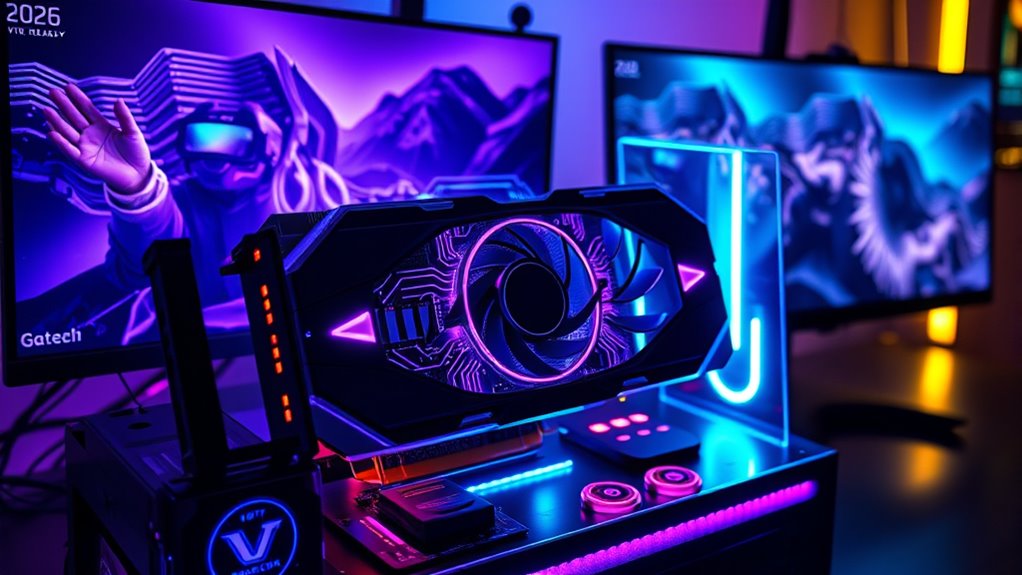

Choosing the right GPU for VR can significantly impact your immersive experience, balancing performance, price, and compatibility. The ASRock Radeon RX 9060 XT Challenger 16GB stands out as the best overall pick, offering strong performance and VR readiness. The ASUS Dual GeForce RTX 5060 Ti 16GB delivers excellent ray tracing and future-proofing, making it ideal for high-end VR gaming. Meanwhile, the ASRock Radeon RX 7700 XT Challenger 12GB provides a compelling mid-range option with good performance-to-price ratio. The main challenge for buyers remains balancing power and affordability, as not all GPUs handle demanding VR titles equally well. Continue reading for a detailed breakdown of each option and what to look for when choosing your perfect VR GPU.

Get the latest gadgets delivered free with Prime
- Fast, free delivery on millions of items
- Prime Video, Amazon Music and more included
- Member-only deals all year
Complete the kit



Key Takeaways
- The top-performing GPUs generally feature 16GB VRAM, which is crucial for high-fidelity VR experiences.
- Mid-range options like the RX 7700 XT balance performance and cost, suitable for most VR users.
- Ray tracing capabilities vary widely; premium cards excel here, but many mid-tier GPUs can still deliver a good VR experience.
- VR readiness depends not just on GPU specs but also on system compatibility and output options.
- Price-to-performance ratio is key; the most expensive GPU isn’t always the best choice for every VR user.
| ASRock Radeon RX 9060 XT Challenger 16GB OC Graphics Card |  | Best Overall for High-Resolution VR and Creative Work | Graphics Coprocessor: AMD Radeon RX 9060 XT | Memory: 16 GB | GPU Clock Speed: 3290 MHz | VIEW ON AMAZON | See Our Full Breakdown |
| ASUS Dual GeForce RTX 5060 Ti 16GB GDDR7 OC Edition Gaming Graphics Card |  | Best for Compact High-Resolution VR in Small Chassis | Graphics Coprocessor: NVIDIA GeForce RTX 5060 Ti | RAM: 16 GB | GPU Clock Speed: 2632 MHz | VIEW ON AMAZON | See Our Full Breakdown |
| ASUS Dual GeForce RTX 3050 6GB GDDR6 OC Edition Gaming Graphics Card |  | Best for Entry-Level VR in Compact Builds | Graphics Coprocessor: NVIDIA GeForce RTX 3050 | Memory: 6 GB | GPU Clock Speed: 1500 MHz | VIEW ON AMAZON | See Our Full Breakdown |
| ASRock Radeon RX 7700 XT Challenger 12GB OC Graphics Card |  | Best for Gaming and Content Creation with AMD RDNA 3 | Architecture: AMD RDNA 3 | Compute Units: 54 | RT+AI Accelerators: Yes | VIEW ON AMAZON | See Our Full Breakdown |
| XFX Radeon RX 580 GTS XXX Edition 1386MHz OC+, 8GB GDDR5, VR Ready, Dual BIOS, 3xDP HDMI DVI |  | Best for Budget VR Gaming and Compatibility | GPU Model: Radeon RX 580 GTS XXX Edition | Base Clock: 1386MHz | Memory: 8GB GDDR5 | VIEW ON AMAZON | See Our Full Breakdown |
| XFX Swift AMD Radeon RX 9060 XT OC Triple Fan Gaming Edition with 16GB GDDR6 |  | Best High-End VR Performance | Chipset: AMD RX 9060 XT | Memory: 16 GB GDDR6 | Boost Clock: 3320 MHz | VIEW ON AMAZON | See Our Full Breakdown |
| Radeon RX 580 8GB Graphics Card, VR Ready, DisplayPort HDMI Video Card for Gaming |  | Best Budget VR Card | Chipset: AMD Radeon RX 580 | GPU Chip: Ellesmere | Video Memory: 8 GB GDDR5 | VIEW ON AMAZON | See Our Full Breakdown |
| gpu for vr | Memory |
|---|---|
| ASRock Radeon RX 9060 XT Chall | 16 GB |
| ASUS Dual GeForce RTX 5060 Ti | — |
| ASUS Dual GeForce RTX 3050 6GB | 6 GB |
| ASRock Radeon RX 7700 XT Chall | 12GB GDDR6 |
| XFX Radeon RX 580 GTS XXX Edit | 8GB GDDR5 |
| XFX Swift AMD Radeon RX 9060 X | 16 GB GDDR6 |
| Radeon RX 580 8GB Graphics Car | — |
More Details on Our Top Picks
ASRock Radeon RX 9060 XT Challenger 16GB OC Graphics Card
The ASRock Radeon RX 9060 XT Challenger stands out for its massive 16GB GDDR6 memory and impressive boost clock of up to 3290 MHz, making it ideal for demanding VR experiences and creative tasks. Compared with the XFX Radeon RX 580 GTS XXX, it offers significantly higher VRAM and performance headroom, but this comes with a larger size (249mm) and higher power requirements of at least 550W. Its support for 8K resolution ensures compatibility with the latest high-end VR headsets, yet the limited details on warranty might concern some buyers. This card is best suited for serious gamers and creators who prioritize raw power and high resolution, but it isn’t the best fit for compact builds or those on a tighter budget.
Pros:- Massive 16GB GDDR6 memory for future-proof VR and creative work
- High boost clock of 3290 MHz ensures smooth rendering
- Supports up to 8K resolution for the latest VR headsets
- Dual-fan cooling for effective heat management
Cons:- Requires a spacious chassis due to its 249mm length
- Power supply must be at least 550W, limiting upgrade options
- Unclear warranty and support details
Best for: High-end VR enthusiasts and content creators needing maximum resolution and memory.
Not ideal for: Small PC builds or users with limited power supply capacity.
- Graphics Coprocessor:AMD Radeon RX 9060 XT
- Memory:16 GB
- GPU Clock Speed:3290 MHz
- Video Output Interface:DisplayPort, HDMI
- Graphics Ram Type:GDDR6
- Display Maximum Resolution:7680 x 4320
Our verdict“This card suits high-end users who need maximum VR resolution and memory, but it demands a spacious PC case and a robust power supply.”
ASUS Dual GeForce RTX 5060 Ti 16GB GDDR7 OC Edition Gaming Graphics Card
The ASUS Dual GeForce RTX 5060 Ti offers a compelling balance of performance and size, with 16GB GDDR7 memory and a compact 2.5-slot design that makes it suitable for smaller cases. Unlike the ASRock RX 9060 XT Challenger, it leverages NVIDIA’s RTX 50 Series technology, including advanced ray tracing and DLSS, for high-quality VR visuals. Its dual Axial-tech fans and 0dB technology provide effective cooling without noise, but the need for a PCIe 5.0 slot for optimal performance could be a barrier for some builders. The 2632 MHz GPU clock offers solid gaming performance, yet the higher power consumption and limited user reviews mean it might be better for experienced builders seeking cutting-edge features in a smaller form factor.
Pros:- Compact size fits in small chassis without sacrificing power
- High-performance 16GB GDDR7 memory supports demanding VR titles
- Effective cooling with dual Axial-tech fans and whisper-quiet operation
- Supports resolutions up to 7680×4320 with HDMI 2.1b and DisplayPort 2.1b
Cons:- Requires PCIe 5.0 slot, limiting upgrade options for older systems
- Potentially higher power draw increases system demands
- Limited user feedback on long-term reliability
Best for: Gamers with limited space who want high resolution VR with NVIDIA’s latest features.
Not ideal for: Users with older PCIe 4.0 slots or those prioritizing budget over newer tech.
- Graphics Coprocessor:NVIDIA GeForce RTX 5060 Ti
- RAM:16 GB
- GPU Clock Speed:2632 MHz
- Video Output Interface:DisplayPort 2.1b, HDMI 2.1b
- Graphics Ram Type:GDDR7
- Maximum Resolution:7680×4320
Our verdict“Ideal for gamers seeking high-end VR capabilities within a small build, provided their system supports PCIe 5.0.”
ASUS Dual GeForce RTX 3050 6GB GDDR6 OC Edition Gaming Graphics Card
The ASUS Dual GeForce RTX 3050 provides a solid entry point into VR gaming with 6GB GDDR6 memory and support for ray tracing and AI features. Compared to the RX 7700 XT Challenger, it offers a more modest VRAM capacity and lower overall performance, but its small size (7.9″ long) makes it compatible with small cases. Its 1500 MHz core clock is adequate for many VR titles, yet the limited VRAM restricts ultra-high-res experiences and future-proofing. The dual Axial-tech fans keep temperatures in check, but it requires a PCIe 4.0 slot for best performance, which might limit compatibility with older motherboards. This card makes sense for budget-conscious users new to VR or those with space constraints.
Pros:- Compact size easily fits in small cases
- Supports ray tracing and AI features at an affordable price
- Durable stainless steel bracket with dust resistance
- 3-year warranty adds peace of mind
Cons:- Limited VRAM of 6GB may hinder future VR titles
- Requires PCIe 4.0 slot, limiting older systems
- Lower core clock compared to higher-end models
Best for: Beginners or casual gamers seeking affordable VR-ready graphics in small systems.
Not ideal for: Power users or gamers wanting 4K VR or high-end graphics performance.
- Graphics Coprocessor:NVIDIA GeForce RTX 3050
- Memory:6 GB
- GPU Clock Speed:1500 MHz
- Display Maximum Resolution:3840 x 2160
- Interface:PCI-Express x16
- Additional Features:IP5X Dust Resistance, Stainless Steel Bracket
Our verdict“A good starter card for VR newcomers with space constraints, but not suited for demanding or future VR titles.”
ASRock Radeon RX 7700 XT Challenger 12GB OC Graphics Card
The ASRock Radeon RX 7700 XT Challenger offers a compelling blend of gaming and content creation power, thanks to AMD RDNA 3 architecture and 12GB GDDR6 memory. Unlike the RX 9060 XT Challenger, it trades some VRAM for a more balanced profile suitable for mid-range builds, with a boost clock of 2584 MHz. Its dual fans and heatpipes ensure effective cooling, but system compatibility is not guaranteed without verifying power and PCIe support. Its multiple display outputs support high-resolution monitors, making it versatile for immersive VR or multi-monitor setups. This card targets gamers and creators who want solid performance without exceeding typical power and size constraints, though it may require a more capable power supply.
Pros:- AMD RDNA 3 architecture delivers strong gaming and creative performance
- Effective cooling with dual fans and heatpipes
- Supports multiple high-resolution displays
- Durable metal backplate for added protection
Cons:- Not compatible with all pre-built systems; verify specifications first
- Power consumption can be high for some systems
- Less VRAM than flagship models, limiting ultra-high-res VR
Best for: Mid-range gamers and content creators who want reliable AMD performance in VR.
Not ideal for: High-end VR users needing maximum VRAM or ultra-high resolution support.
- Architecture:AMD RDNA 3
- Compute Units:54
- RT+AI Accelerators:Yes
- Boost Clock:2584 MHz
- Memory:12GB GDDR6
- Display Outputs:3 x DisplayPort 2.1, 1 x HDMI 2.1
Our verdict“A balanced choice for gamers and creators seeking dependable AMD performance in VR, with some system compatibility considerations.”
XFX Radeon RX 580 GTS XXX Edition 1386MHz OC+, 8GB GDDR5, VR Ready, Dual BIOS, 3xDP HDMI DVI
The XFX Radeon RX 580 GTS XXX Edition offers a reliable, factory-overclocked 8GB GDDR5 card suitable for VR gaming on a budget. Compared to the ASRock RX 9060 XT Challenger, it features lower VRAM and performance, but its affordability and dual BIOS options make it appealing for entry-level VR setups. Its high-performance heatsink and ultra-low noise inductors help maintain stable operation, yet it requires at least a 500W power supply, limiting some upgrade paths. While it supports VR, its older architecture and lower VRAM mean it may struggle with newer, more demanding titles or future virtual reality experiences. This card is best for casual VR gamers or those upgrading from older hardware without high performance expectations.
Pros:- Factory overclocked for improved performance
- VR ready with multiple display outputs
- Dual BIOS enhances reliability and flexibility
- Low noise operation with high-performance heatsink
Cons:- Limited VRAM of 8GB may hinder new titles
- Requires at least 500W power supply, limiting upgrades
- Older architecture may lack features of newer cards
Best for: Budget-conscious VR gamers seeking decent performance without breaking the bank.
Not ideal for: High-end VR users or future-proofers aiming for ultra-high resolution VR.
- GPU Model:Radeon RX 580 GTS XXX Edition
- Base Clock:1386MHz
- Memory:8GB GDDR5
- Display Outputs:3x DisplayPort, HDMI, DVI
- VR Ready:Yes
- Cooling Technology:High Performance Unibody Heatsink
Our verdict“A solid choice for casual VR users on a budget, but unsuitable for demanding or future VR applications.”
XFX Swift AMD Radeon RX 9060 XT OC Triple Fan Gaming Edition with 16GB GDDR6
This XFX Radeon RX 9060 XT stands out for its substantial 16 GB GDDR6 memory and impressive boost clock of up to 3320 MHz, making it a strong choice for demanding VR applications that benefit from large textures and complex scenes. Compared to the Radeon RX 580, which offers only 8 GB GDDR5, this card provides a clear advantage in handling modern, high-resolution VR titles without bottlenecking. Its triple fan cooling system helps maintain performance during extended gaming sessions, but it does require a compatible desktop and consumes more power, which could add to setup costs. The support for 4K UHD resolution ensures crisp visuals, but without detailed warranty info, there is some risk for buyers looking for long-term reliability. Overall, this card is ideal for serious VR enthusiasts who prioritize performance and large memory capacity, accepting the higher power and cooling requirements.
Pros:- 16 GB GDDR6 memory supports large VR textures and future-proofing
- High boost clock of 3320 MHz ensures fast rendering
- Triple fan cooling maintains stable performance under load
- Supports 4K UHD resolution for sharp visual clarity
Cons:- Requires a compatible, potentially high-capacity power supply
- No warranty details provided, adding uncertainty for long-term use
- Potentially high power consumption may increase operating costs
Best for: Vendors or gamers with high-end desktops seeking top-tier VR fidelity and large texture handling capabilities.
Not ideal for: Casual VR users or those on budget, since its high power demands and cost might outweigh the benefits for lighter use.
- Chipset:AMD RX 9060 XT
- Memory:16 GB GDDR6
- Boost Clock:3320 MHz
- Video Output:HDMI, DisplayPort
- Maximum Resolution:3840×2160
- Interface:PCI-Express x16
Our verdict“This card is best suited for high-end VR users who need maximum performance and large memory capacity, accepting higher power and cooling requirements.”
Radeon RX 580 8GB Graphics Card, VR Ready, DisplayPort HDMI Video Card for Gaming
Compared to the more powerful RX 9060 XT, the Radeon RX 580 offers a solid entry point into VR with 8 GB GDDR5 memory and a reliable GPU clock of 1284 MHz. While it may not match the raw power of higher-end options, its VR readiness ensures compatibility with most headsets, making it suitable for casual or budget-conscious VR users. Its multiple outputs, including HDMI and DisplayPort, provide flexible connectivity for different setups, but performance can sometimes be inconsistent during intense VR sessions—especially when pushing the resolution or scene complexity. This card is a good choice for those starting with VR or upgrading older systems, though more demanding titles may require lower settings or compromise on smoothness. The RX 580’s durability and long service life make it a dependable, affordable entry into VR gaming.
Pros:- VR ready for immediate compatibility with most headsets
- 8 GB GDDR5 memory supports smooth gameplay at moderate settings
- Multiple outputs enable versatile connectivity options
- Durable build suitable for long-term use
Cons:- Performance may vary with intensive VR titles, leading to inconsistent gameplay
- Limited to 1284 MHz GPU clock compared to newer, higher-clocked models
- Requires compatible VR headsets and may not handle the latest demanding titles at high settings
Best for: Budget-conscious gamers or VR newcomers who want reliable performance without breaking the bank.
Not ideal for: High-end VR enthusiasts or users seeking the best possible graphics quality, as this card may struggle with demanding titles or high resolutions.
- Chipset:AMD Radeon RX 580
- GPU Chip:Ellesmere
- Video Memory:8 GB GDDR5
- GPU Clock:1284 MHz
- Outputs:HDMI x 1, DisplayPort x 2
- Interface:PCI Express 3.0
Our verdict“This card is ideal for entry-level VR users who prioritize affordability and reliable compatibility over top-tier performance.”

How We Picked
The GPUs included in this roundup were evaluated based on their raw performance in VR workloads, compatibility with popular headsets, build quality, and future-proofing features. We prioritized models with ample VRAM, high CUDA or Stream Processor counts, and support for the latest graphics technologies like ray tracing and DLSS/FSR. Cost was also a factor, but not at the expense of essential VR capabilities. The ranking reflects a balance between price, performance, and features that matter most for immersive virtual reality gaming and applications.Factors to Consider When Choosing Gpu For Vr
When selecting a GPU for VR, it’s important to consider several key factors that influence your overall experience. Beyond raw power, compatibility, and future-proofing, you’ll want to think about your existing system, budget, and the types of VR content you plan to enjoy. Making the right choice can prevent bottlenecks, reduce latency, and ensure smooth visuals. Here are some critical factors to keep in mind:Performance and VRAM
VR gaming demands high frame rates and stable rendering. A GPU with at least 8GB VRAM is recommended, but 12GB or more is ideal for maintaining quality at higher resolutions and detail levels. Look for cards with robust processing power—more CUDA cores or Stream Processors translate into smoother, more immersive VR experiences. Avoid sacrificing performance for lower cost, as VR’s real-time rendering is unforgiving of bottlenecks.
Compatibility and Outputs
Ensure the GPU supports your VR headset’s connection types, such as HDMI or DisplayPort. Some high-end headsets require specific outputs, and mismatched connections can cause frustration. Also, check if the GPU fits your PC case and power supply. Future compatibility with upcoming VR standards can save you from needing an upgrade sooner than expected.
Ray Tracing and Visual Fidelity
While not strictly necessary for VR, ray tracing can enhance realism by providing more accurate lighting and reflections. Premium GPUs with ray tracing support can deliver richer environments, but often come at a higher cost. Consider whether your VR titles or applications will benefit enough to justify the expense, or if a mid-tier card offers a better balance.
Price and Value
VR setups can become expensive quickly, so it’s vital to weigh performance against cost. Sometimes, slightly older or less powerful GPUs can handle most VR tasks well enough at a fraction of the price. Be cautious of overpaying for features you’ll never use—focus on the core performance needed for smooth VR experiences.
Future-Proofing
Investing in a GPU that supports the latest standards and has headroom for future titles can extend the lifespan of your VR setup. Features like DLSS, FSR, and support for upcoming VR protocols can keep your system ready for new content without immediate upgrades. However, higher-end cards also come with higher costs, so consider your long-term VR ambitions.
Frequently Asked Questions
Can I use a gaming GPU for VR, or do I need a specialized VR GPU?
Most modern gaming GPUs are suitable for VR, provided they meet the recommended specifications for your headset and VR titles. VR demands higher frame rates and lower latency, so a GPU with ample VRAM and processing power is essential. While there are no dedicated ‘VR GPUs,’ high-performance gaming cards are designed to handle the demanding rendering tasks VR requires, making standard gaming GPUs an excellent choice for most users.
How much VRAM do I need for smooth VR gaming?
For most VR applications, 8GB of VRAM is the minimum to ensure smooth performance at lower resolutions. However, for high-resolution headsets or future-proofing, 12GB or more is advisable. More VRAM helps manage larger textures and complex scenes without dropping frame rates, which are critical for comfort and immersion in VR.
Is ray tracing necessary for a good VR experience?
Ray tracing is not essential but can significantly enhance visual realism if your GPU supports it and your VR titles utilize it. Premium GPUs with ray tracing capabilities will provide richer environments, but for most users, a high-quality non-ray-tracing GPU will still deliver a compelling VR experience. Budget-conscious buyers often prioritize performance and VRAM over ray tracing features.
Should I prioritize a more powerful GPU or save money with a mid-range option?
The decision depends on your VR usage and budget. If you’re aiming for high-fidelity, future-proofed experiences, investing in a more powerful, high-end GPU makes sense. However, for casual or less demanding VR gaming, mid-range options can offer excellent performance at a more affordable price. Be mindful that a weaker GPU might struggle with newer, more demanding titles, leading to less smooth visuals.
How important are the connection options on a GPU for VR?
Connection options are vital because mismatched outputs can prevent your VR headset from functioning correctly. Most VR headsets use HDMI or DisplayPort connections, so verifying that your GPU has compatible outputs is crucial. Additionally, having multiple outputs can allow for future upgrades or multi-monitor setups, making your VR experience more flexible and hassle-free.
Conclusion
For most users seeking a balanced experience, the ASRock Radeon RX 9060 XT Challenger 16GB offers the best overall performance at a reasonable price. If you’re after cutting-edge features and high future-proofing, the ASUS Dual GeForce RTX 5060 Ti 16GB is a strong premium choice. Budget-conscious buyers or newcomers will find the Radeon RX 580 8GB sufficient for casual VR, while enthusiasts focused on high-fidelity visuals should consider higher-end models. Ultimately, your choice should match your VR ambitions, system compatibility, and budget constraints, ensuring a smooth, immersive experience.
As an affiliate, we earn on qualifying purchases.Halloween Picks
halloween